The Chinese and Asian Art Forum. For Fans, Collectors and Dealers.
 Basic Rules For the BidAmount Asian Art Forum: Talk about whatever you want. You can even discuss and offer things that are for sale if they are authentic. Maximum image file size per post is 2 MB. Images of 700pxl x 700pxl are optimal if saved at a medium resolution. Be respectful of others and enjoy yourself. Click the YouTube link for a brief tutorial on using the forum. You can also EMBED Videos by cutting and pasting from You-Tube, Vimeo etc.
NOTE: To post an item or add a new post, click open the category title from the FORUM LIST, and CLICK the Blue ADD TOPIC button.

@johnshoe it’s crazy. I haven’t seen that wide of a rim on this size bowl (4.3 to top of metal). Not even at the major auction houses, I don’t believe. I may not have looked hard enough though. Would love to see one.

I was idly flicking through a book today and came across this. It isn’t much info but may be interesting. Sorry, the photos aren't great.
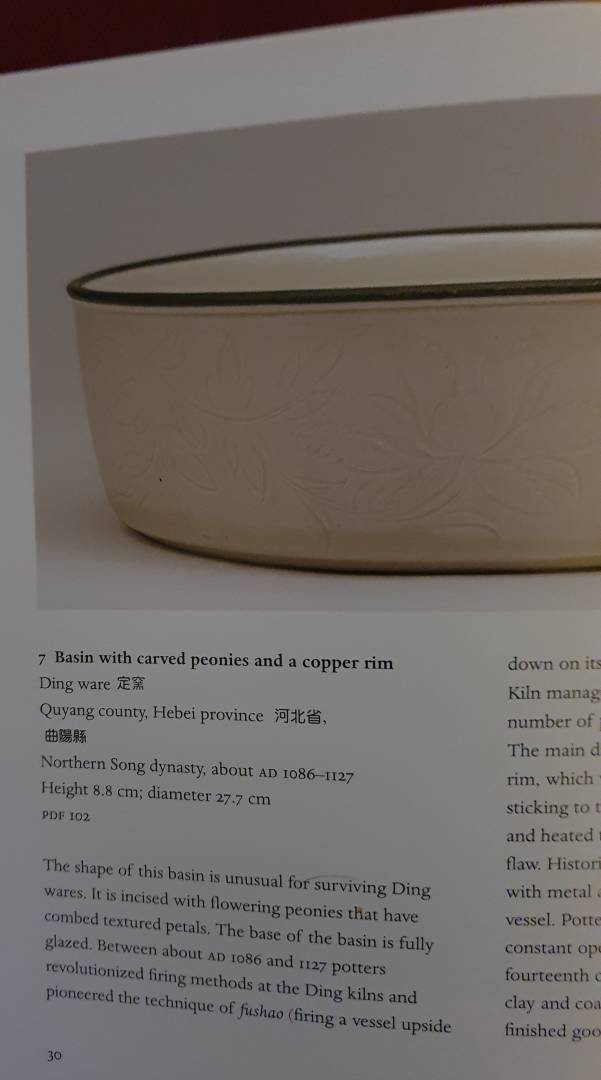
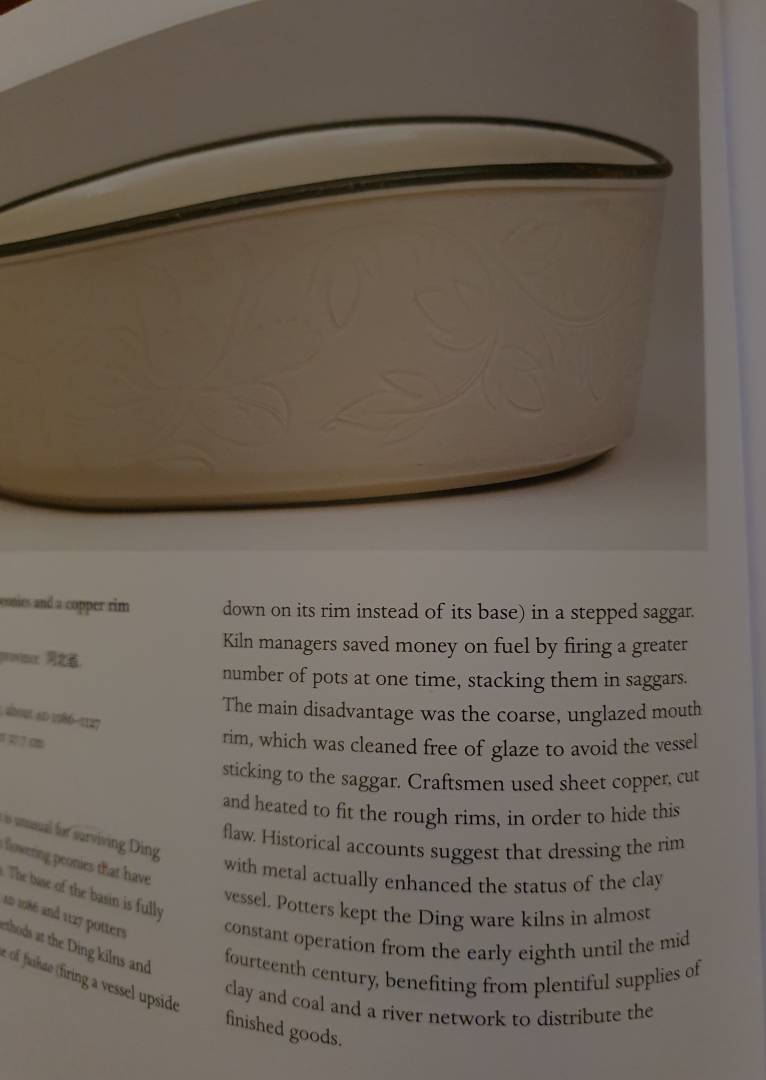
You will have to click on the photo to read it! I hope it works.

I checked the AI response on metal rims. This is what I assumed.
Metal rims on some Chinese bowls, especially older or specialized ones (like tea bowls or those needing durability), use the principle of thermal expansion: the rim is made slightly smaller and heated so it expands to fit the ceramic, then cools to contract and create a tight, secure fit, strengthening the edge against chips, a technique similar to blacksmiths fitting iron tires on cart wheels. This process of heating, fitting, and cooling (thermal fitting) is a physical change that uses metal's property to expand when hot and shrink when cool, making the rim incredibly snug.
- Slightly Smaller: The metal rim is manufactured with an inner diameter slightly smaller than the ceramic bowl's rim.
- Heating: The metal rim is heated (often by fire or hot water) until it expands significantly, increasing its diameter.
- Fitting: The expanded rim is then quickly placed over the ceramic bowl's edge.
- Cooling & Shrinking: As the metal cools, it contracts, gripping the ceramic tightly and creating a permanent, strong bond.

@kaolin Interesting. This explains the tight fit. But the lack of a noticeable seam is still a mystery to me.
I asked AI the question and it basically sounds like they just worked it really well until the ends of the metal was well merged. Personally I'd like to see someone do it. I mean, the precision that would be necessary to pull it off with the right fit is pretty impressive. As far as I'm concerned any piece that has a metal band should have increased value. They are special.

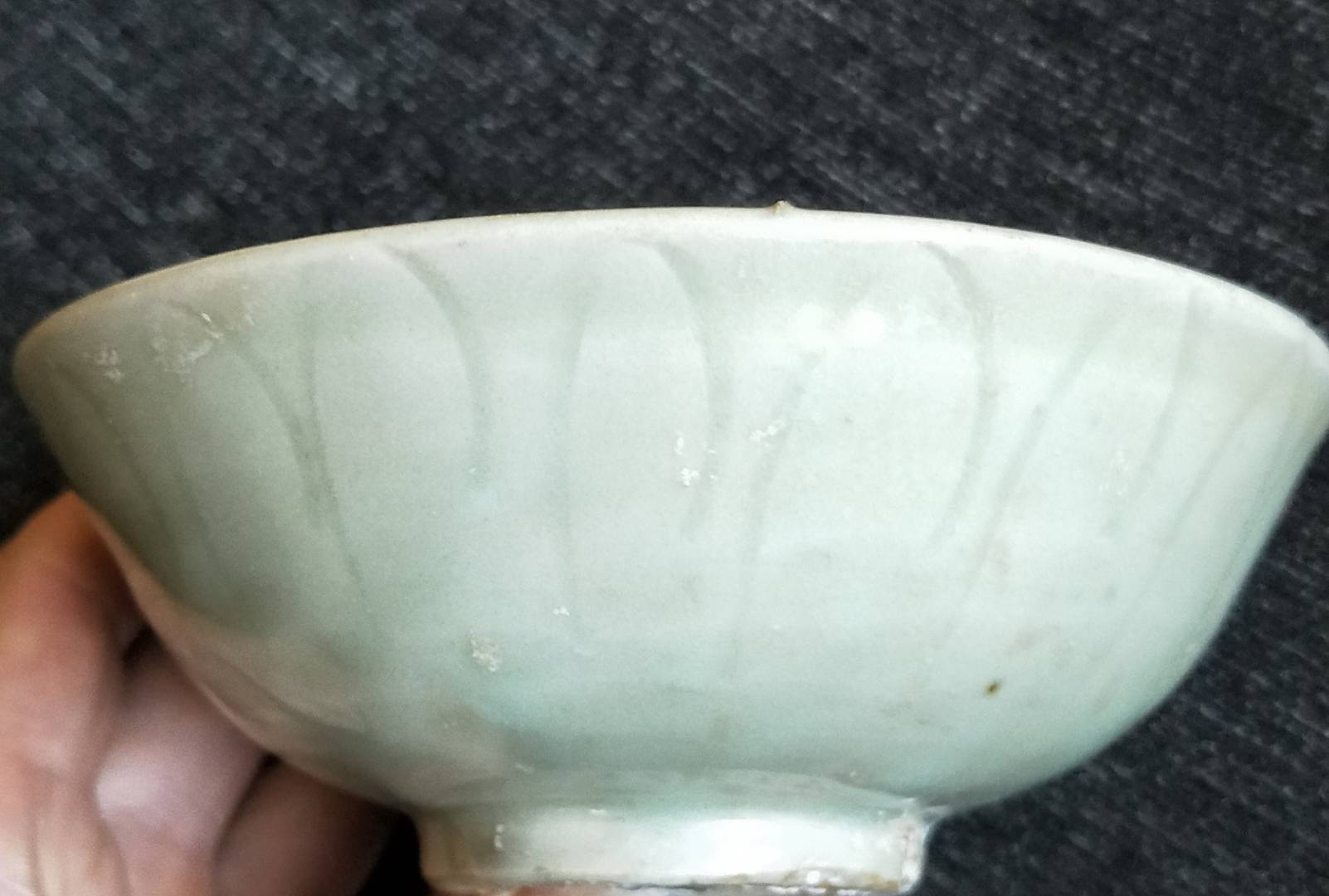
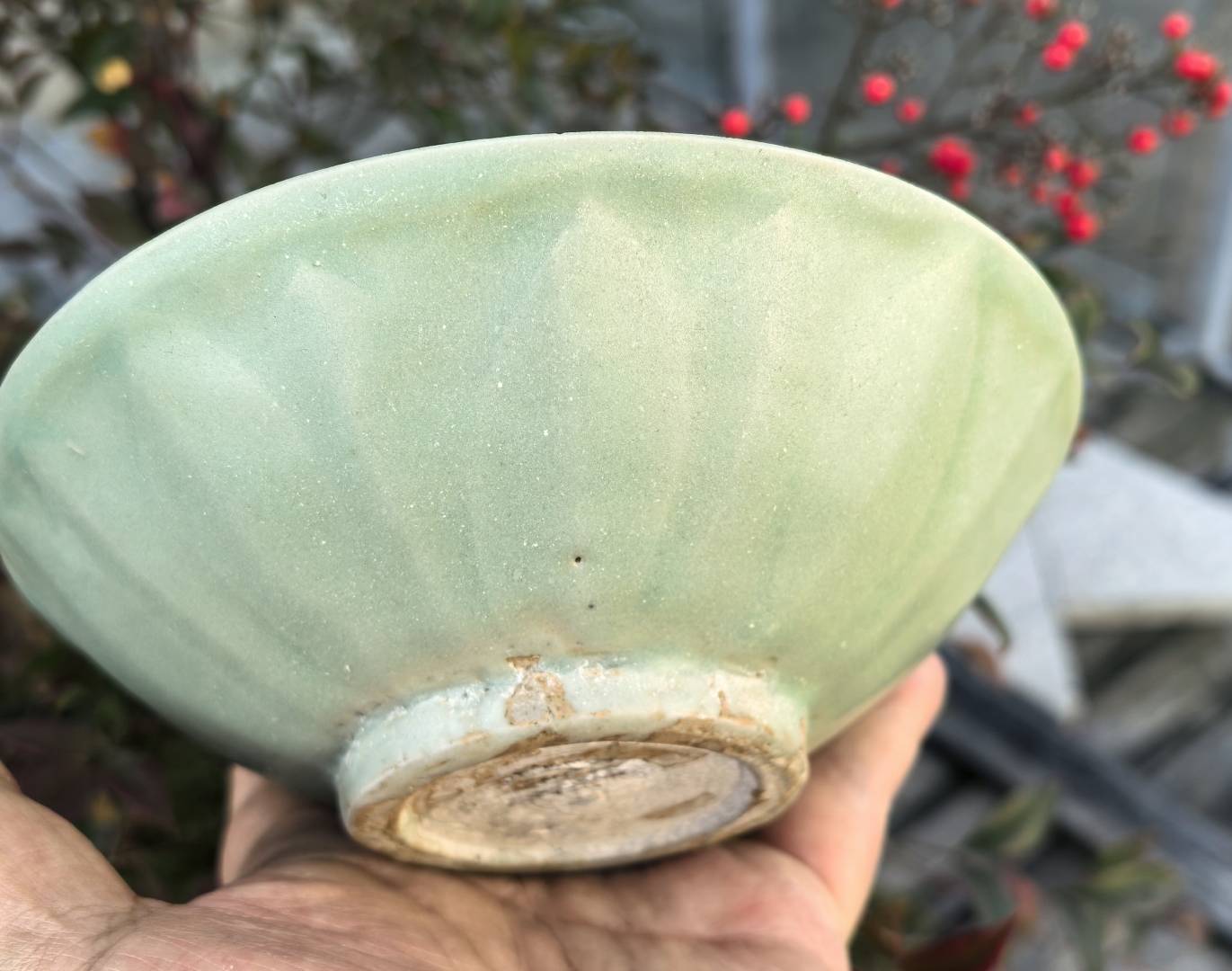
@centralpapottery 您好,通过照片观察,您的那只碗是宋代龙泉窑米黄釉刻仰莲纹碗,采用的是正烧工艺,不是覆烧工艺,因为口沿暴釉后人采用包口工艺给予保护。说错莫怪。
Chinese antique porcelain
@tonysu2573 thank you for your response. Can I ask two questions? Are you saying the lines on the back are the lotus pattern? Also, yellow glazed? I’m not finding this light greenish color when I type yellow glazed with the other information.
@centralpapottery 别客气,别客气。碗外的纹饰:仰莲纹 (莲瓣纹)。釉色:米黄釉 我分享给你一些莲瓣纹的实物照片。如果有什么需要我和你一起分享的尽管说。如果你没有找到那就等有时间了慢慢找。
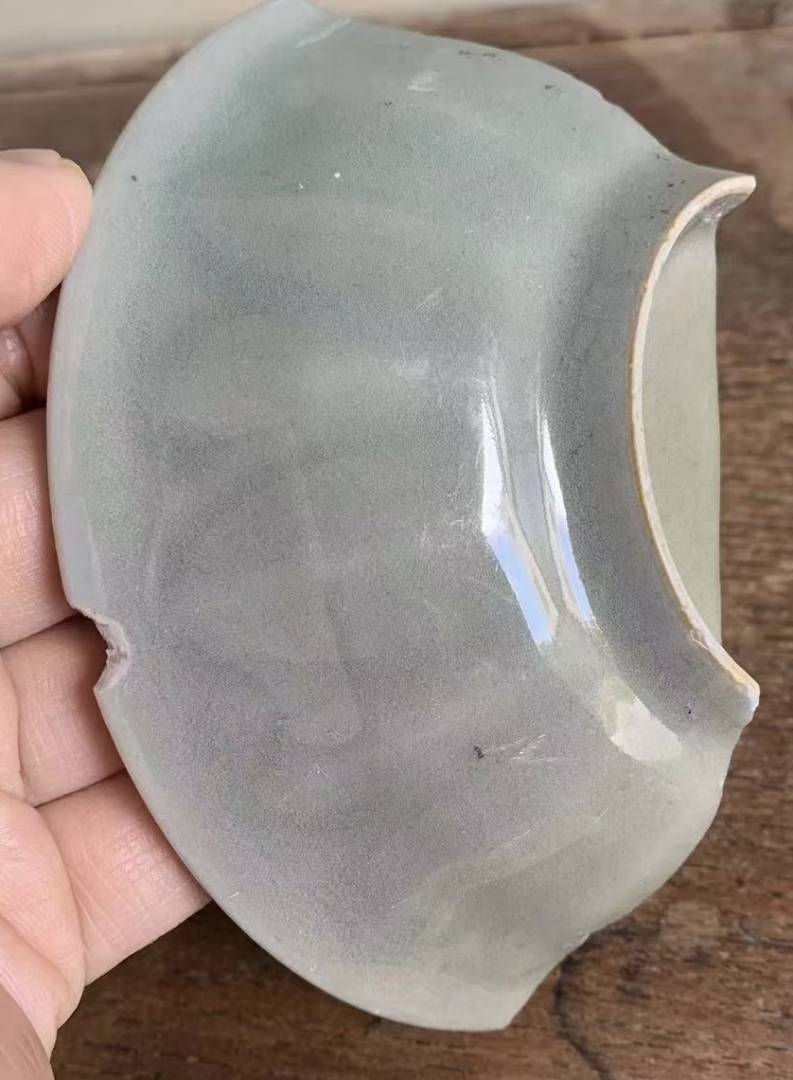
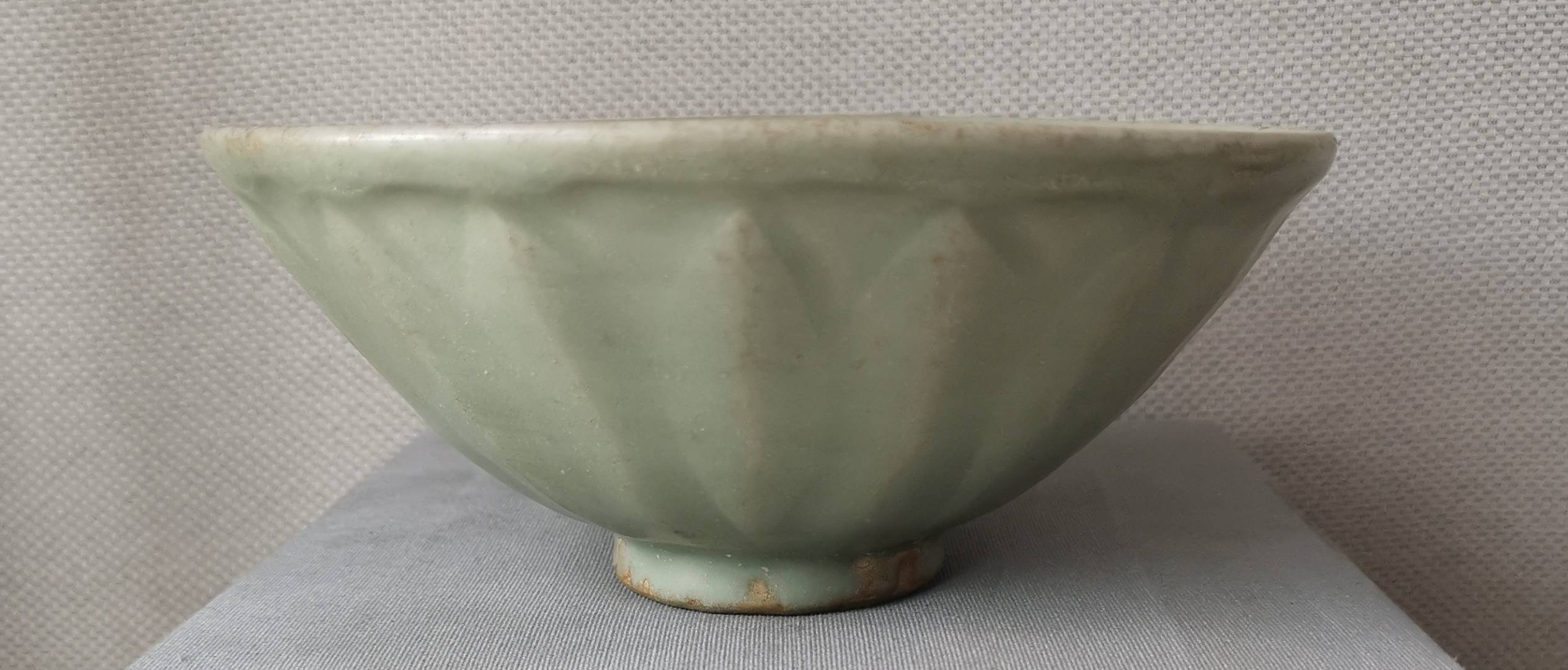
Chinese antique porcelain
@tonysu2573 thank you again! Yes, I see what you mean on yours. Mine are simply lines from the foot to the rim.
@centralpapottery 不用客气,我不会英文,我用翻译软件帮我翻译了下面的我说的中文,希望这个软件翻译的你能看的明白并且对你有一点点用处。
~~~~~~~~~~~~~~~~~~~~~~~~~~~~~~~~~~
Quote-ready version (professional English):
In the term mihuang glaze (米黄釉) or mihuang (米黄色), the element mi (米) should not be understood as a specific reference to millet (小米). Rather, it operates as a conventional colour analogy, corresponding to the modern Chinese colour category of mise/mihuang—a pale, creamy off-white tone with a subtle warm yellow cast, broadly comparable to beige or ivory-beige. Standard dictionary definitions of mise/mihuang likewise describe it essentially as a whitish colour tinged with light yellow.
Within the Longquan ware context (and, more broadly, in discussions of celadon systems such as Southern Song guan ware and Ge ware), mihuang glaze typically denotes a celadon glaze variant that reads warmer and more yellow-leaning, often with a relatively milky or opalescent quality—rather than a bright, lemon yellow. The term is therefore descriptive in nature, and may reflect factors such as firing atmosphere, temperature, and the body–glaze formulation.
Some writings explain the name by likening it to the colour of millet; however, this is best treated as a later metaphorical interpretation rather than a strict etymological conclusion (especially since mi in Chinese can also function as a generic term for “grain/rice”). A more robust reading is to treat mihuang as a fixed colour designation—namely, a beige-toned glaze with a slight yellow cast—without forcing an exclusive choice between “rice” and “millet.”
Chinese antique porcelain
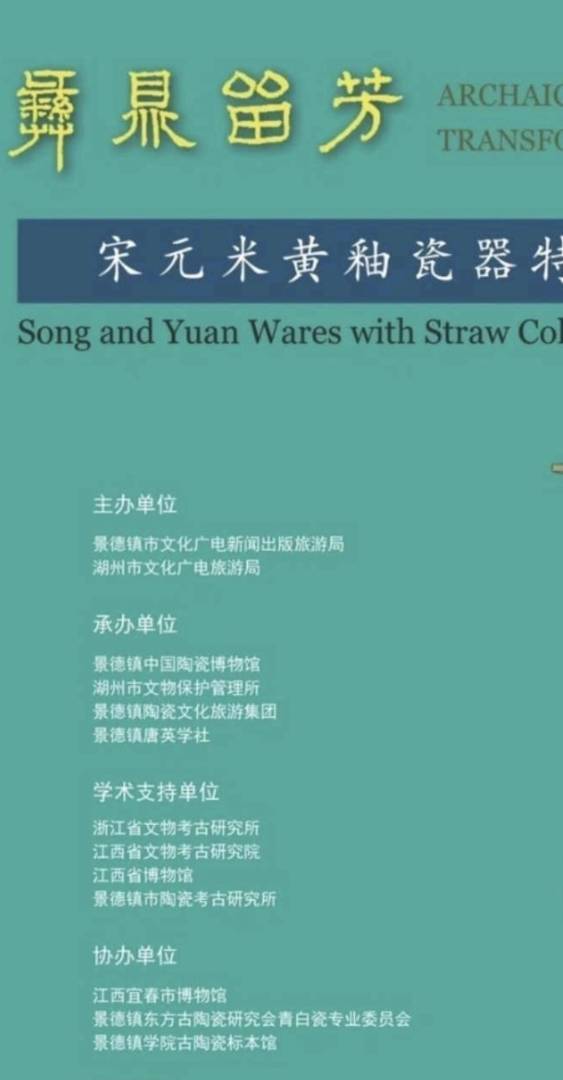
I once read a book many years ago that focused on mihuang (straw-coloured) glazed wares. Unfortunately, I can no longer locate the book. However, I can share an image of its cover with you; if you are able to identify or find the publication, I believe it may be of some help in further understanding the bowl in your possession.
~~~~~~~~~~~~~~~~~~~~~~~~~
The image shows a promotional page for the exhibition “Yiding Liufang: A Special Exhibition of Song and Yuan Mihuang (Straw-Coloured) Glazed Ceramics”. Relevant information is as follows:
Exhibition Information
- Title: Yiding Liufang: A Special Exhibition of Song and Yuan Mihuang (Straw-Coloured) Glazed Ceramics
(English: Song and Yuan Wares with Straw Color) - Organisers: Jingdezhen Municipal Bureau of Culture, Radio, Television, Press and Publication, and Tourism; Huzhou Municipal Bureau of Culture, Radio, Television, and Tourism
- Hosts: Jingdezhen China Ceramics Museum; Huzhou Municipal Institute for Cultural Relics Protection and Management; Jingdezhen Ceramic Culture and Tourism Group; Jingdezhen Tang Ying Society
- Academic Support: Zhejiang Provincial Institute of Cultural Relics and Archaeology; Jiangxi Provincial Institute of Cultural Relics and Archaeology; Jiangxi Provincial Museum; Jingdezhen Ceramic Archaeological Research Institute
- Co-organisers: Yichun Museum (Jiangxi); Qingbai Porcelain Specialised Committee of the Jingdezhen Oriental Ancient Ceramics Research Association; Ancient Ceramics Specimen Museum of Jingdezhen University
Theme and Significance
This special exhibition centres on mihuang-glazed ceramics of the Song and Yuan periods. Characterised by a soft, warm straw-toned glaze, such wares are regarded as one representative branch within the Song dynasty qingbai tradition (also known as yingqing). Combining both utilitarian and aesthetic qualities, the exhibition aims to present—systematically—the techniques, forms, decorative programmes, and cultural context of Song–Yuan mihuang-glazed ceramics, thereby promoting the preservation, interpretation, and wider exchange of ceramic culture.
Chinese antique porcelain
@tonysu2573 thank you, again, so much. Wow! What an extensive explanation. When you said “mihuang glaze typically denotes a celadon glaze variant that reads warmer,” that sounds like an explanation for mine.
Latest Post: Archaic metal dragon key? Our newest member: Katharine LeClair Recent Posts Unread Posts

Thanks for visiting "The BidAmount Asian Art Forum | Chinese Art"
If you sell on eBay, or have a shop feel free to post images and descriptions and links.
Check back often for discussion about the latest news in the Chinese art and antique world. Also find out about the latest Asian art auctions at Sotheby's, Christie's, Bonhams and Tajans.
Auction results for: fine porcelain, ceramics, bronze, jade, textiles and scholar's objects. As well as Japanese, Thai, Vietnamese and other Asian cultures.
Thank you,
Peter Combs
Topics and categories on The BidAmount Asian Art Forum | Chinese Art
Kangxi vases, Kangxi dishes and chargers, Kangxi ritual pieces, Kangxi scholar's objects, Qianlong famille rose, Qianlong enamels, Qianlong period paintings, Qianlong Emporer's court, Fine porcelain of the Yongzheng period. Chinese imperial art, Ming porcelain including Jiajing, Wanli, Xuande, Chenghua as well as Ming jades and bronzes.

Join the BidAmount Chinese and Asian art discussion board and forum today
The BidAmount Asian Art Forum | Chinese Art
A free Asian art discussion board and Asian art message board for dealers and collectors of art and antiques from China, Japan, Korea, Thailand, Cambodia, Vietnam and the rest of Asia. Linked to all of the BidAmount Asian art reference areas, with videos from plcombs Asian Art and Bidamount on YouTube. Sign up also for the weekly BidAmount newsletter and catalogs of active eBay listing of Chinese porcelain, bronze, jades, robes, and paintings.
The art of calligraphy - and for the ancient Chinese it certainly was an art - aimed to demonstrate superior control and skill using brush and ink. Calligraphy established itself as one of the major Chinese art forms during the Han dynasty (206 BCE - 220 CE), and for two millennia after, all educated men were expected to be proficient at it.
The Museum’s collections of Asian art span nearly five millennia and encompass the cultures of China, the Himalayas, India, Japan, Korea, and Southeast Asia. In 2007, the Museum launched an initiative to create dedicated galleries for the collection, beginning with a gallery for the arts of Korea ...
Chinese art is full of symbolism, in that artists typically seek to depict some aspect of a totality of which they are intuitively aware.
China Online Museum is the finest online museum of Chinese art. It features Chinese calligraphy, painting, ceramics, bronzes, carving, and other artworks.
Chinese Ceramics & Works of Art. Overview Upcoming auctions Contacts Auction results ... Christie’s sales of Chinese ceramics and works of art showcase centuries of Chinese history. Held throughout the year in London, New York, Paris and Hong Kong, they attract a wide audience of collectors and connoisseurs vying for pieces as diverse as ...
Explore Asian Art Week. Contact the Specialist Department. Chinese Paintings ... Senior Specialist, Head of Sale. [email protected]. Tel:+1 212 641 5760. Bid in-person or online for the upcoming auction:Fine Chinese Paintings on 10 September 2019 at New York. Bid in-person or online for the upcoming auction:Fine Chinese Paintings on 10 ...
Discover an abundance of must-see art from all corners of a vast continent at Christie’s NY Asian Art Week. From contemporary classical and Chinese paintings to works with exemplary provenance from the Art Institute of Chicago, our Rockefeller Paza galleries will be full of ancient treasures and contemporary masterworks in a salute to the vibrant arts of Asia.
Sold to benefit The Art Institute of Chicago’s Asian Art Acquisition Fund, the sale features 84 lots with a focus on Ming and Qing porcelains, and offers a rare insight into the taste for collecting Chinese ceramics and works of art in the Midwest from the end of the 19th century through the 1980s. Highlights include two Wanli wucai garlic-head vases, a Qianlong mark and period, blue and ...
Specialist, Chinese Paintings, Christie's London Dr Malcolm McNeill is a Specialist in Chinese Paintings at Christie’s, based in London. He previously worked as an assistant curator of the Chinese collections and the Victoria and Albert Museum in London, as a researcher at the British Museum, and as a translator and tour guide at the National Palace Museum in Taipei.
The Christie's Education 2020 Conference: The Chinese Art Market 18 Jun 2019 Christie’s Education is delighted to announce our first international academic conference in Asia which will take place in Hong Kong from 26-27 November 2020 at the Hong Kong Convention and Exhibition Centre and will run in parallel with Christie’s Hong Kong Autumn Auctions.
The summer Chinese Art sale in Hong Kong will feature works of art from several private collections, including Qing porcelains and textile from the collection of the legendary Chinese art dealer A. W. Bahr (1877–1959), fine gilt bronze Buddhist sculptures from an old Hong Kong collection, an East Asian collection of Qing dynasty wine cups and jades, and a Japanese collection of Song ceramics ...
Sotheby's Chinese Works of Art Department holds two auctions each year in London, New York, Hong Kong and Paris.
Chinese Art - View Auction details, bid, buy and collect the various artworks at Sothebys Art Auction House.
With more than 340 Chinese works of art dating from the Neolithic to the Republic periods, highlights of this sale include a selection of Qing Imperial monochromes from the collection of Arnold and Blema Steinberg, early ceramics from the Art Institute of Chicago and Chinese porcelain and works of art from the collection of Henry Arnhold.
Results: Sotheby's Asia Week achieved $52.4 million in six strong auctions, exceeding pre-sale estimates. With 76.5% of lots sold and 60.3% of lots surpassing high estimates, the Asian art sales at Sotheby's indicate continued collector interest in the finest works of art from China, India and and the Himalayas.
Today's sale of Important Chinese Art will proceed as planned with sessions at 10 AM and 2 PM EDT. Sotheby's will be monitoring the weather conditions throughout the day and will be available to coordinate alternative bidding options should conditions make it difficult for clients to attend the auction in person.
Bonhams Chinese Art department is renowned for offering the finest works of art representing the richness and breadth of China's artistic heritage, particularly Imperial porcelain, white and spinach green jades, cloisonné and Buddhist art. Specialised international auctions are held globally, including London, Hong Kong and San Francisco.
Bonhams : Chinese Works of Art We use cookies to remember choices you make on functionality and personal features to enhance your experience to our site. By continuing to use our site you consent to the use of cookies. Please refer to our privacy and cookie policies for more information.
Bonhams Fine Art Auctioneers & Valuers: auctioneers of art, pictures, collectables and motor cars. We use cookies to remember choices you make on functionality and personal features to enhance your experience to our site. By continuing to use our site you consent to the use of cookies. ... Chinese Art (US) General enquiries
Bonhams : Fine Chinese Art We use cookies to remember choices you make on functionality and personal features to enhance your experience to our site. By continuing to use our site you consent to the use of cookies. Please refer to our privacy and cookie policies for more information.
Bonhams Fine Art Auctioneers & Valuers: auctioneers of art, pictures, collectables and motor cars Bonhams : Asian Art We use cookies to remember choices you make on functionality and personal features to enhance your experience to our site.
Bonhams are international auctioneers of fine Chinese and Japanese art. We specialise in rare Imperial and Export Chinese ceramics and works of art, as well as Japanese ceramics, fine and decorative works of art from the Neolithic Period to the 20th century. View on map
Bonhams Fine Art Auctioneers & Valuers: auctioneers of art, pictures, collectables and motor cars. We use cookies to remember choices you make on functionality and personal features to enhance your experience to our site. By continuing to use our site you consent to the use of cookies. ... Asian Art Bonhams. Work. 22 Queen St.