The Chinese and Asian Art Forum. For Fans, Collectors and Dealers.
 Basic Rules For the BidAmount Asian Art Forum: Talk about whatever you want. You can even discuss and offer things that are for sale if they are authentic. Maximum image file size per post is 2 MB. Images of 700pxl x 700pxl are optimal if saved at a medium resolution. Be respectful of others and enjoy yourself. Click the YouTube link for a brief tutorial on using the forum. You can also EMBED Videos by cutting and pasting from You-Tube, Vimeo etc.
NOTE: To post an item or add a new post, click open the category title from the FORUM LIST, and CLICK the Blue ADD TOPIC button.


Hi all -
A short update …
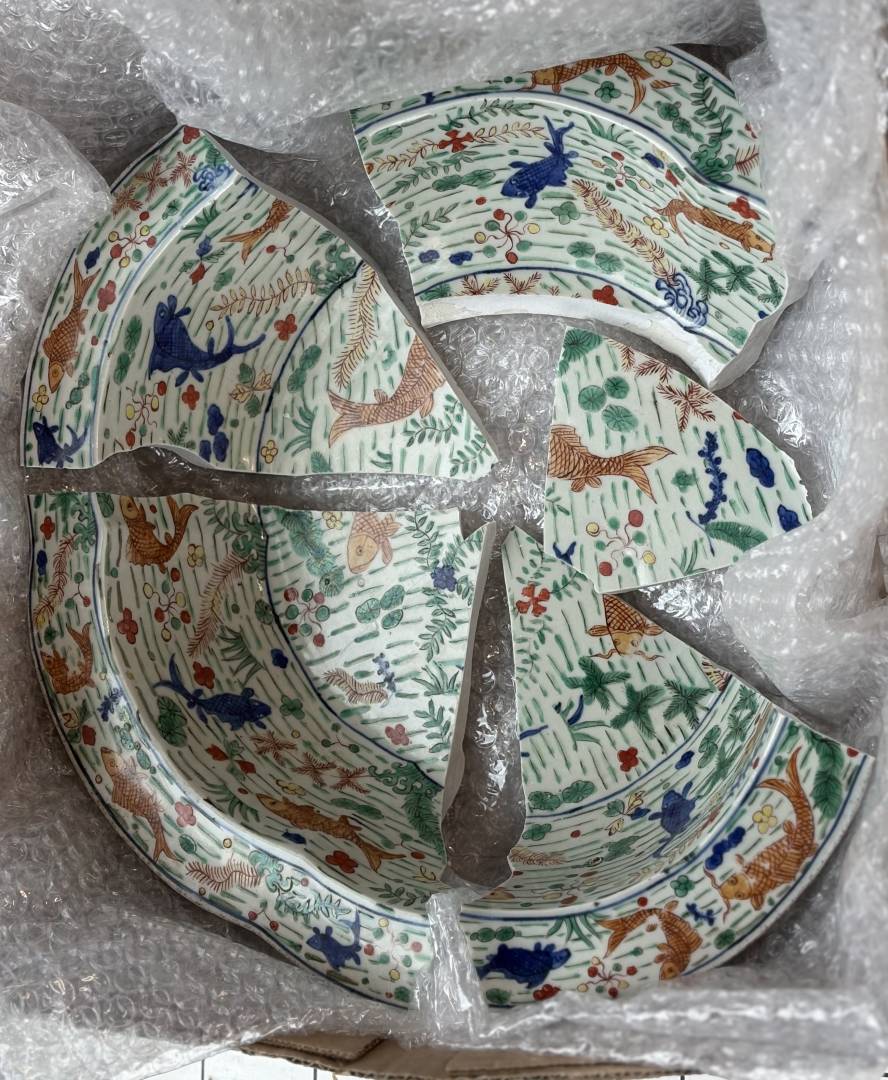
I visited my restorer earlier today with two friends, one of whom was collecting a finished piece …
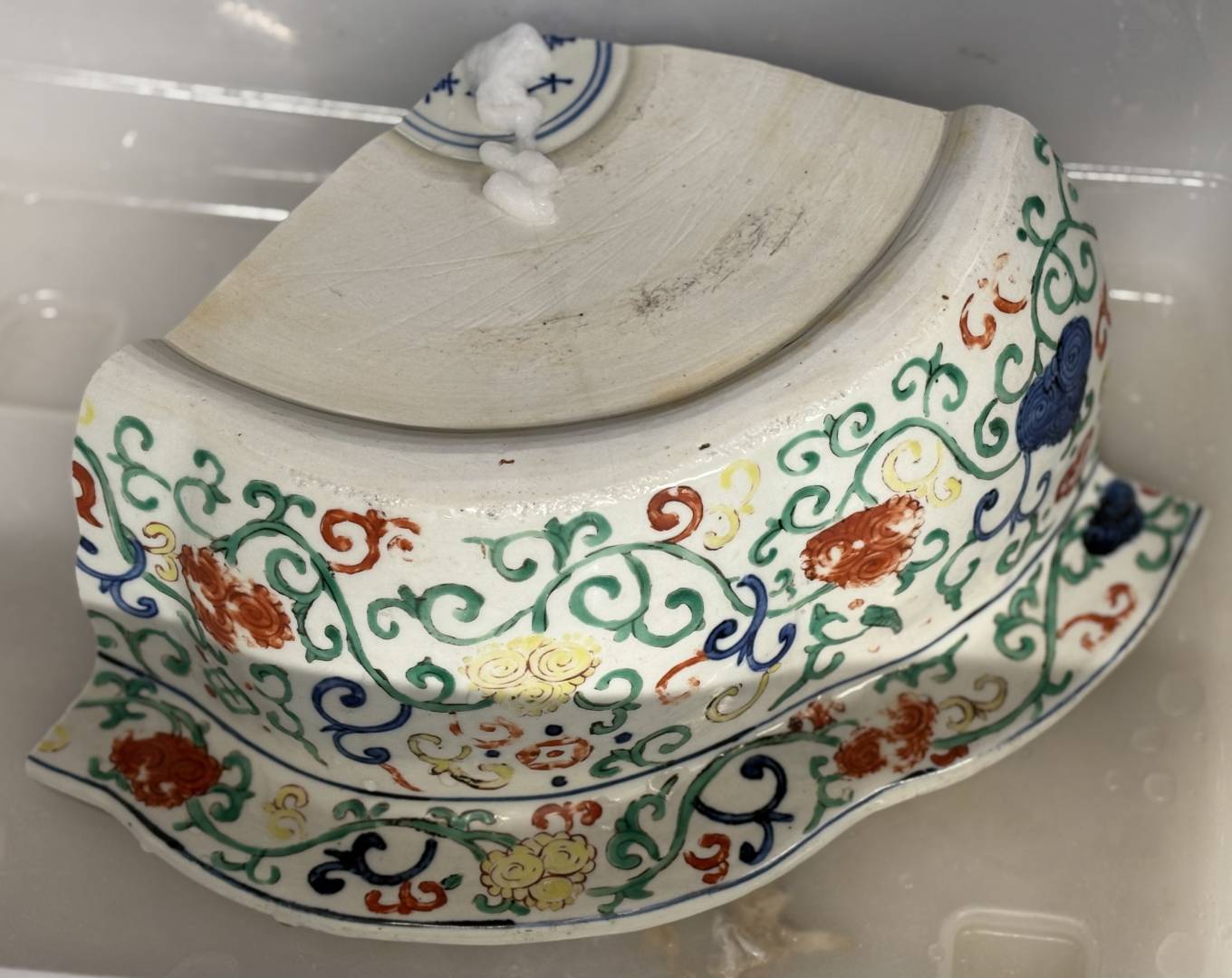
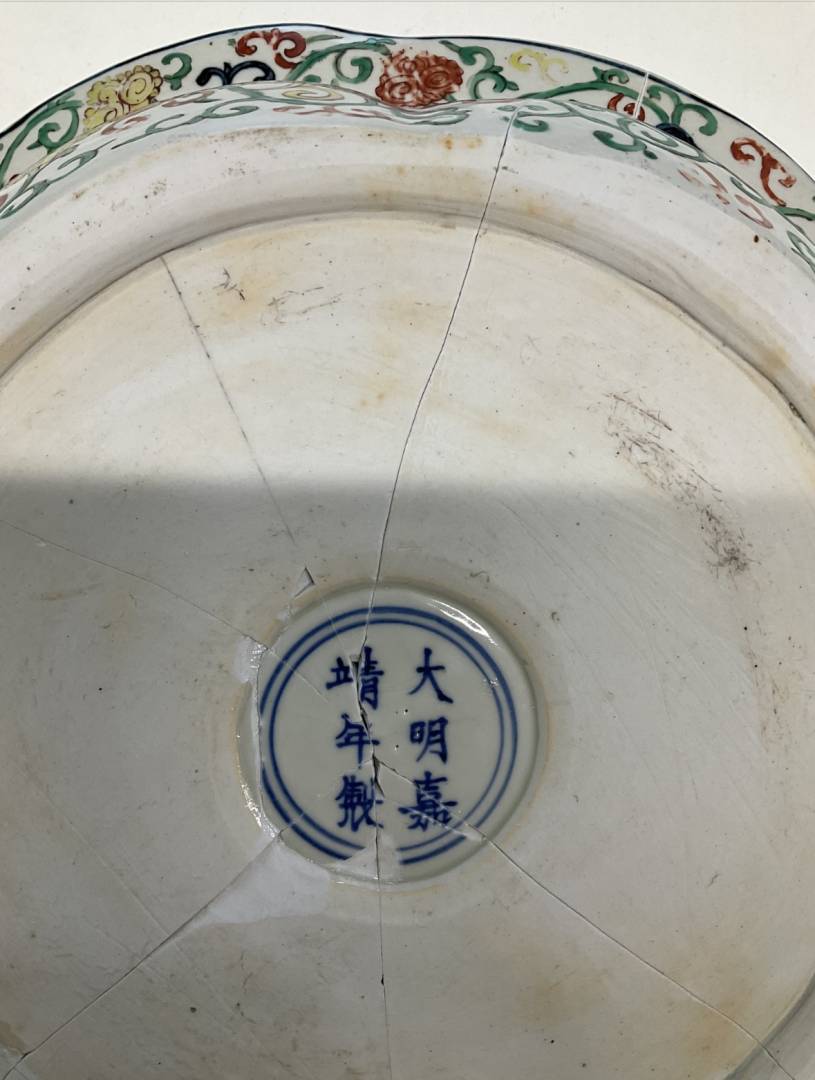
Two images attached of the basin undergoing third stage cleaning …
The box containing the large number of fragments are mostly finished, although he wanted to asked my thoughts regarding tight hairlines that can still be seen on two pieces …
The cleaning of the single large piece, second image, is undergoing extensive treatment, especially to a very tight break running through the mark. The cleaning of this single crack has been ongoing for over two months, just to give some impression of involved time scales, and continues still …
Stuart
Hi all -
An early Christmas present …
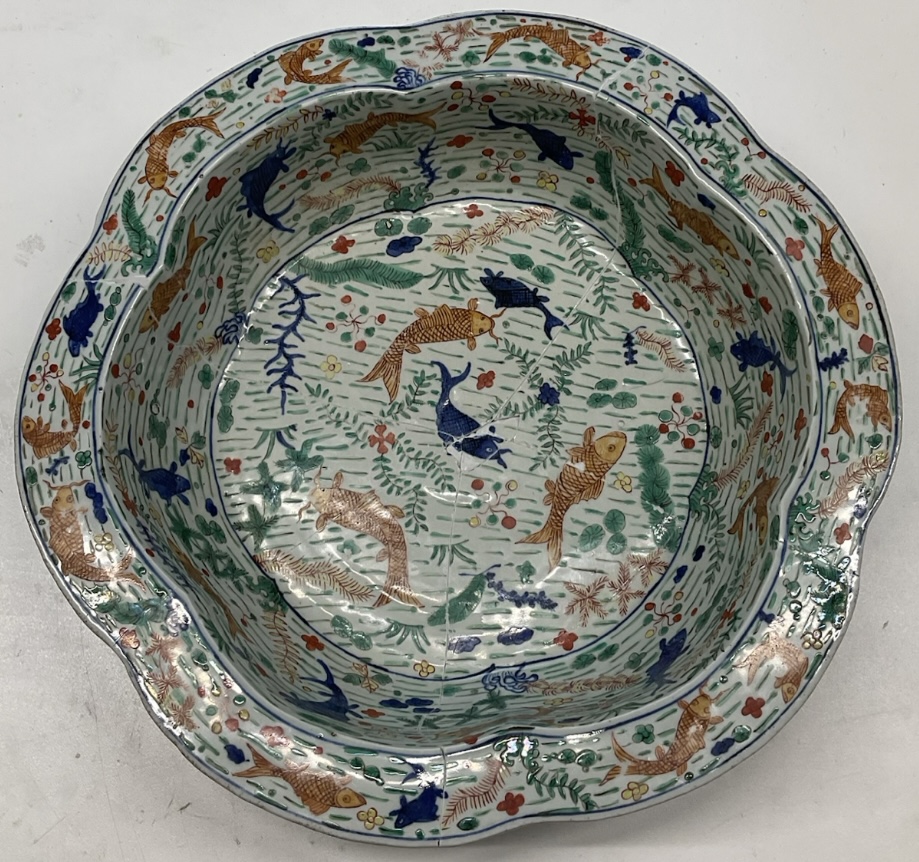
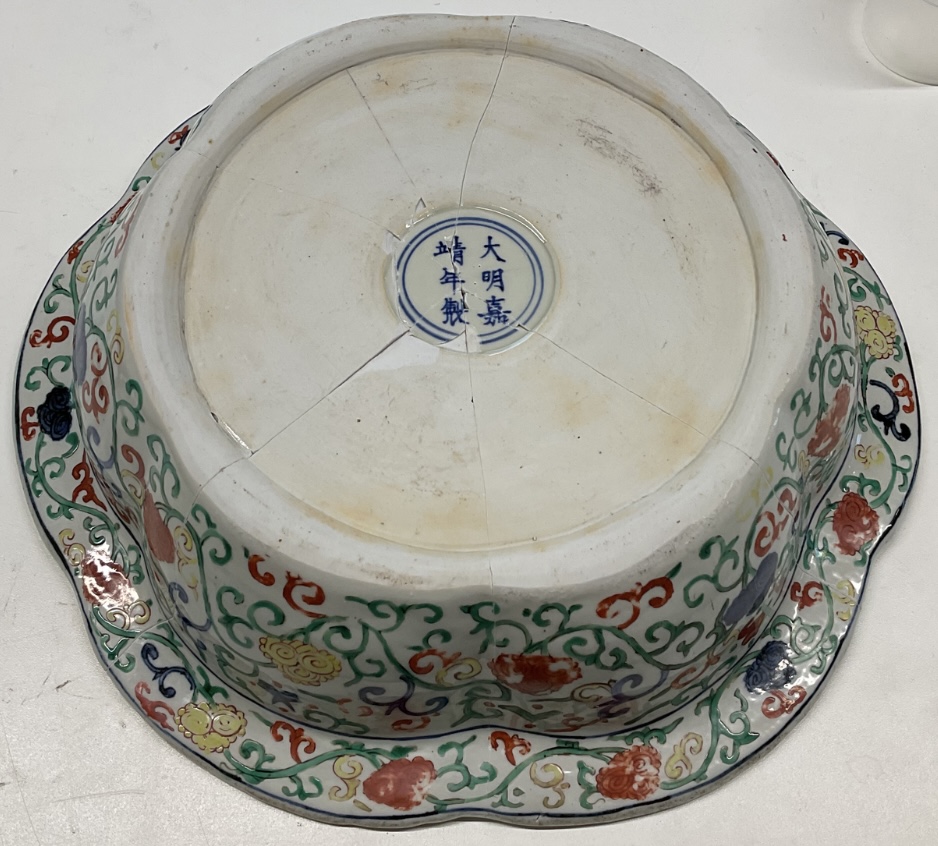
I have just received these images from my restorer. He has finished cleaning process, and has bonded the sections back together …
The next stage will be to fill in all losses along the break lines, then colour code and retouch all damage areas of enamels and underglaze blue, including the mark …
Again, due to the lighting or brightest, not the best images but, compared to the original condition, he’s doing a superb job …
Stuart

Very nice Stewart like me damaged is not important with fine art.

Dear Stuart,
I come a little late to the party, and also feel somewhat impertinent about offering a view on a Ming-period piece, but in spite of my reservations, I have a couple of observations that I will venture anyway.
First, I wonder why the auction house in which you found the basin thought it to be later than its reign mark would indicate. This strikes me as curious, since the auction house was clearly aware that the mark indicated the Jiajing reign; it was therefore not utterly unacquainted with matters Chinese. (I note that you did not mention the name of the auction house in which you found it. Someone's judgement obviously lay behind the opinion expressed in the catalogue; I found myself wondering whose this may have been, whether it was the product of in-house expertise, or whether it had come from an external consultant.)
Second, some of the photographs you supplied of the basin in its disassembled state suggested to me that the porcelain might be thick enough to withstand TL testing. The samples taken by Oxford Authentication, as I know from my own experience with them, are quite discreet, and though the testing process is unavoidably invasive to some extent, the traces it leaves on more substantial pieces are hardly noticeable. Such testing is necessarily impractical on finer porcelains, but possibly not in your particular and more thickly potted case. It has now in any event become impractical, because the basin has been reassembled in the course of its restoration. But it occurred to me that a TL test would almost certainly have concluded definitively what the results of connoisseurship would suggest.
And in that latter regard, the diligence of your research is quite excellent. From what I can see - although as I said above, my acquaintance with Ming-period pieces is not as wide ranging as it is with the Qing - your case appears to be a very strong one indeed.
If this proves indeed to be a mark and period basin, you have done exceptionally well to have acquired it at the price indicated in your catalogue annotation. Even though heavily restored, it is such a rarity - possibly a unique rarity - that that fact alone should be enough to counterbalance substantially the drawbacks posed by its damaged state.
One of the morals arising from this story is, keep looking in those secluded spots! And your experience here shows how even gems may occasionally lurk hidden in plain sight if they are wrongly assessed and described.
All good wishes,
Alan

@kaishul
Hi Alan -
Never feel any reservations regarding ‘venture observations’ on this, or indeed, any other forum post! We are all here to learn from one another’s experiences, thoughts and opinions …
Out of discretion and respect, I do not wish to name the auction house where offered. I will, however, relay what I was told by the head of there Asian department when enquiring about this piece …
When initially offered by the consigner who, I understand is a dealer, they were unsure whether to accept it for consignment due to the obvious damage and condition issues. After deciding to accepted, there were some discussions and uncertainty regarding how it should be described and catalogued, so the ‘safe option’ was taken.
Let me elaborate;
The provincial/smaller auction houses have to catalogue a wide range of numerous objects in differing media from several different countries. Therefore, department heads to have a very wide, broad knowledge range and, by implication, means they can lack specific, in-depth knowledge in specialist areas …
As you may be aware, auctions houses sometimes have to be cautious when cataloging. If, after conducting preliminary research no authentic comparisons are traced, this could suggest the object is later then initially thought which, may, imply it could be problematic and therefore difficult to sell. Also, the last thing they would wish to incur is bad publicity or, possible, litigation if the cataloguing proves incorrect …
Regarding the Jiajing base mark; One must know the differing writing characteristics of that found on both Imperial and private kiln period pieces, those written in honour or veneration in later reigns and periods, and those added to deceive. Marks, if applicable, are the last feature you should look at and examine closely, as it merely confirms whether the piece is, or is not, of a specific period …
Thank you for your suggestion and opinions on TL testing, something which I have already thought about and discussed with others. It can be very useful but, unfortunately, the dating range supplied would be too broad in this particular case …
Stuart
Dear Stuart,
Yes indeed, the provincial auction houses, with a few notable exceptions, do not have the depth of expertise required to arbitrate with any confidence on the authenticity of some of the lots they offer, especially in this particular area of the market where the fakes as we know can be very skilfully done. Such auction houses will, as you note, take the safer course of being noncommittal in the way they describe things, and I have all the more respect for them when I find them exercising caution in this respect. Yet sometimes, knowing their in-house limitations, they will call in external expertise. I had wondered whether this had been done in your case, but evidently not, they had simply exercised caution. This caution can be handy from the point of view of the buyer if that buyer knows what s/he is doing, as you evidently do. Less knowledgeable buyers might be deterred from bidding by the auction house's caution, knowing that they would have no recourse if the item did indeed turn out to be a modern copy. So the motto here is that the caution of the auction house can sometimes work in the knowledgeable buyer's favour. Competition will be deterred.
Allow me to clarify a little about the potential value of the TL test. Again in your case, had you been in a position to go down the TL route (less practical now because your item is undergoing restoration), I imagine that the route might have proceeded like this: you would have told Oxford Authentication that, by all appearances and belief, your basin was created between 1522 and 1566, and could they test it to either confirm or refute that belief. This, I believe, they would have been perfectly capable of doing. We know that the date ranges they are able to establish are not exact, and that these ranges have latitude of a few hundred years either side of the median date that the laboratory testing arrives at. However, mid Ming is a period that, all things being equal, they would be able to express a scientifically defensible opinion on which would have been useful from your point of view; Oxford Authentication ought certainly to have been able to confirm that the basin was indeed not a modern fake, and if not a modern fake, when else outside of Jiajing could it possibly have been made (we know of course of early Qing examples of retrospective reign marks, many of which chose those of the Jiajing emperor, but none of these early Qing examples would coincide with what is on the base of your item)? So by a process of elimination, the TL test would, I think, have clinched it, that if the item walks like a duck and quacks like a duck, then it is indeed a duck, especially when science says there's no reason either why it shouldn't be!
Thank you again for this most interesting thread.
Alan
Thanks for visiting "The BidAmount Asian Art Forum | Chinese Art"
If you sell on eBay, or have a shop feel free to post images and descriptions and links.
Check back often for discussion about the latest news in the Chinese art and antique world. Also find out about the latest Asian art auctions at Sotheby's, Christie's, Bonhams and Tajans.
Auction results for: fine porcelain, ceramics, bronze, jade, textiles and scholar's objects. As well as Japanese, Thai, Vietnamese and other Asian cultures.
Thank you,
Peter Combs
Topics and categories on The BidAmount Asian Art Forum | Chinese Art
Kangxi vases, Kangxi dishes and chargers, Kangxi ritual pieces, Kangxi scholar's objects, Qianlong famille rose, Qianlong enamels, Qianlong period paintings, Qianlong Emporer's court, Fine porcelain of the Yongzheng period. Chinese imperial art, Ming porcelain including Jiajing, Wanli, Xuande, Chenghua as well as Ming jades and bronzes.

Join the BidAmount Chinese and Asian art discussion board and forum today
The BidAmount Asian Art Forum | Chinese Art
A free Asian art discussion board and Asian art message board for dealers and collectors of art and antiques from China, Japan, Korea, Thailand, Cambodia, Vietnam and the rest of Asia. Linked to all of the BidAmount Asian art reference areas, with videos from plcombs Asian Art and Bidamount on YouTube. Sign up also for the weekly BidAmount newsletter and catalogs of active eBay listing of Chinese porcelain, bronze, jades, robes, and paintings.
The art of calligraphy - and for the ancient Chinese it certainly was an art - aimed to demonstrate superior control and skill using brush and ink. Calligraphy established itself as one of the major Chinese art forms during the Han dynasty (206 BCE - 220 CE), and for two millennia after, all educated men were expected to be proficient at it.
The Museum’s collections of Asian art span nearly five millennia and encompass the cultures of China, the Himalayas, India, Japan, Korea, and Southeast Asia. In 2007, the Museum launched an initiative to create dedicated galleries for the collection, beginning with a gallery for the arts of Korea ...
Chinese art is full of symbolism, in that artists typically seek to depict some aspect of a totality of which they are intuitively aware.
China Online Museum is the finest online museum of Chinese art. It features Chinese calligraphy, painting, ceramics, bronzes, carving, and other artworks.
Chinese Ceramics & Works of Art. Overview Upcoming auctions Contacts Auction results ... Christie’s sales of Chinese ceramics and works of art showcase centuries of Chinese history. Held throughout the year in London, New York, Paris and Hong Kong, they attract a wide audience of collectors and connoisseurs vying for pieces as diverse as ...
Explore Asian Art Week. Contact the Specialist Department. Chinese Paintings ... Senior Specialist, Head of Sale. [email protected]. Tel:+1 212 641 5760. Bid in-person or online for the upcoming auction:Fine Chinese Paintings on 10 September 2019 at New York. Bid in-person or online for the upcoming auction:Fine Chinese Paintings on 10 ...
Discover an abundance of must-see art from all corners of a vast continent at Christie’s NY Asian Art Week. From contemporary classical and Chinese paintings to works with exemplary provenance from the Art Institute of Chicago, our Rockefeller Paza galleries will be full of ancient treasures and contemporary masterworks in a salute to the vibrant arts of Asia.
Sold to benefit The Art Institute of Chicago’s Asian Art Acquisition Fund, the sale features 84 lots with a focus on Ming and Qing porcelains, and offers a rare insight into the taste for collecting Chinese ceramics and works of art in the Midwest from the end of the 19th century through the 1980s. Highlights include two Wanli wucai garlic-head vases, a Qianlong mark and period, blue and ...
Specialist, Chinese Paintings, Christie's London Dr Malcolm McNeill is a Specialist in Chinese Paintings at Christie’s, based in London. He previously worked as an assistant curator of the Chinese collections and the Victoria and Albert Museum in London, as a researcher at the British Museum, and as a translator and tour guide at the National Palace Museum in Taipei.
The Christie's Education 2020 Conference: The Chinese Art Market 18 Jun 2019 Christie’s Education is delighted to announce our first international academic conference in Asia which will take place in Hong Kong from 26-27 November 2020 at the Hong Kong Convention and Exhibition Centre and will run in parallel with Christie’s Hong Kong Autumn Auctions.
The summer Chinese Art sale in Hong Kong will feature works of art from several private collections, including Qing porcelains and textile from the collection of the legendary Chinese art dealer A. W. Bahr (1877–1959), fine gilt bronze Buddhist sculptures from an old Hong Kong collection, an East Asian collection of Qing dynasty wine cups and jades, and a Japanese collection of Song ceramics ...
Sotheby's Chinese Works of Art Department holds two auctions each year in London, New York, Hong Kong and Paris.
Chinese Art - View Auction details, bid, buy and collect the various artworks at Sothebys Art Auction House.
With more than 340 Chinese works of art dating from the Neolithic to the Republic periods, highlights of this sale include a selection of Qing Imperial monochromes from the collection of Arnold and Blema Steinberg, early ceramics from the Art Institute of Chicago and Chinese porcelain and works of art from the collection of Henry Arnhold.
Results: Sotheby's Asia Week achieved $52.4 million in six strong auctions, exceeding pre-sale estimates. With 76.5% of lots sold and 60.3% of lots surpassing high estimates, the Asian art sales at Sotheby's indicate continued collector interest in the finest works of art from China, India and and the Himalayas.
Today's sale of Important Chinese Art will proceed as planned with sessions at 10 AM and 2 PM EDT. Sotheby's will be monitoring the weather conditions throughout the day and will be available to coordinate alternative bidding options should conditions make it difficult for clients to attend the auction in person.
Bonhams Chinese Art department is renowned for offering the finest works of art representing the richness and breadth of China's artistic heritage, particularly Imperial porcelain, white and spinach green jades, cloisonné and Buddhist art. Specialised international auctions are held globally, including London, Hong Kong and San Francisco.
Bonhams : Chinese Works of Art We use cookies to remember choices you make on functionality and personal features to enhance your experience to our site. By continuing to use our site you consent to the use of cookies. Please refer to our privacy and cookie policies for more information.
Bonhams Fine Art Auctioneers & Valuers: auctioneers of art, pictures, collectables and motor cars. We use cookies to remember choices you make on functionality and personal features to enhance your experience to our site. By continuing to use our site you consent to the use of cookies. ... Chinese Art (US) General enquiries
Bonhams : Fine Chinese Art We use cookies to remember choices you make on functionality and personal features to enhance your experience to our site. By continuing to use our site you consent to the use of cookies. Please refer to our privacy and cookie policies for more information.
Bonhams Fine Art Auctioneers & Valuers: auctioneers of art, pictures, collectables and motor cars Bonhams : Asian Art We use cookies to remember choices you make on functionality and personal features to enhance your experience to our site.
Bonhams are international auctioneers of fine Chinese and Japanese art. We specialise in rare Imperial and Export Chinese ceramics and works of art, as well as Japanese ceramics, fine and decorative works of art from the Neolithic Period to the 20th century. View on map
Bonhams Fine Art Auctioneers & Valuers: auctioneers of art, pictures, collectables and motor cars. We use cookies to remember choices you make on functionality and personal features to enhance your experience to our site. By continuing to use our site you consent to the use of cookies. ... Asian Art Bonhams. Work. 22 Queen St.