The Chinese and Asian Art Forum. For Fans, Collectors and Dealers.
 Basic Rules For the BidAmount Asian Art Forum: Talk about whatever you want. You can even discuss and offer things that are for sale if they are authentic. Maximum image file size per post is 2 MB. Images of 700pxl x 700pxl are optimal if saved at a medium resolution. Be respectful of others and enjoy yourself. Click the YouTube link for a brief tutorial on using the forum. You can also EMBED Videos by cutting and pasting from You-Tube, Vimeo etc.
NOTE: To post an item or add a new post, click open the category title from the FORUM LIST, and CLICK the Blue ADD TOPIC button.

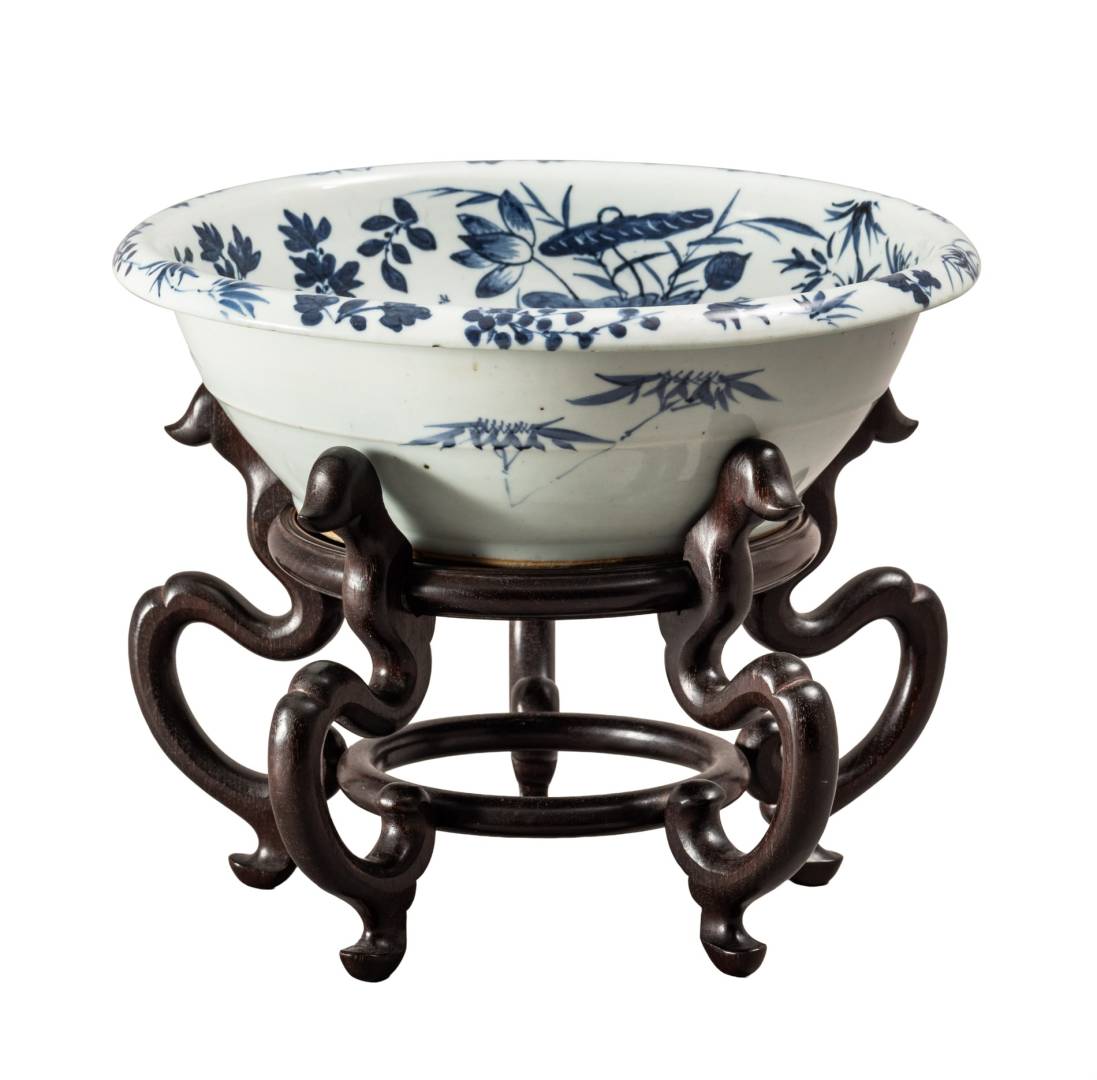
Large Chinese blue & white basin, Qing dynasty.
Probably Kangxi period (1662–1722), scholar’s room piece.
Porcelain, diameter approx. 14.1 inches, total height with stand approx. 15.7 inches.
Well-painted in varied cobalt tones with a bird perched among bamboo, a classic late 17th-century scholar motif.
The rim carries a freehand leaf-and-berry border typical of Kangxi domestic blue & white.
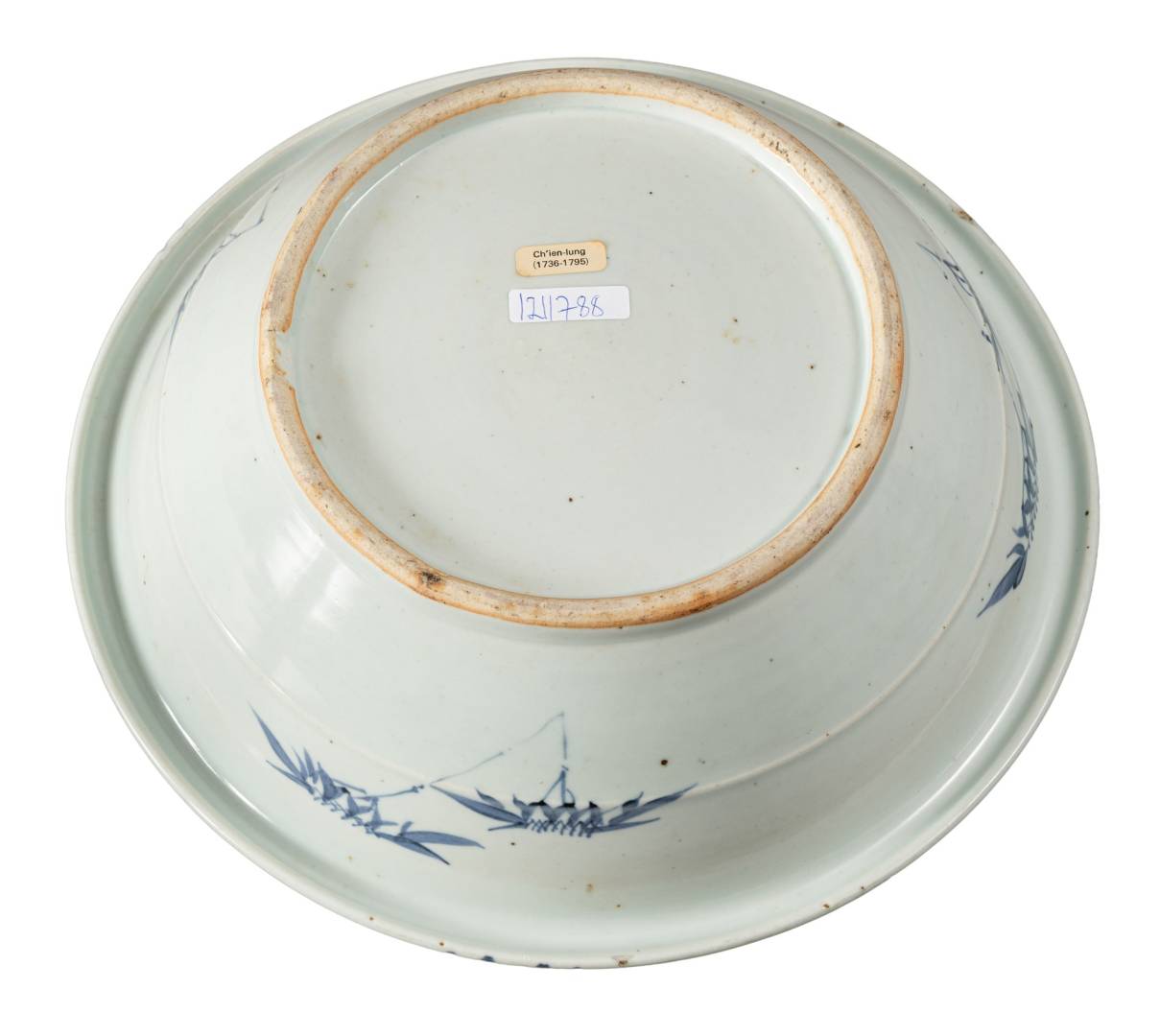
The exterior shows a subtle throwing line (shoulder ring) – a structural feature associated with large Transitional / early Kangxi wheel-thrown vessels.
Glaze is smooth with a slight cool tint; the footrim is neatly cut, hard-fired, with light iron speckling consistent with early Qing production.
Overall form, cobalt quality, and construction details support a dating in the late Kangxi period rather than later 18th–19th century manufacture.
Comes with an old carved hardwood stand (19th century), well-fitted to the piece.
Acquired at Scandinavian auction. Am i correct? The sticker under is 1736-1795 but i think it is wrong?

Ok, if no one can answer your question now, when it arrives please post up some more pictures. 😊
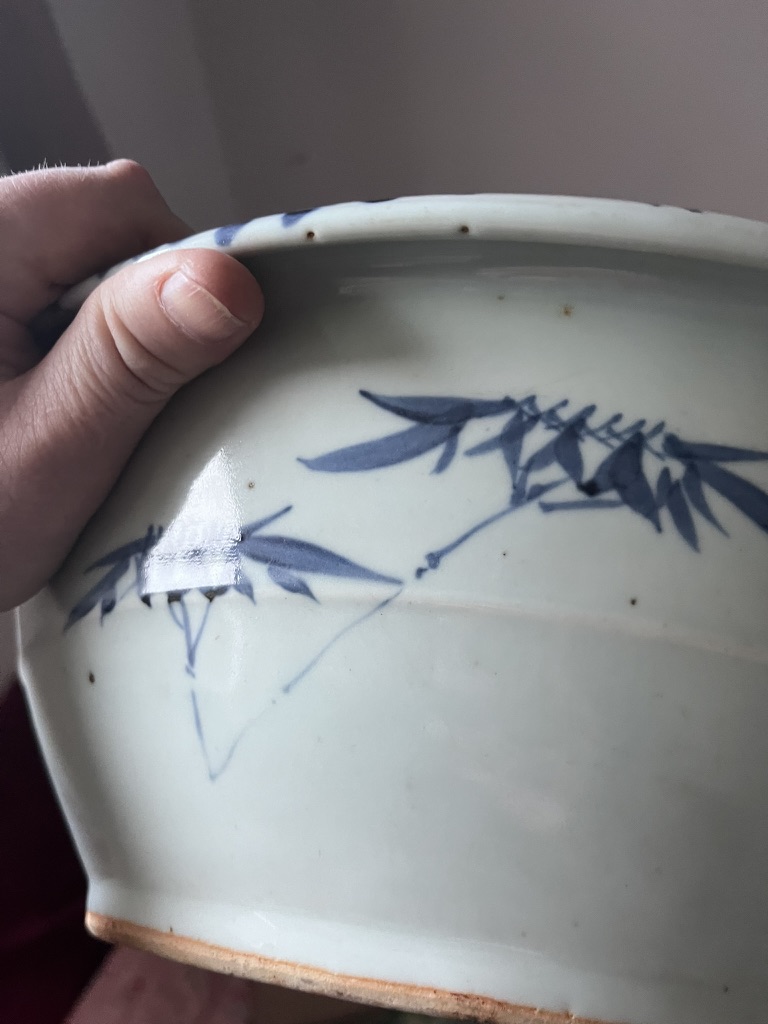
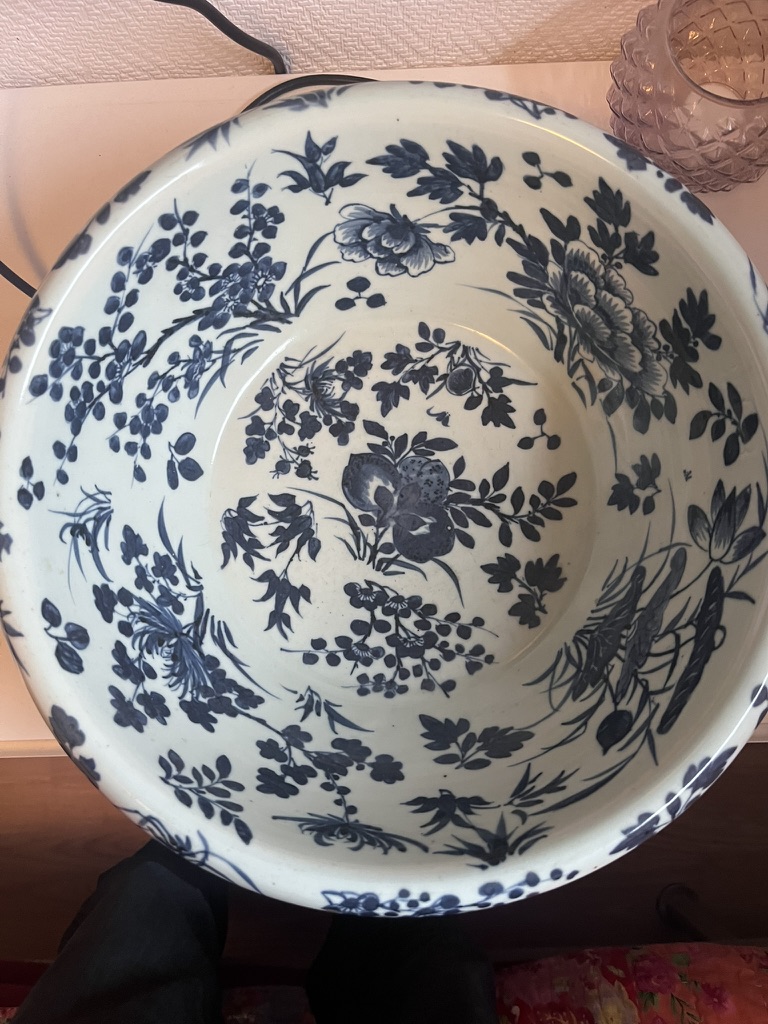

I wonder if it could be Japanese.
Birgit
@shinigami Hey I'm 100% sure it's not Japanese; now when I hold it in my hands I'm sure it's Kangxi 1680-1700.
The form, mass, cobalt tone, glaze texture and rim treatment categorically exclude Japanese origin. This basin is Chinese, Jingdezhen, late 17th century (late Kangxi period).

@lotusblack Thank you for the input. I’m not convinced this fits Qianlong. The heavy body, down-turned rim, decoration running fully to the edge, and the character of the cobalt and glaze point to a late 17th century Kangxi date, retaining strong late Ming transitional traits.
Do you have a comparison for the turned down rim? I think the external decoration looks 19th c but the interior could pass for qianlong only there is something rather strange about it, that I feel is wrong.
@julia Thank you – that is exactly the aspect I find most diagnostic. The down-turned, thickened rim is not a Qianlong feature. In Qianlong basins the rim is typically straighter, thinner and more controlled, often with decoration stopping short of the lip. Here the decoration runs fully to and over the rim, and the lip itself turns slightly inward/downward in a very functional, weight-bearing manner. This rim treatment is well documented on late 17th century Kangxi basins and in the late Ming / transitional tradition, particularly on large scholar’s wash basins where strength and stability were prioritised over refinement. What may feel “strange” is precisely that the interior painting retains a Ming-derived looseness and weight that survives into early Kangxi, but becomes increasingly incompatible with mid–late Qianlong aesthetics. When combined with the heavy body, glaze texture and cobalt tone, the overall construction does not sit comfortably in the Qianlong period despite some superficial decorative similarities. I therefore see this as late Kangxi (circa 1685–1700), strongly retaining late Ming transitional characteristics.
Interesting as, although we agree the decoration is off somehow, I don't find the decoration loose, I see it as rather stiff.
I still haven't found a curved rim dating to the 18th c or earlier. I will keep looking as this is an interesting thing to know.
Thank you – that’s a fair point, and I agree that “loose” may not be the best word here. The decoration is indeed quite controlled and structured, but what I see as non-Qianlong is not looseness per se, rather the absence of Qianlong refinement: the brushwork retains a Ming-derived directness without the polish, layering and tonal modulation typical of mid-18th century court wares.
Regarding the rim, I think the difficulty in finding parallels lies in classification. This is not a decorative curved rim in the 18th–19th century sense, but a functional turned-down reinforced lip, intended to strengthen the edge and control water flow. Such rims appear sporadically on large late 17th-century utilitarian forms (wash basins, water vessels), but are uncommon and rarely illustrated, as these were working objects rather than display pieces.
I agree it’s an unusual feature, which is precisely why I hesitate to place it comfortably in the Qianlong period, where form tends to be more standardised and elegance takes precedence over function.
I never thought of the rims being decorative. They were very common on old UK water basins, as it not only assists water flow, but the lifting of the piece.
I wonder if any old paintings show these chinese wash bowls? I shall keep my eyes open.
That’s an interesting comparison, and I agree entirely – the rim makes perfect sense as a functional solution, much like on early European wash basins.
As for pictorial evidence: Chinese scholar’s wash bowls do appear in late Ming and early Qing paintings, though usually incidentally rather than as focal objects. They are most often seen in wenren studio scenes depicting scholars at desks, sometimes placed on low stands beside writing tables. Because they were utilitarian objects, artists rarely emphasised them, which makes them easy to overlook.
A few late Ming paintings of scholar studios (for example in the tradition of Chen Hongshou and his circle) do show large ceramic basins used in this way, though they are not always rendered with enough detail to show rim profiles clearly. Still, their scale and placement are consistent with the type of object we are discussing.
I agree it would be very interesting to find a clearly detailed painted example – they are probably there, but hidden in plain sight.
Latest Post: Canton export plate and bowl with unusual double-joinery handles Our newest member: victor BAUDRU Recent Posts Unread Posts

Thanks for visiting "The BidAmount Asian Art Forum | Chinese Art"
If you sell on eBay, or have a shop feel free to post images and descriptions and links.
Check back often for discussion about the latest news in the Chinese art and antique world. Also find out about the latest Asian art auctions at Sotheby's, Christie's, Bonhams and Tajans.
Auction results for: fine porcelain, ceramics, bronze, jade, textiles and scholar's objects. As well as Japanese, Thai, Vietnamese and other Asian cultures.
Thank you,
Peter Combs
Topics and categories on The BidAmount Asian Art Forum | Chinese Art
Kangxi vases, Kangxi dishes and chargers, Kangxi ritual pieces, Kangxi scholar's objects, Qianlong famille rose, Qianlong enamels, Qianlong period paintings, Qianlong Emporer's court, Fine porcelain of the Yongzheng period. Chinese imperial art, Ming porcelain including Jiajing, Wanli, Xuande, Chenghua as well as Ming jades and bronzes.

Join the BidAmount Chinese and Asian art discussion board and forum today
The BidAmount Asian Art Forum | Chinese Art
A free Asian art discussion board and Asian art message board for dealers and collectors of art and antiques from China, Japan, Korea, Thailand, Cambodia, Vietnam and the rest of Asia. Linked to all of the BidAmount Asian art reference areas, with videos from plcombs Asian Art and Bidamount on YouTube. Sign up also for the weekly BidAmount newsletter and catalogs of active eBay listing of Chinese porcelain, bronze, jades, robes, and paintings.
The art of calligraphy - and for the ancient Chinese it certainly was an art - aimed to demonstrate superior control and skill using brush and ink. Calligraphy established itself as one of the major Chinese art forms during the Han dynasty (206 BCE - 220 CE), and for two millennia after, all educated men were expected to be proficient at it.
The Museum’s collections of Asian art span nearly five millennia and encompass the cultures of China, the Himalayas, India, Japan, Korea, and Southeast Asia. In 2007, the Museum launched an initiative to create dedicated galleries for the collection, beginning with a gallery for the arts of Korea ...
Chinese art is full of symbolism, in that artists typically seek to depict some aspect of a totality of which they are intuitively aware.
China Online Museum is the finest online museum of Chinese art. It features Chinese calligraphy, painting, ceramics, bronzes, carving, and other artworks.
Chinese Ceramics & Works of Art. Overview Upcoming auctions Contacts Auction results ... Christie’s sales of Chinese ceramics and works of art showcase centuries of Chinese history. Held throughout the year in London, New York, Paris and Hong Kong, they attract a wide audience of collectors and connoisseurs vying for pieces as diverse as ...
Explore Asian Art Week. Contact the Specialist Department. Chinese Paintings ... Senior Specialist, Head of Sale. [email protected]. Tel:+1 212 641 5760. Bid in-person or online for the upcoming auction:Fine Chinese Paintings on 10 September 2019 at New York. Bid in-person or online for the upcoming auction:Fine Chinese Paintings on 10 ...
Discover an abundance of must-see art from all corners of a vast continent at Christie’s NY Asian Art Week. From contemporary classical and Chinese paintings to works with exemplary provenance from the Art Institute of Chicago, our Rockefeller Paza galleries will be full of ancient treasures and contemporary masterworks in a salute to the vibrant arts of Asia.
Sold to benefit The Art Institute of Chicago’s Asian Art Acquisition Fund, the sale features 84 lots with a focus on Ming and Qing porcelains, and offers a rare insight into the taste for collecting Chinese ceramics and works of art in the Midwest from the end of the 19th century through the 1980s. Highlights include two Wanli wucai garlic-head vases, a Qianlong mark and period, blue and ...
Specialist, Chinese Paintings, Christie's London Dr Malcolm McNeill is a Specialist in Chinese Paintings at Christie’s, based in London. He previously worked as an assistant curator of the Chinese collections and the Victoria and Albert Museum in London, as a researcher at the British Museum, and as a translator and tour guide at the National Palace Museum in Taipei.
The Christie's Education 2020 Conference: The Chinese Art Market 18 Jun 2019 Christie’s Education is delighted to announce our first international academic conference in Asia which will take place in Hong Kong from 26-27 November 2020 at the Hong Kong Convention and Exhibition Centre and will run in parallel with Christie’s Hong Kong Autumn Auctions.
The summer Chinese Art sale in Hong Kong will feature works of art from several private collections, including Qing porcelains and textile from the collection of the legendary Chinese art dealer A. W. Bahr (1877–1959), fine gilt bronze Buddhist sculptures from an old Hong Kong collection, an East Asian collection of Qing dynasty wine cups and jades, and a Japanese collection of Song ceramics ...
Sotheby's Chinese Works of Art Department holds two auctions each year in London, New York, Hong Kong and Paris.
Chinese Art - View Auction details, bid, buy and collect the various artworks at Sothebys Art Auction House.
With more than 340 Chinese works of art dating from the Neolithic to the Republic periods, highlights of this sale include a selection of Qing Imperial monochromes from the collection of Arnold and Blema Steinberg, early ceramics from the Art Institute of Chicago and Chinese porcelain and works of art from the collection of Henry Arnhold.
Results: Sotheby's Asia Week achieved $52.4 million in six strong auctions, exceeding pre-sale estimates. With 76.5% of lots sold and 60.3% of lots surpassing high estimates, the Asian art sales at Sotheby's indicate continued collector interest in the finest works of art from China, India and and the Himalayas.
Today's sale of Important Chinese Art will proceed as planned with sessions at 10 AM and 2 PM EDT. Sotheby's will be monitoring the weather conditions throughout the day and will be available to coordinate alternative bidding options should conditions make it difficult for clients to attend the auction in person.
Bonhams Chinese Art department is renowned for offering the finest works of art representing the richness and breadth of China's artistic heritage, particularly Imperial porcelain, white and spinach green jades, cloisonné and Buddhist art. Specialised international auctions are held globally, including London, Hong Kong and San Francisco.
Bonhams : Chinese Works of Art We use cookies to remember choices you make on functionality and personal features to enhance your experience to our site. By continuing to use our site you consent to the use of cookies. Please refer to our privacy and cookie policies for more information.
Bonhams Fine Art Auctioneers & Valuers: auctioneers of art, pictures, collectables and motor cars. We use cookies to remember choices you make on functionality and personal features to enhance your experience to our site. By continuing to use our site you consent to the use of cookies. ... Chinese Art (US) General enquiries
Bonhams : Fine Chinese Art We use cookies to remember choices you make on functionality and personal features to enhance your experience to our site. By continuing to use our site you consent to the use of cookies. Please refer to our privacy and cookie policies for more information.
Bonhams Fine Art Auctioneers & Valuers: auctioneers of art, pictures, collectables and motor cars Bonhams : Asian Art We use cookies to remember choices you make on functionality and personal features to enhance your experience to our site.
Bonhams are international auctioneers of fine Chinese and Japanese art. We specialise in rare Imperial and Export Chinese ceramics and works of art, as well as Japanese ceramics, fine and decorative works of art from the Neolithic Period to the 20th century. View on map
Bonhams Fine Art Auctioneers & Valuers: auctioneers of art, pictures, collectables and motor cars. We use cookies to remember choices you make on functionality and personal features to enhance your experience to our site. By continuing to use our site you consent to the use of cookies. ... Asian Art Bonhams. Work. 22 Queen St.