Bidamount News November 27, 2026, Vol 658
 MARY ELLEN HAYWARD YEHIA

Ornamental Carving on Boston Furniture of the Chippendale Style
AT least three major furniture carvers, each with his own particular style of carving, worked in Boston between the years 1755 and 1785. One style of carving, seen on a chest-on-chest signed by John Cogswell, is notable for its three-dimensionality and the wide shallow grooves articulating the surface of the leaves (fig. 139). Another style, distinguished by two-dimensionality and the thin, narrow grooves used to indicate leaf forms, is evident on a desk and bookcase by George Bright (fig. 140). A third style, seen on a distinctive group of chairs and settees, is notable for its amorphous quality and lack of sharp articulating lines (fig. 141).
Personal and business papers relating to the activities of furniture craftsmen in eighteenth-century Boston are scarce. No record of a transaction between a cabinetmaker and carver in the Chippendale period in Boston has yet come to light. Whether cabinetmakers carved some or all of the products of their shops, hired specialized carvers for individual, specific jobs, or arranged for carving on a contract basis has yet to be discovered. Certainly in the Boston of the 1770s and 1780s cabinetmakers were the prestige segment of the furniture-making population. It was the cabinetmaker’s name that appeared on a bill for furniture and if any name appeared on a piece of furniture it was more likely the cabinetmaker’s than the carver’s. If the cabinetmaker himself did not do the skillfully carved decorations, he certainly took credit for the finished product.
The pre-eminence of the cabinetmaker is well illustrated by the correspondence between David Spear and his fiancée, Marcy Higgins. David Spear wrote to Marcy excitedly telling her that his father was going to get “Mr. Bright” to make the mahogany furniture for their new home. David was pleased because he knew that George Bright was “esteemed the neatest workman in town.” The “very good Furniture” from Bright’s shop that the Spears were anticipating was probably being, at that very moment, decorated by someone far less exalted than Mr. Bright—someone who would have received a very small sum for his very skillful services. In the 1780 tax lists for Suffolk County, George Bright and the equally successful cabinetmaker Alexander Edwards were assessed £120 apiece whereas the carver Joshua Bowles paid £10 and carvers Simeon and John Skillin paid only £20 and £15 respectively.
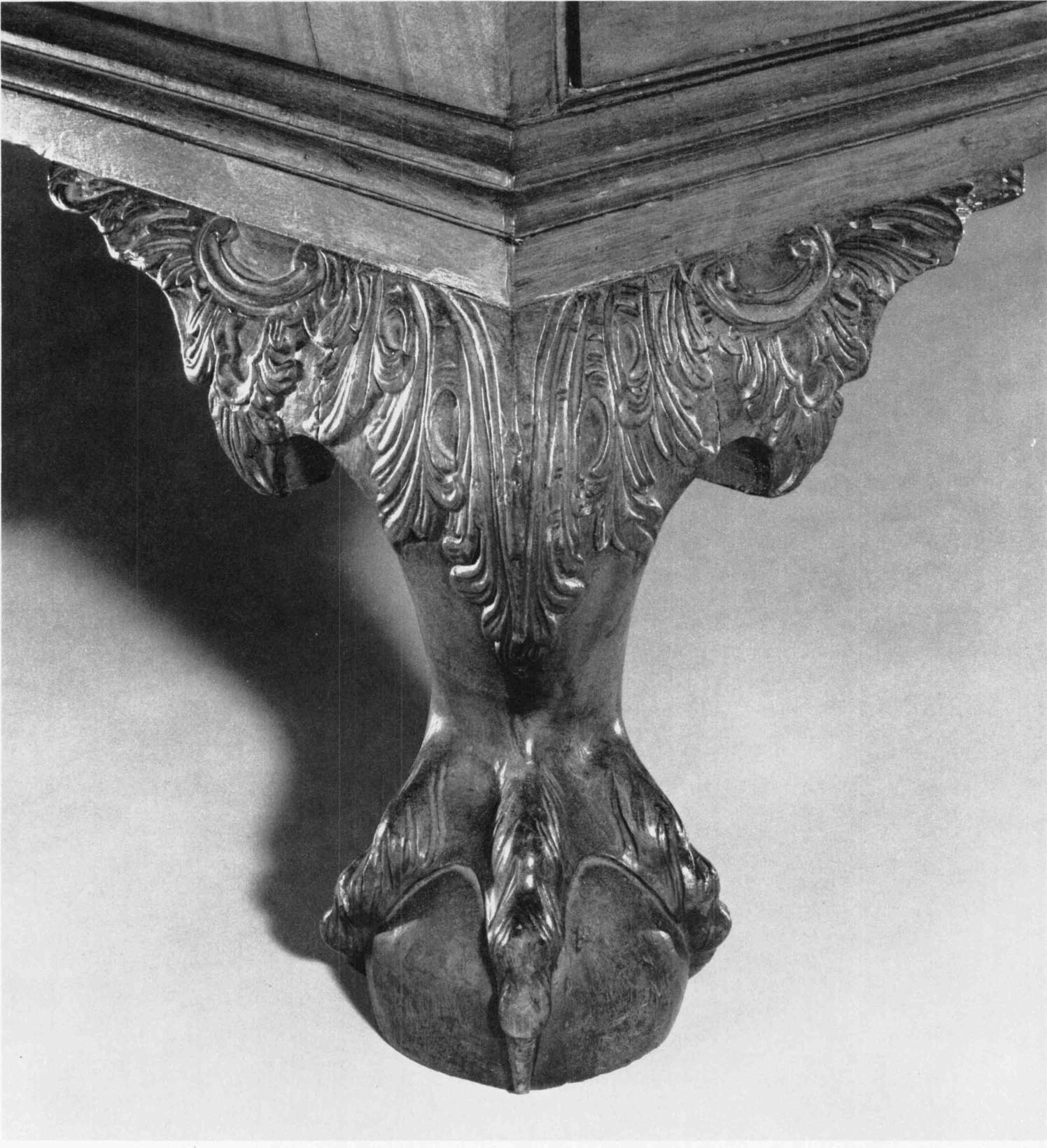
139. Detail of Carved Foot of Chest-on-Chest. Made by John Cogswell. (Museum of Fine Arts, Boston, William Francis Warden Fund, 1973.289.) See also figs. 125 and 143.
It is comparatively easy to sort, sift, and separate visual data, but no carved work can yet be associated with the name of a known carver. Therefore, this discussion of ornamental carving on Boston furniture emphasizes the carving styles. The names of some craftsmen likely to have executed the carved work will be suggested.
John Cogswell apparently employed more than one carver since carved work of very different styles is found on casepieces made by this cabinetmaker. The carver of the bracket feet on the signed Cogswell chest-on-chest (fig. 139) favored a general three-dimensional style of carving, with C-scrolls carved in high relief, dense leaves lapping one over the other, and shallow grooves used to articulate the surface of the leaves. Similarly carved feet are found on a chest of drawers at the Museum of Fine Arts, Boston (figs. 128 and 142), which, on the basis of the carving style and construction details, is attributed to Cogswell. A different carver undoubtedly executed the sophisticated decoration applied to the pediment (fig. 143) of the signed Cogswell chest-on-chest as the rich, highly three-dimensional style of the carving is quite different from that of the carving on the bracket feet.
Another type of three-dimensional carving is seen on a side chair in the Museum of Fine Arts, Boston (fig. 144), from the James Prince Mansion in Newburyport and probably made for Nathaniel Tracy (1751–1796), a prosperous merchant and previous owner of the house. The chair is part of a set including four other chairs and a sofa which was exhibited as American at the Girl Scout Loan Exhibition of 1929. (The sofa is in the collection of Colonial Williamsburg.) There is now doubt as to the origin of the group of furniture. The seat frames are beech and thin, open seat braces are used. If the beech can be identified by micro-analysis as American beech, this elaborately carved group of furniture from the Boston area will present a new area of study in Boston carving of the three-dimensional type.
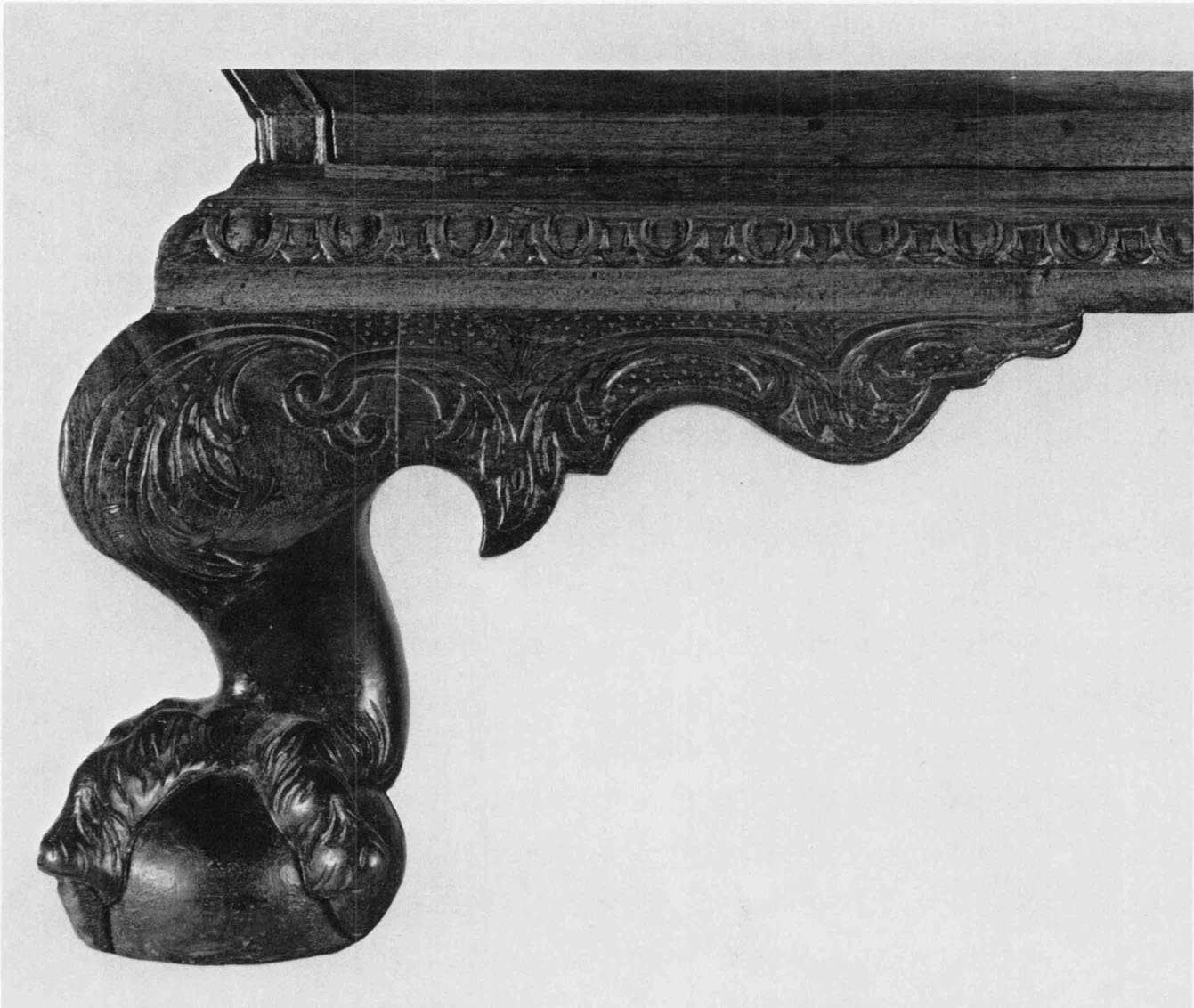
140. Detail of Carved Foot of Desk and Bookcase. Made by George Bright. (Museum of Fine Arts, Boston, Bequest of Miss Charlotte Hazen, 56.1194.) See also fig. 124.
The craftsman who carved the George Bright desk and bookcase had a distinctive style of his own characterized by an overall two-dimensionality (fig. 140). On the carved feet and brackets he used long narrow grooves to articulate the surface of sparse, hatchet-shaped leaves. A star-punched background partially fills the uncarved surface. The carving on the bracket is contained by a smooth band along the lower edge.
Two-dimensionality characterizes much of the carving on Massachusetts Chippendale furniture, but some ornamentation relates directly to the work on the Bright desk and bookcase. A bombé chest of drawers with serpentine front in the Museum of Fine Arts, Boston, has claw and ball feet and brackets with similarly fashioned leaves, a star-punched background, and a smooth band forming a border along the bracket’s lower edge. It is unlikely, however, that the two pieces of furniture were carved by the same hand for different punches were used on the two backgrounds and the smooth bordered edge extends much further along the bracket on the chest than on the desk and bookcase. The similarities suggest that the craftsman who executed the carving on the chest was familiar with, if not trained by, the craftsman responsible for the carving on the Bright desk and bookcase.
The third major style of furniture carving seen in Boston in the Chippendale period appears on a very interesting and sophisticated group of furniture notable for its unusual, asymmetrically designed carved decorations. The group consists of: matching settees in the Winterthur Museum (fig. 145) and the Metropolitan Museum of Art; a card table in a private collection; two armchairs and ten side chairs at the Yale University Art Gallery (fig. 141); a side chair at the Winterthur Museum (fig. 146); and an armchair in the collection of Israel Sack, Inc. (fig. 147). For the sake of convenience, Chart I lists various pieces of seating furniture belonging to this group, giving secondary woods, construction methods, and pertinent measurements.
The most distinctive feature of the pieces of furniture in this group, a feature that they all have in common, is the unusual carved ornamentation on the knees. The decorative motif is markedly asymmetrical. (Most carved designs on American Chippendale furniture are totally symmetrical in spite of the rococo penchant for asymmetry.) It consists of a large C-scroll with leafy appendages placed diagonally across the surface of the knee. Beneath the C-scroll hangs a wilted and drooping leaf.
| Location | Type | Construction; woods | Measurements |
|---|---|---|---|
| 1. Winterthur 51.80 | Armchair knee with asymmetrical carving; hairy paw feet | beech seat frame; thin beech open seat braces | h. 37¼″, w. 25½″, d. 20½″ |
| 2. Israel Sack, Inc. | Armchair knee with asymmetrical carving; claw and ball feet | maple rear seat rail veneered with mahogany; triangular corner blocks (3½″ × 1½″) with thin chamfered edge, held in place by 2 round-headednails ⅜″d. | h. 37½″, w. 29″, d. 19″W. top rail: 20⅜″Splat: h. 19¾″w. at rosettes 8½″, w. at base 49/10″Seat: w. rear 17⅞″, w. front 22¾″, d. 17″H. of leg: 14⅝″ |
| 3. Yale University 1967.28.1 | Side chair knee with asymmetrical carving; claw and ball feet | maple seat frame; white pine triangular corner blocks (3¼″ × 1½″) with thin chamfered edge, held in place by 4 round-headed nails ¼″d.; American black ash and maple open seat braces held in place with round-headed nails ⅜″d. | h. 37⅝″, w. 22⅞″, d. 18¾″W. top rail: 20½″Splat: h. 19¾″, w. at rosettes 8½″, w. at base 49/10″Seat: w. rear 17⅞″, w. front 22⅞″, d. 17¼″H. of leg: 14⅝″ |
| 4. Yale University 1967.26 | Armchair knee with asymmetrical carving; claw and ball feet | maple seat frame; birch rear triangular corner blocks (3 ¼″ × 1½″) with thin chamfered edge, held in place by 2 round-headed nails ⅜″d.; maple open seat braces | h. 37⅜″, w. 26½″, d. 199/16″W. top rail: 21½″Splat: h. 19¾″, w. at rosettes 9¼″, w. at base 58/10″Seat: w. rear 18⅞″, w. front 25½″, d. 18¼″H. of leg: 14⅝″ |
| 5. Winterthur 52.242 | Side chair knee with asymmetrical carving; hairy paw feet | oak rear seat rail veneered with mahogany; triangular corner blocks cherry (3½″ × 1½″) with thin chamfered edge, held in place by screws that have replaced original nails | h. 37″, w. 21½″, d. 17¾″W. top rail: 20⅜″Splat: h. 19¼″, H. of leg: 14⅝″ |
| 6. Winterthur 59.1877 | Settee knee with asymmetrical carving; claw and ball feet | maple seat rail and rear legs, also top of scroll arms; cedar top rail, side rail, front and sides of arms; birch brace of top rail; triangular corner blocks (45/16″ × 2⅛″) with thin chamfered edge, held in place by 4 round-headed nails ⅜″d. | h. 36″, l. 57″, d. 24″H. of leg: 14⅝″ |
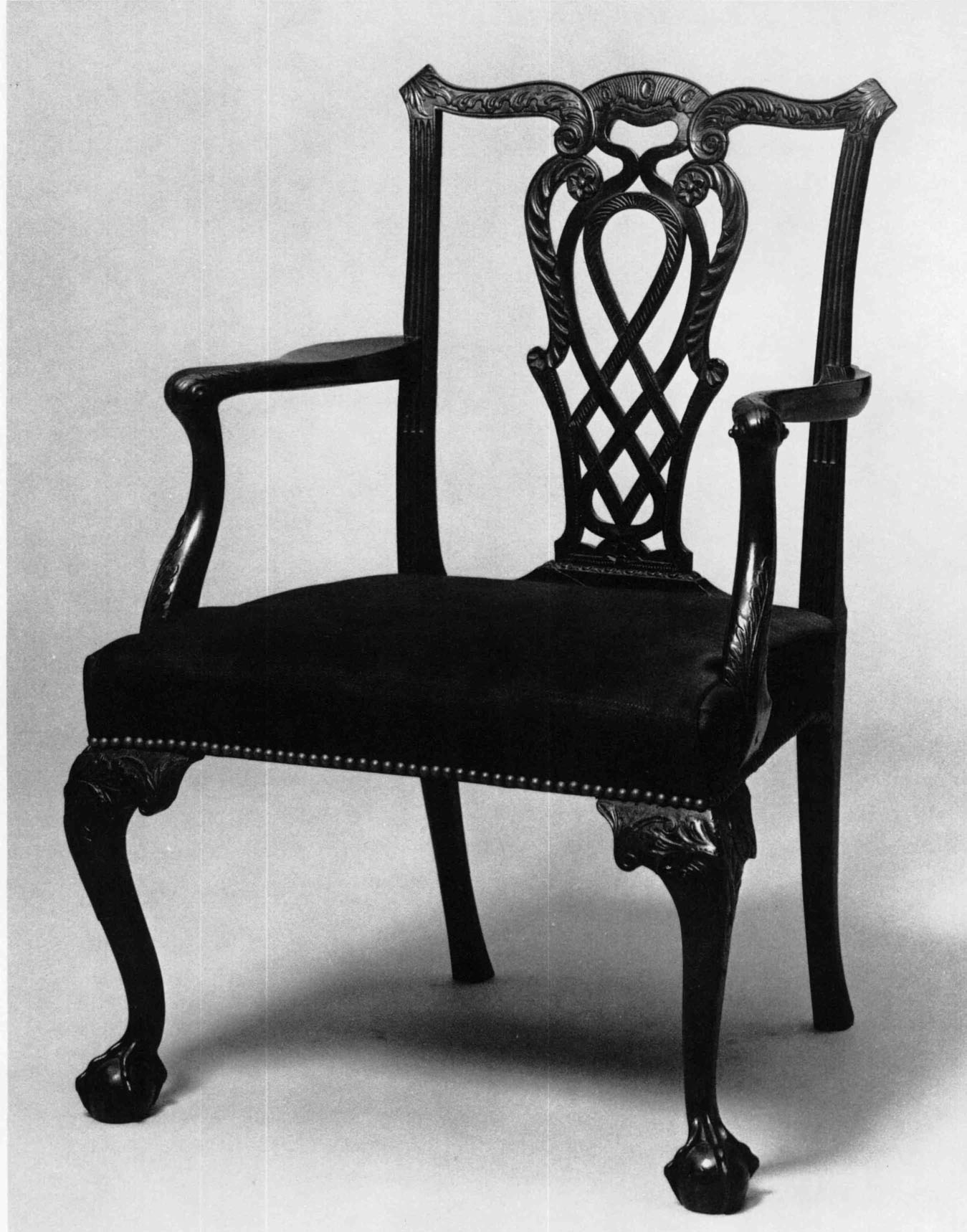
141. Armchair. Boston area, c. 1760–1780. Mahogany, maple, and birch; h. 37⅜ inches, w. 26½ inches, d. 199/16 inches. (Yale University Art Gallery, Mabel Brady Garvan Collection.)
An armchair at Winterthur (fig. 148 and no. 1, chart i) seemingly identical to the group of chairs at Yale University (fig. 141 and nos. 3 and 4, chart i)—with the same asymmetrical knee decoration and the same splat design—proves on closer inspection, however, to have been carved by a different hand than all of the other pieces of furniture in the group. A close look reveals many subtle differences.
The Winterthur armchair has stiles fluted in an a, b, a pattern with the center flute rising higher than those to the sides. Its carved leafage across the top rail descends to various levels on the rail. The flutes on the splat’s central figure-eight motif are closely spaced and subtly varied in direction to follow the curve of the figure-eight.
In contrast, the carving on the set of chairs at Yale (fig. 141 and nos. 3, 4, chart i) and that on an armchair owned by Israel Sack (fig. 147 and no. 2, chart i) show a less artistic hand at work. The flutes in the stiles all reach the same height. The carved leafage across the top rail is equidistant from the lower edge of the rail. There are far fewer flutes on the figure-eight motif on the splat and these are rather carelessly arranged.
One may conclude that the chairs at Yale and the chair owned by Israel Sack, Inc., were copied from the chair owned by Winterthur, but copied by a craftsman who was not so particular in carrying out the details of execution. There has long been speculation about whether the Winterthur chair is American. Acting on the authority of an antiques dealer in Massachusetts who told him that the chair was found in a Massachusetts house, Joseph Downs considered the chair as American despite its beech seat frame and traditionally English seat braces.
It seems quite likely that the armchair at Winterthur is English and that it or a member of its set (the Museum of Fine Arts, Boston, owns a seemingly identical side chair) was used as the model for the rest of the furniture in this group. Particularly intriguing in this context are the thick, wide, open seat braces found on the twelve chairs at Yale. It seems as though the Boston chairmaker attempted to copy not only the design and carving of the English chair, but also its method of construction. The open seat braces on the Boston-made versions are much heavier and cruder than on the imported model, and the Boston chairmaker refused to abandon his own traditional method of supporting the chair seats with triangular corner blocks, so that the seats are supported by both open braces and corner blocks.
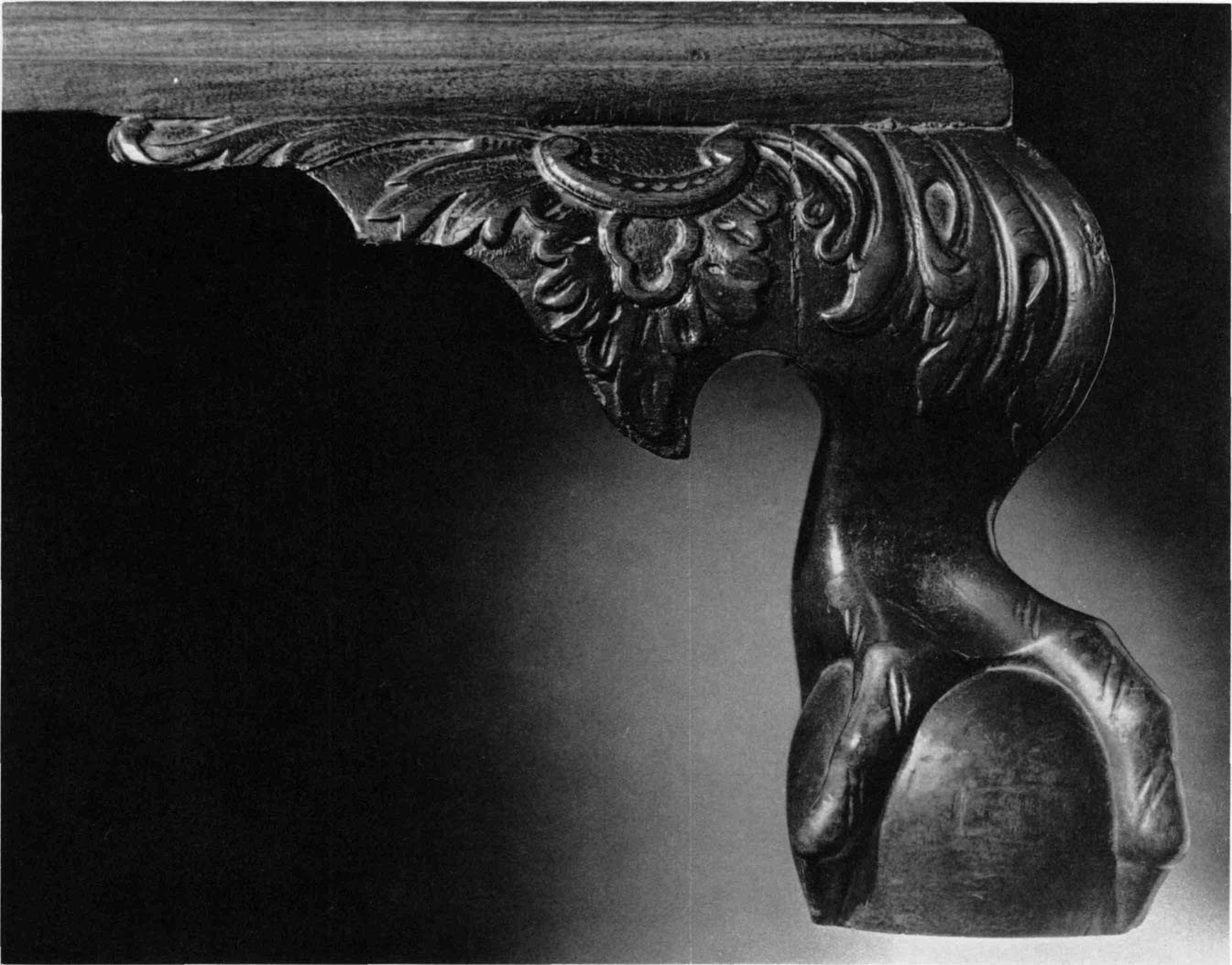
142. Detail of Carved Foot of Chest of Drawers. Attributed to John Cogswell. (Museum of Fine Arts, Boston, Bequest of Maria Theresa Burnham Hopkins, 37.34.) See also fig. 128.
Consistent construction methods indicate that chairmaker and carver (and they may have been the same person) worked on all of the members of this particular group of furniture. In each chair and in the settees the maker used triangular corner blocks with thinly chamfered edges, approximately 3½ inches wide, held in place with either four or two large, round-headed nails. The Yale chairs (fig. 141 and nos. 3, 4, chart i) are upholstered over the frame; the Sack chair (fig. 147 and no. 2, chart i) and a side chair at Winterthur (fig. 146 and no. 5, chart i) have slip seats with rear seat rails veneered with mahogany. Although the splat of the Winterthur side chair is not the same design as that of the other chairs in this group, its cresting rail was made with the same template used for the top rails of the other chairs (they all measure 20½ inches in width). All of the legs belonging to the group of chairs and settees measure 14⅝ inches in height, indicating that the craftsman worked on a piece basis, turning out carved leg after carved leg (thirty-two legs in all). Only the center legs of the settees differ in style.
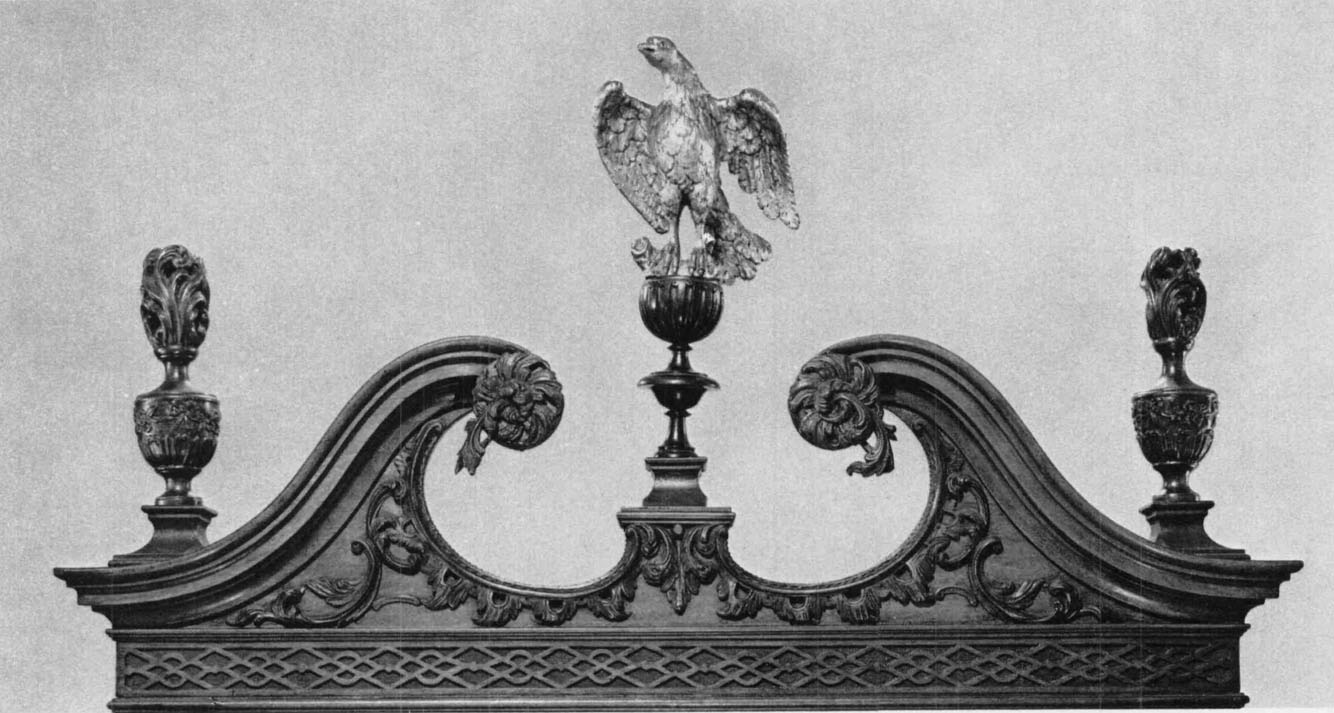
143. Detail of Pediment of Chest-on-Chest. Made by John Cogswell. (Museum of Fine Arts, Boston, William Francis Warden Fund, 1973.289.) See also figs. 125 and 139.
More modest types of chairs produced in Boston in the 1770s and 1780s also show interesting carved work by three or more different hands. A variety of chairs arranged by splat type are listed in Chart II giving details of construction, secondary woods, and measurements.
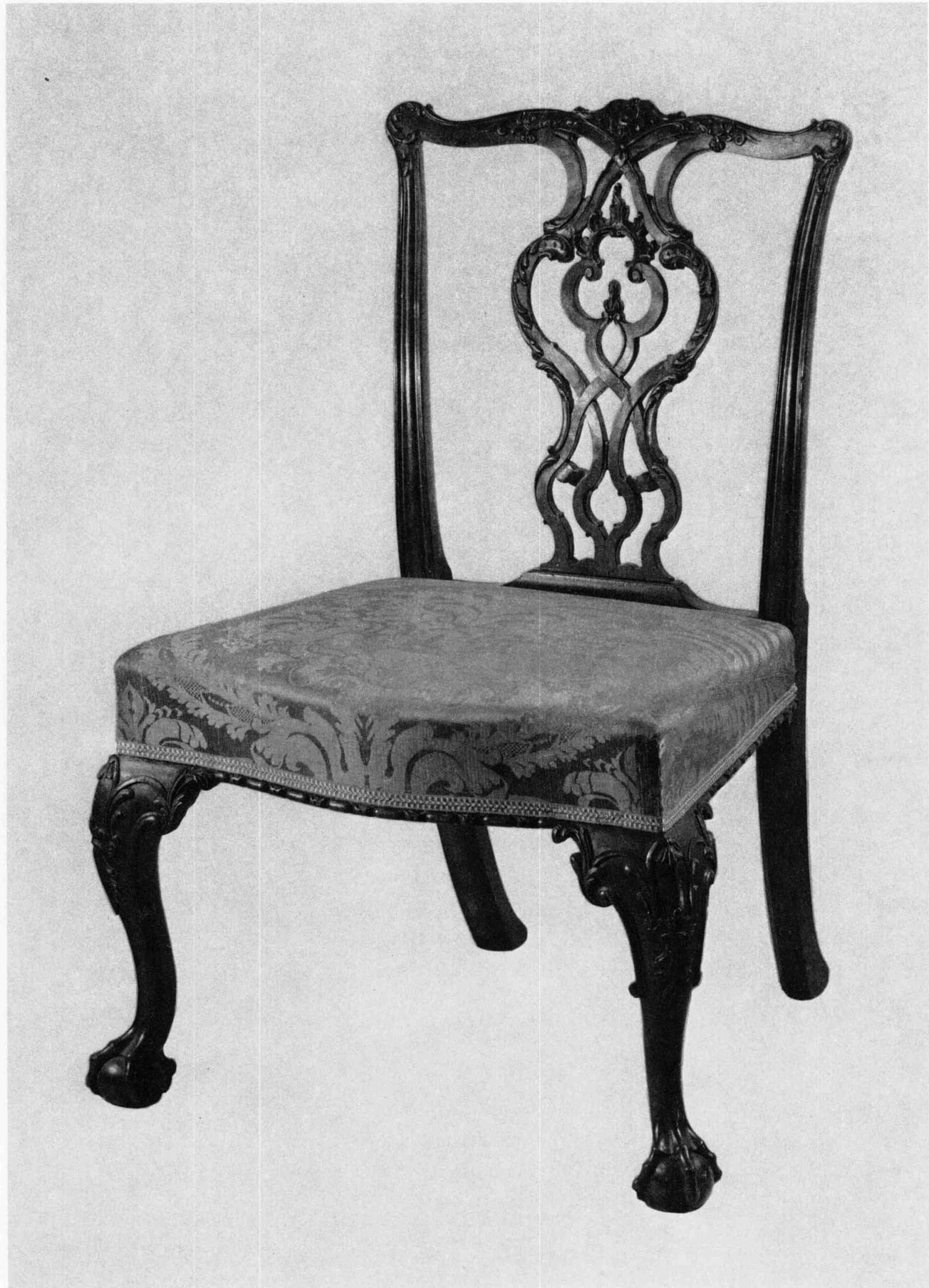
144. Side Chair. England or Boston area, c. 1760–1780. Mahogany and beech; h. 37¼ inches, w. 22½ inches, d. 19 inches. (Museum of Fine Arts, Boston, Gift of Mrs. Guy Currier, 35.1977.) According to family tradition, this chair was owned by Nathaniel Tracy (1751–1796) of Newburyport, Massachusetts.
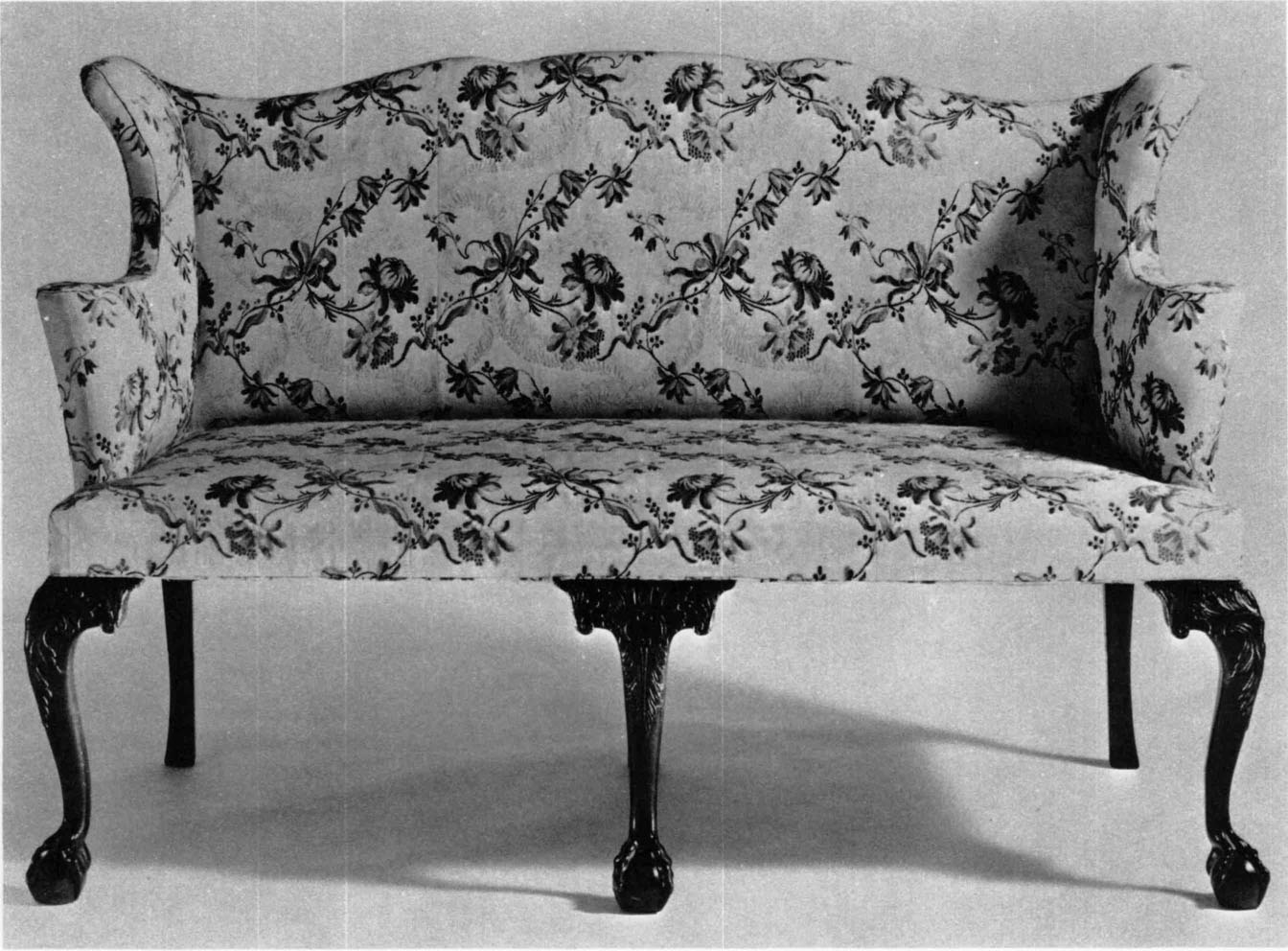
145. Settee. Boston area, c. 1760–1780. Mahogany, maple, cedar, and birch; h. 36 inches, w. 57 inches, d. 24 inches. (The Henry Francis du Pont Winterthur Museum.)
A Boston-made chair popular among those who could afford mahogany furniture was one with a splat of intertwined scrolls, splat a. Examples are located in the Winterthur Museum (no. 1, chart ii), the Museum of Fine Arts, Boston (fig. 149 and no. 2, chart ii), and the Metropolitan Museum of Art (no. 4, chart ii). Chairs of this type, found frequently in New England, appear not only with ornamental carving, but also in a plain, undecorated form.
Chairs numbers 1 and 2 (fig. 149) on Chart II with this splat design appear identical to chairs numbers 3 (fig. 150) and 4 with the same splat, but subtle differences in the size of the carved motifs indicate that the chairs were carved by different hands. Differences in construction further indicate that chairs numbers 3 and 4 were not produced in the same shop as numbers 1 and 2, emphasizing the popularity of the chair design.
Numbers 5 (fig. 151) and 6 are two chairs from a large set with unusual splat designs of attenuated C-scrolls, a central Gothic arch, and a small solid trefoil near the base, splat b. They were probably made by the same chairmaker who fashioned chairs numbers 3 (fig. 150) and 4, or, at least, carved by the same hand.
Chairs numbers 8 and 9 with splat c (fig. 152) are copied from plate 9 in Robert Manwaring’s The Cabinet and Chair-Maker’s Real Friend and Companion (London, 1765). A very differently designed chair with a two-tiered Gothic splat (fig. 153 and no. 10, chart ii), splat d, shows a similar two-dimensional style of carving and similar construction, making tenable an attribution to the same shop and carver. The carving on the chair with the two-tiered splat relates in its two-dimensional character to that on the Bright desk and bookcase (fig. 140).
Although as yet no carver can be identified with a specific piece of furniture, there is an accumulating body of documentary material relating to a number of craftsmen known to have been working in Boston between 1755 and 1785.
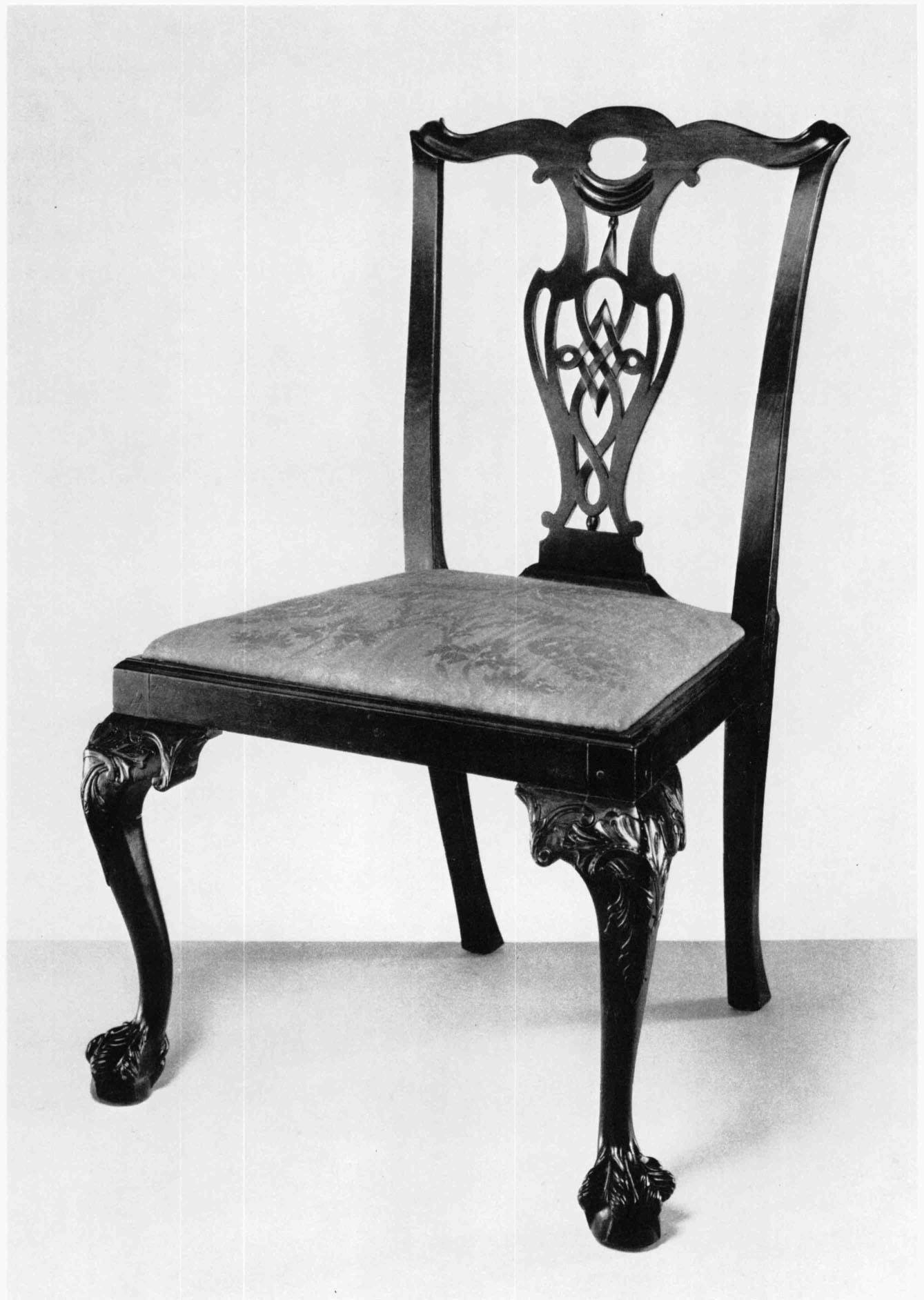
146. Side Chair. Boston area, c. 1760–1780. Mahogany, oak, and cherry; h. 37 inches, w. 21½ inches, d. 17¾ inches. (The Henry Francis du Pont Winterthur Museum.)
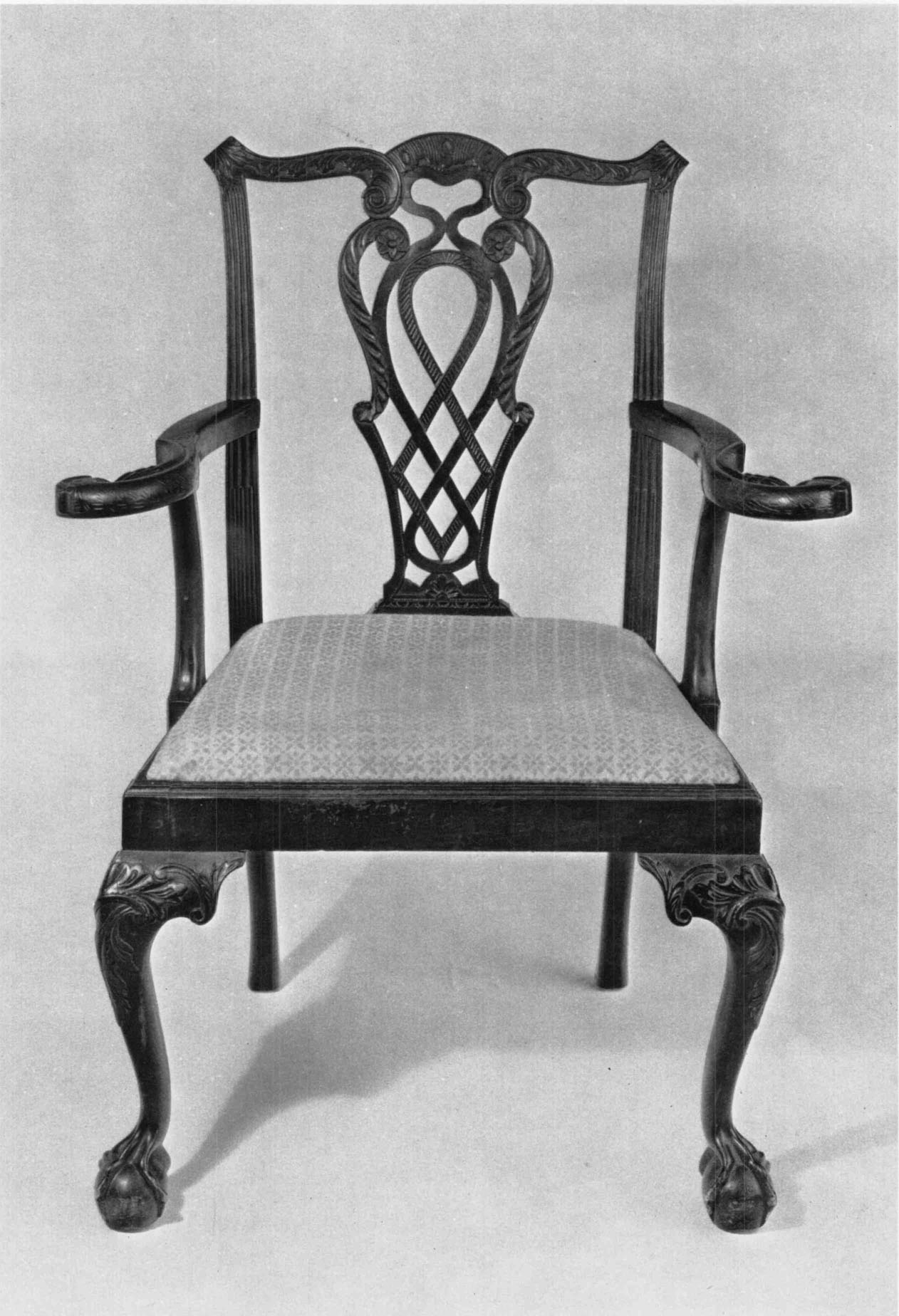
147. Armchair. Boston area, c. 1760–1780. Mahogany and maple; h. 37½ inches, w. 29 inches, d. 19 inches. (Israel Sack, Inc., New York City.) According to family tradition, this chair was owned by Elias Hasket Derby (1739–1799) of Salem.
One of the most important identifiable carvers of pre-Revolutionary Boston was John Welch. Born in 1711, Welch is famed for carving the “Sacred Codfish” for the Hall of Representatives in the Boston State House in 1736. In 1733 he purchased a lot of land forty by eighty feet in Green Lane, or in Green Street, presumably in anticipation of his marriage to the granddaughter of the prosperous carver George Robinson. The association with the Robinson family was an important one for Welch. He may have served an apprenticeship under Robinson. The unfortunate death of Welch’s young wife in 1736 left Welch with a substantial portion of the Robinson estate. In 1738 and 1743 Welch increased his holdings in the Green Street area. He made his home on Green Lane, but from 1733 until 1758 he kept a shop on the town dock, a good location for a man who was probably primarily a ship carver.
In 1758 Isaac Dupee, a ship carver, petitioned to have the use of the “Town’s shop that John Welch occupied.” In the same year Welch advertised the sale of many household possessions because he proposed “to go to England in a short time.” He did travel to England, presumably on business, but returned to Boston about 1760.
The 1789 inventory of Welch’s estate indicates that he was involved in the sale of imported looking glasses. A list of shop goods includes a gilt framed glass, a mahogany framed glass, and four looking glass frames as well as carving tools and “5 ps Carved Work.” The inventory of his personal property lists “A Marble slab and frame” and “2 Busts,” an intriguing reference when one recalls the popularity of carved busts as ornaments for casepieces in Boston in the 1770s and 1780s.
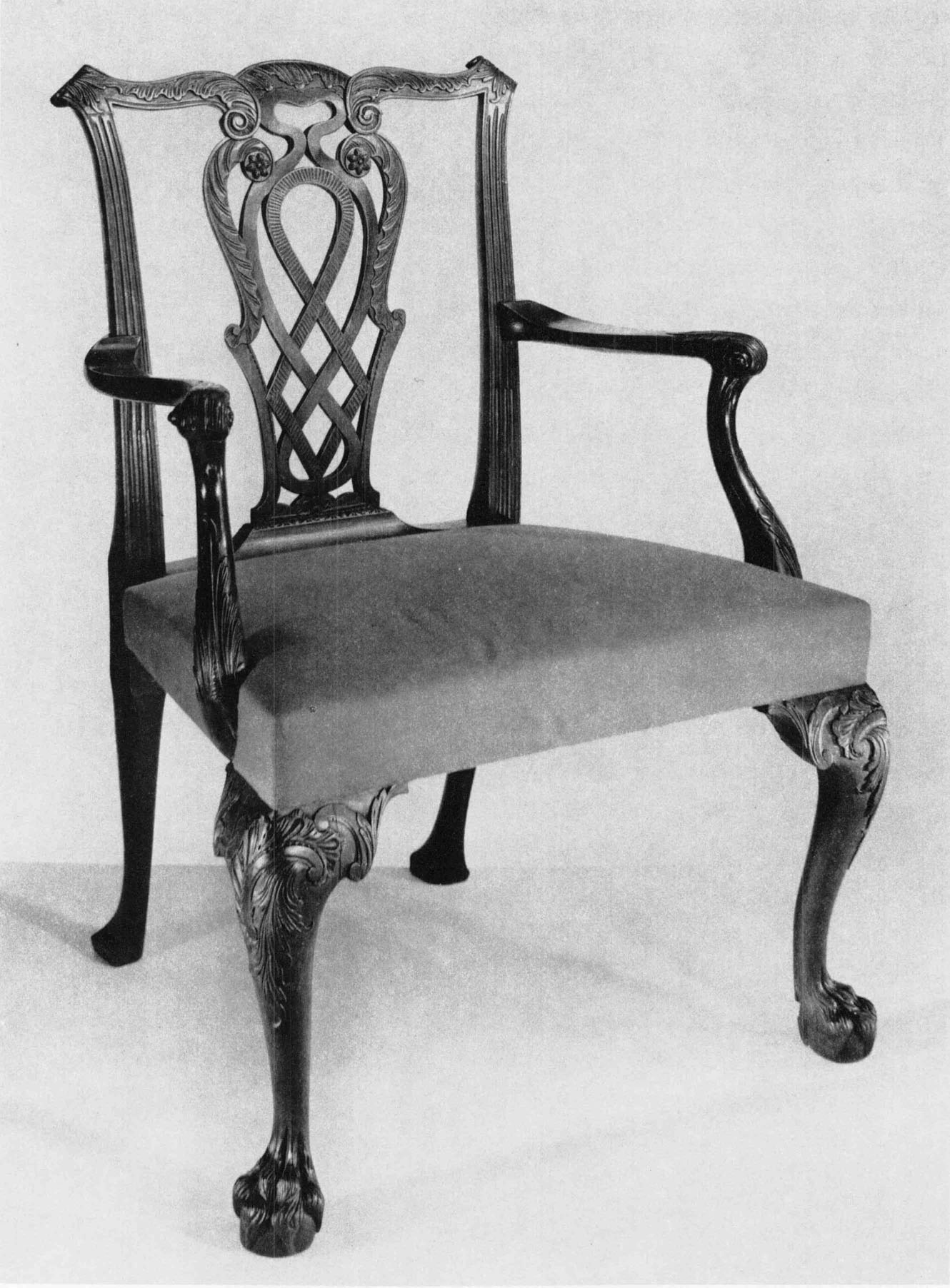
148. Armchair. England, c. 1760–1780. Mahogany and beech; h. 37¼ inches, w. 25½ inches, d. 20½ inches. (The Henry Francis du Pont Winterthur Museum.)
Welch was a very prosperous carver in pre-Revolutionary Boston. The list of his household furniture before the 1758 trip to England included: “Large and Small Sconces, Looking Glasses, Chimney and Dressing Glasses, a very handsome japanned Chest of Drawers and Bureau, a Marble topped table supported by Carved Eagles.” Numerous real estate transactions established Welch as a shrewd businessman. In May, 1774, for example, John Welch bought a lot adjoining his own in Green Lane from John Singleton Copley for £153 and resold it a few weeks later for £253. He also had property in the Bowdoin Square-Sudbury Street area and in 1780 he paid the large tax of £50, more than double the sum paid by any other Boston carver.
Most of the other men designated as carvers in public records seem, like Welch, to have been primarily ship carvers. Joshua Bowles and Thomas Luckis had been keeping shop together along the wharf when their inventory was destroyed by the great fire of 1760. They were also engaged in other aspects of the shipping trade for in addition to the “3 Carved heads and carving tools,” they lost two boat masts, fifteen cod and mackerel lines, and three barrels of flour. A bill from Bowles and Luckis to John Hancock further identifies these carvers as ship carvers. Mr. Hancock was charged £28 for a woman’s head “7 foot long” and £13 more for brackets, a trail board, and two scrolls. By 1780, Joshua Bowles and Thomas Luckis were working separately. At that time Bowles appears to have been slightly more successful, but by Luckis’ death in 1808 he had improved his financial situation and had a house and land on Scotts Court worth $3000.
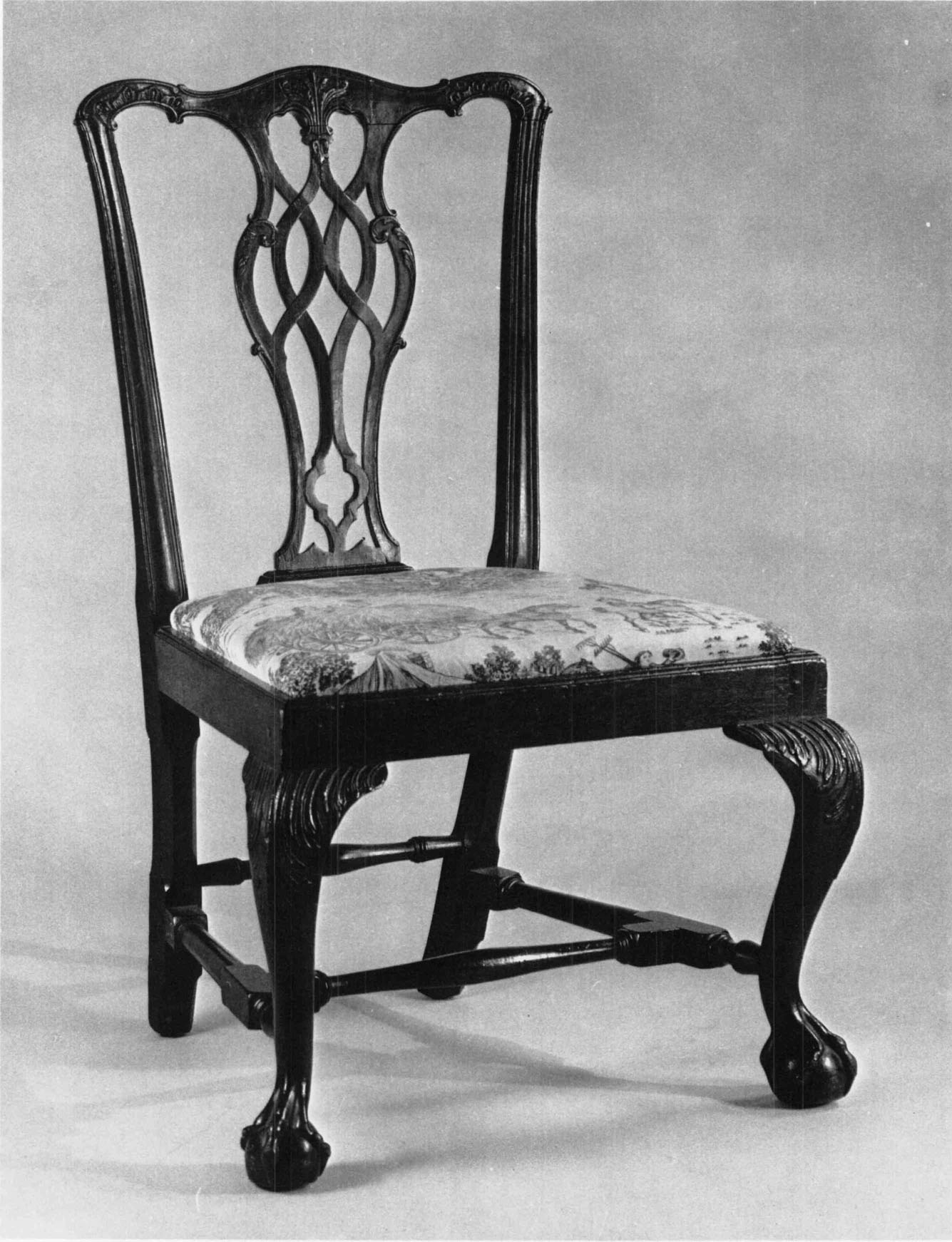
149. Side Chair. Boston, c. 1760–1780. Mahogany, maple, and white pine; h. 37 inches, w. 21⅜ inches, d. 17⅝ inches. (Museum of Fine Arts, Boston, Gift of Mrs. F. Carrington Weems, 60.1176.) This chair descended in the Lane family of Boston. The splat of this chair is an example of splat A.
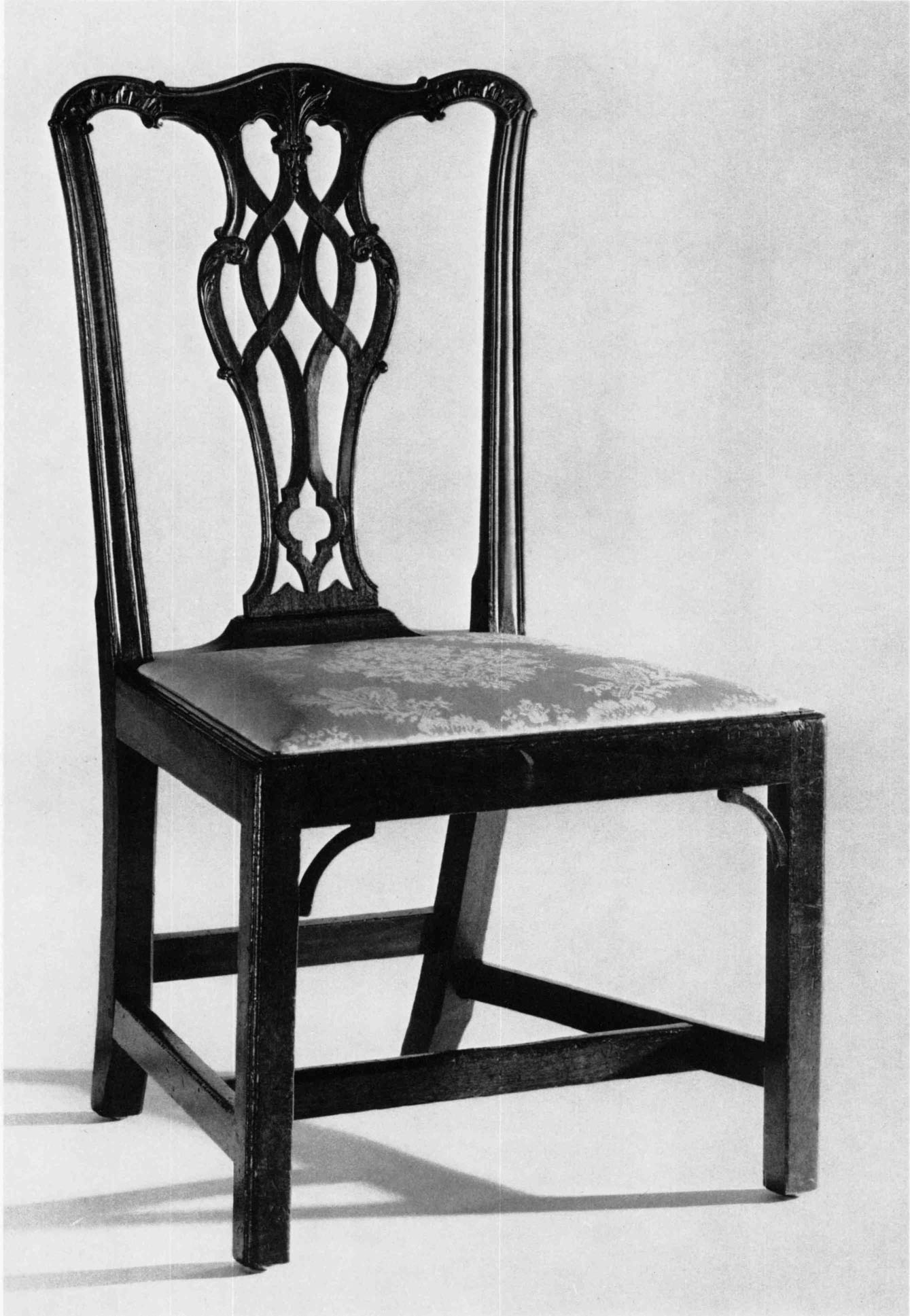
150. Side Chair. Boston area, c. 1760–1780. Mahogany; h. 36¾ inches, w. 21¼ inches, d. 18 inches. (The Henry Francis du Pont Winterthur Museum.) Splat A.
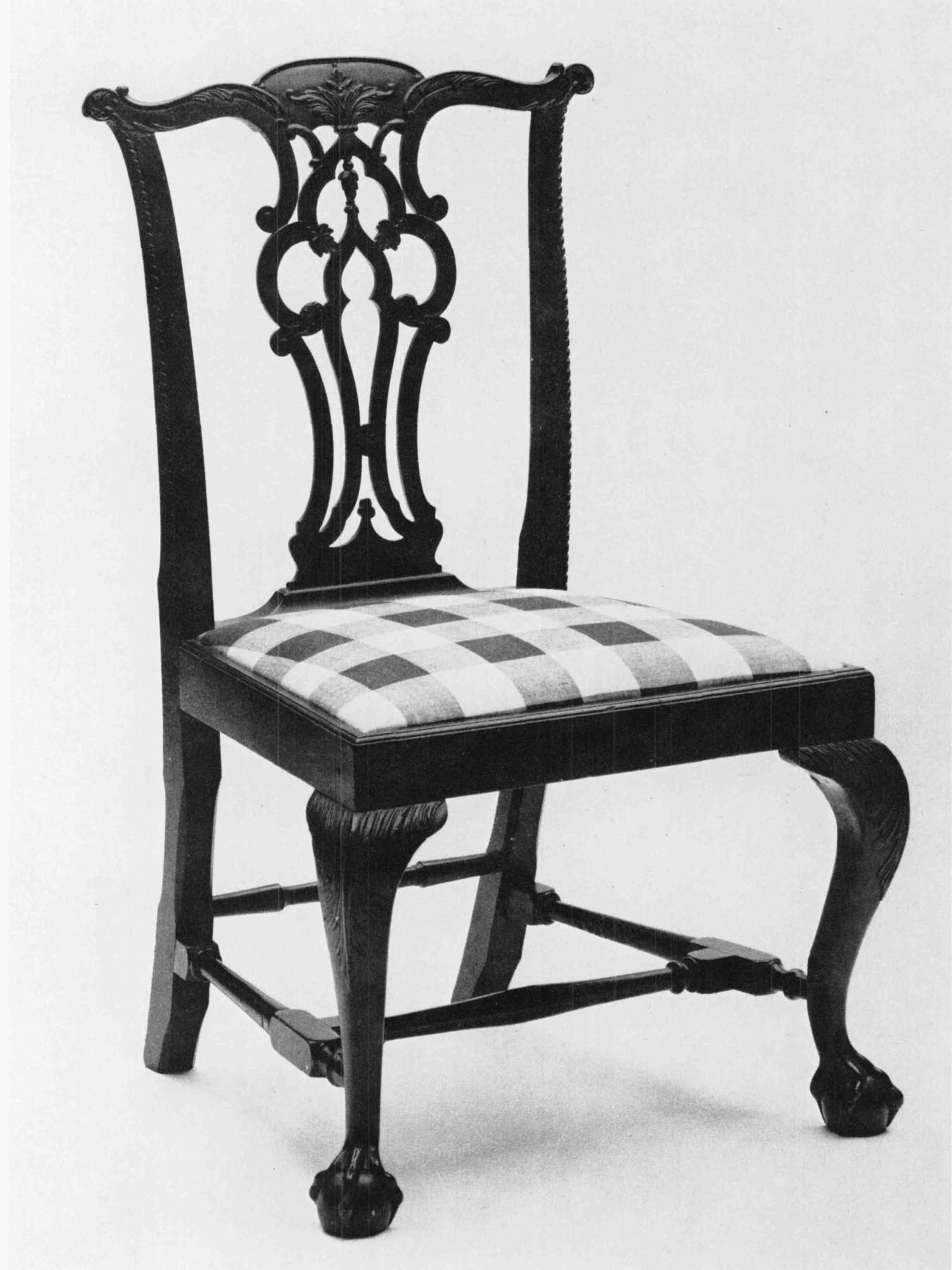
151. Side Chair. Boston, c. 1760–1780. Mahogany; h. 38 inches, w. 23½ inches, d. 19 inches. (The Henry Francis du Pont Winterthur Museum.) This chair descended in the De Wolf family of Boston. The splat of this chair is an example of splat B.
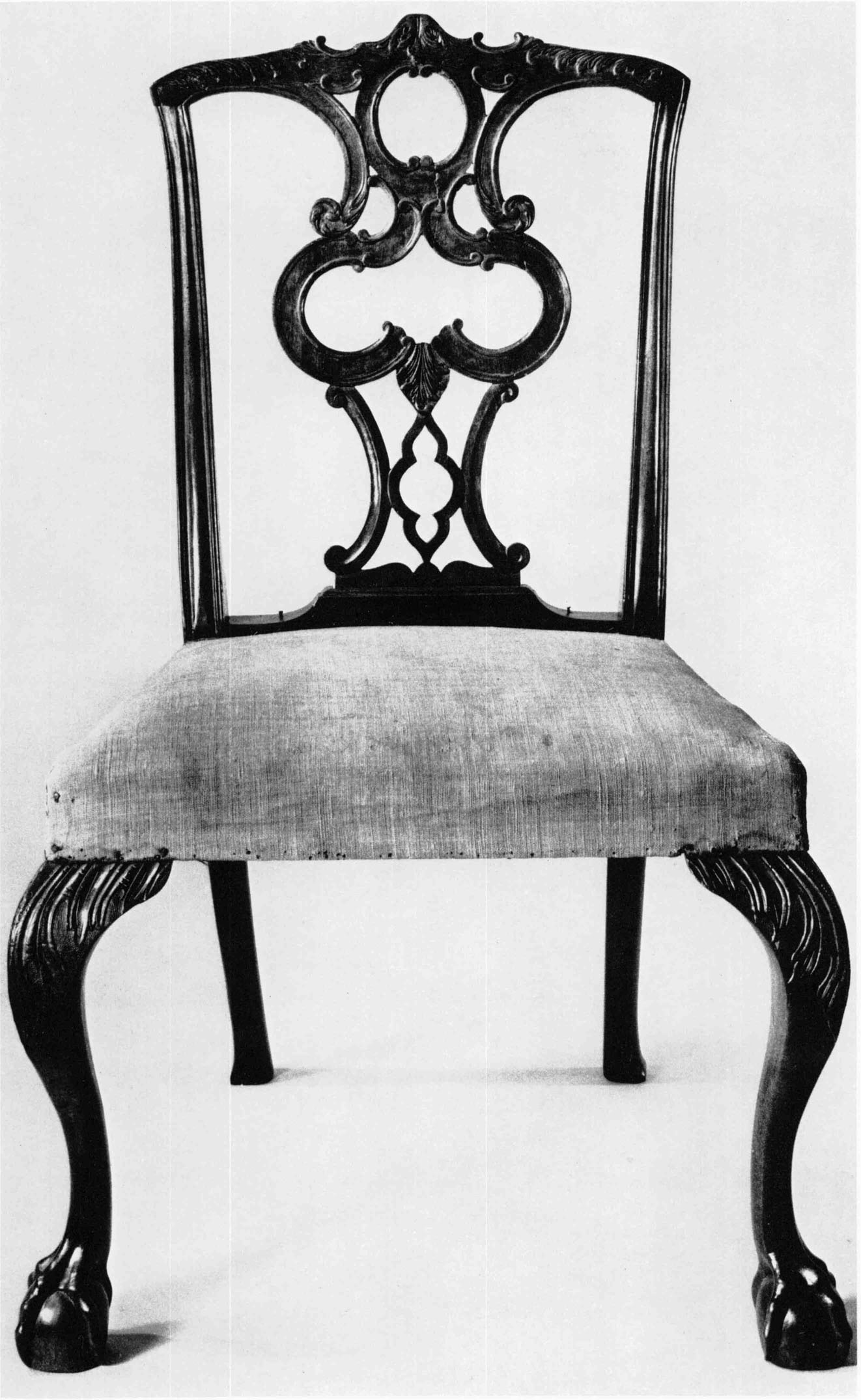
152. Side Chair. Boston or Salem, c. 1760–1780. Mahogany, maple, and white pine; h. 38¼ inches, w. 23⅝ inches, d. 17¾ inches. (Massachusetts Historical Society: photo, Richard Cheek.) Splat C.
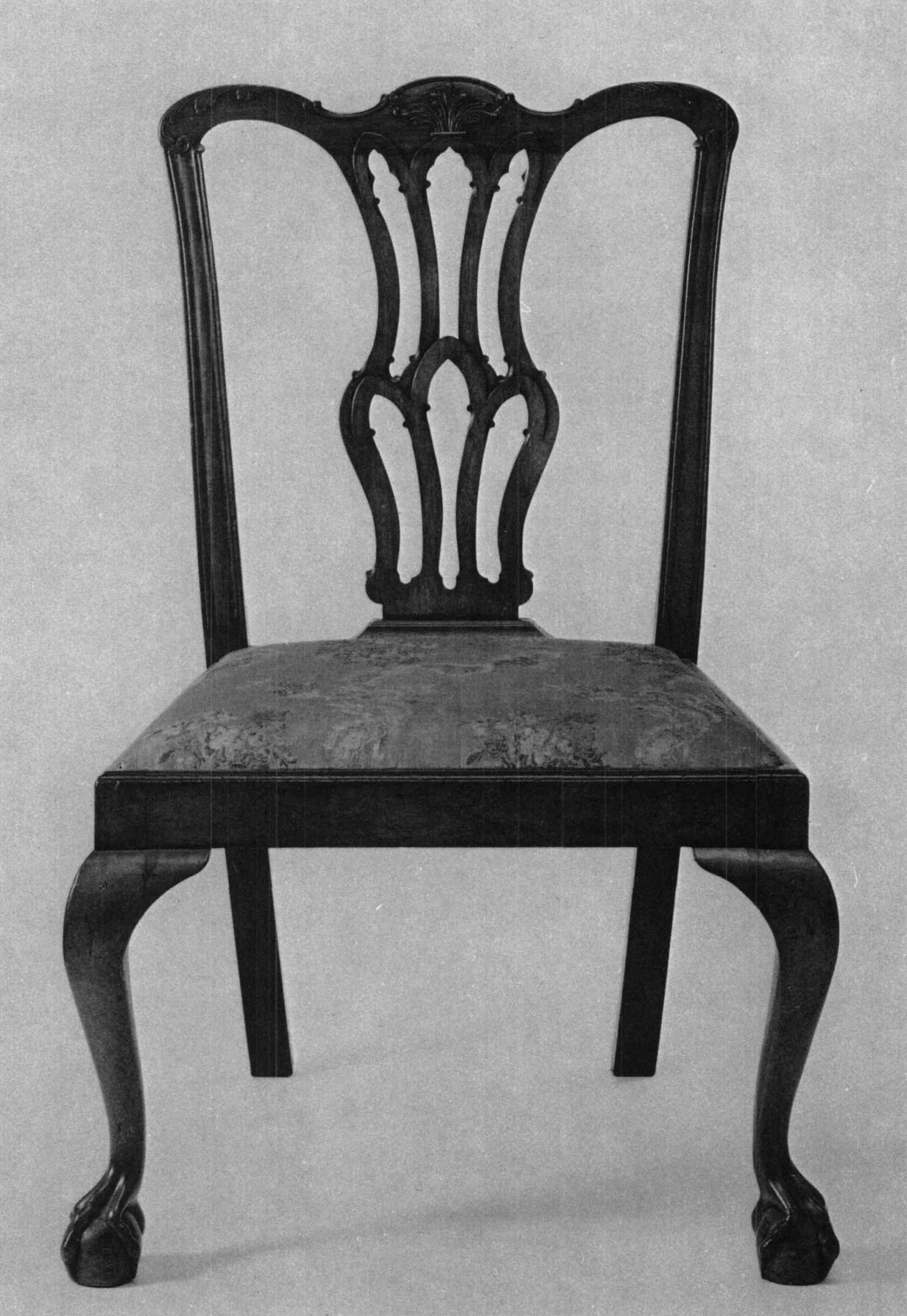
153. Side Chair. Boston, c. 1760–1780. Mahogany, maple, and white pine; h. 38 inches, w. 2215/16 inches, d. 19 inches. (Museum of Fine Arts, Boston, Gift of Mary W. Bartol, John W. Bartol, and Abigail W. Clark, Res. 28.78.) According to family tradition, this chair was owned by James Swan (1754–1830) of Boston and Dorchester. The splat of this chair is an example of splat D.
Another known carver is Simeon Skillin, Sr., who was in business by 1741 in Salutation Alley. Simeon Skillin’s activities as a ship carver are well documented but no evidence has been found to show that he carved for cabinetmakers.
Joshua Bowles, Thomas Luckis, and Simeon Skillin may have sometimes carved furniture for the great Boston cabinetmakers, but probably they did not permanently associate themselves with one particular cabinetmaker.
One prominent Boston cabinetmaker who may have employed carvers is Alexander Edwards. Although little is known about his life, his economic success in the cabinetmaking trade associates him with a high-style, highly decorated type of furniture.
Alexander Edwards’ father, Benjamin Edwards, a mariner, arrived in Boston in 1716 and three years later bought a large piece of property in Back Street. During his thirty-five years in Boston Benjamin Edwards became a successful merchant, owning at the time of his death in 1751 a “Mansion House” with warehouse and wharf worth £800, four other houses in Back Street, Ship Street, and White Bread Alley, and two Negro slaves.
When his father died, Alexander was eighteen years old and still considered a minor. The cabinetmaker Thomas Sherburne, a neighbor, was made his guardian and probably Edwards was apprenticed to Sherburne in the cabinetmaking trade. Upon his maturity Alexander Edwards inherited his father’s Back Street property and set up shop there as a “Gentleman-Cabinetmaker.” He was a patriot and in March, 1777, was appointed to a committee of public safety representingWard 4. In 1780 he was taxed the considerable sum of £120, the same amount as George Bright.
As with the other Boston cabinetmakers, no carver’s name can be linked to Alexander Edwards. The difficulty of associating known carvers with existing carved furniture is compounded by the inability to readily discriminate in documentary sources among furniture, ship, or sign carvers.
This analytical study has attempted to isolate the different styles of the craftsmen who carved Boston furniture during the Chippendale period. Eventually, further study may link these styles with identifiable craftsmen and clarify the relationship between carvers and cabinetmakers.
A Steward of Chinese Artistry
Immersed in antique Chinese paintings for decades, Tony Dai has amassed not just an enviable art collection, but also a profound understanding of his cultural heritage
Tony Dai, an art collector, scholar, and antique dealer, hails from a lineage of esteemed collectors in Shanghai that began during the Qing Dynasty. Raised in an environment steeped in traditional Chinese art and culture, his childhood was filled with echoes of their tales. Across four generations, this passion for paintings has coursed through Dai’s veins, shaping his destiny as a dedicated custodian of Chinese antiquity.
His journey into the world of fine art began at age six when he began to study traditional Chinese calligraphy. Two years later, he received a notable second-place win in a national children’s calligraphy competition. Despite his artistic talent, when faced with a choice between becoming an artist or an art collector, Dai unequivocally embraced the path of an art collector. Reflecting on his first acquisition at the age of 12 (from his allowance money), Dai acknowledges its sentimental value: “While not a lucrative investment, the painting held a personal allure,” he says.
Encouraged by his family, the young man’s formative years were dedicated to the study and appraisal of antiques and paintings. Dai quickly garnered the attention of Shanghai’s art collectors, attracting mentors eager to impart wisdom and showcase rare treasures to him. Filled with such valuable insights, 19-year-old Dai staged his first exhibition in Australia, presenting a curated assembly of renowned Ming and Qing Dynasty artworks alongside 20th-century masterpieces.
Over the years, Dai’s personal collection has grown in value, and so has his expertise and passion for traditional Chinese artwork. In this article, he graciously imparts his expertise in the art of traditional Chinese painting.

Spiritual resonance
Through studying the works of great artists such as the famous Four Monks of the Qing Dynasty and calligraphy virtuoso Wang Xizhi, Dai realized that these works were not just feats of artistry but also a reflection of the inner spirit of their creators. Seeking his spiritual improvement through the meditation practice Falun Dafa, Dai has grown in wisdom and deepened his artistic understanding. “Through my cultivation, I find myself more attuned to the spiritual essence that those master painters sought to convey thousands of years ago,” he says.
One of the artists Dai reveres is Xie He, an important figure in 6th-century Chinese art history, who penned The Record of the Classification of Old Painters. This pivotal work identified six foundational principles of Chinese painting: spirit resonance (or the energy transmitted by the work), the use of the brush, faithful resemblance to the object, specific colouration, composition and planning, and learning from old masters. For He, the spirit resonance represented the most important aspect of artistic excellence.
“To achieve seamless continuity in a painting, a deep mastery of fundamentals is crucial,” Dai says. “The artist must authentically capture the subject’s essence—its ‘spirit resonance’—by deftly wielding the brush and ink to recreate its vivid reality.”
It’s this spirit resonance that breathes life into a painting, enabling it to manifest the subject’s inner spirit through its physical form. This quality serves as a marker distinguishing genuine works from forgeries. “When assessing a painting’s authenticity, the absence of spirit is often a decisive factor. In forged paintings, the spirit lacks coherence, depriving the piece of vitality,” Dai says.

The beauty of nothingness
A distinct feature of traditional Chinese paintings is the deliberate use of vast negative space. The concept of liubai, “leaving blank space,” represents an artful use of negative space, a technique that not only enriches the work’s overall ambiance but also establishes a delicate equilibrium with the filled spaces. Liubai finds its origins in the Taoist philosophy, which reveres emptiness and non-action. As Lao Tzu writes in Tao Te Ching, “All things under Heaven are born from what exists, and what exists is born from emptiness.”

During the Song Dynasty (960–1279), a period known for its pursuit of simplicity and elegance in art, liubai gained prominence and became artfully refined. According to Dai, the piece Angler on a Wintry Lake by Song Dynasty painter Ma Yuan is an exemplary use of the technique. “The painting draws inspiration from a Tang Dynasty verse: ‘In a lone boat, an old man in a straw rain hat and straw raincoat fishes upon the frigid river snow in solitude.’ Except for subtle lines hinting at ripples around the boat, the rest is left unadorned. However, it’s precisely this expansive emptiness that encapsulates the core of solitude and sparks boundless imagination within the vast atmosphere Ma aimed for,” Dai says.
According to him, mastery of the liubai technique necessitates wisdom and a tranquil attitude. In the hustle and bustle of modern life, Dai reminds us that it’s equally crucial to create moments of liubai for the weary soul—a period of emptiness to maintain purity, a respite from restlessness to achieve composure, and a release of tension to navigate life with ease.

Spiritual connection
Often termed as freehand brushwork, the concept of xieyi translates as “writing ideas,” and it’s a distinct genre within traditional Chinese painting. Addressing a common misconception, Dai says that while xieyi may advocate for loose precision in depicting landscapes and figures, it still demands immediate recognition of the subject. “[Ancient Chinese painter] Gu Kaizhi introduced the concept of ‘expression of spirit through form,’ which meant that the portrayal of a subject’s physical appearance should be a conduit to unveiling its inner essence and vitality,” Dai says.
Xieyi served as a means for ancient Chinese intellectuals to articulate their thoughts and aspirations. “Most ancient Chinese painters belonged to the literati class. They were not only adept artists but also accomplished poets, essayists, and politicians. Their paintings were visual representations of their intellect and spiritual realm,” Dai says.
“A xieyi painting should evoke a sense of mental tranquility and offer enlightenment. These are experiences distinct from abstract art, which exerts a strong visual impact,” Dai says.
Human and divine
Ancient Chinese culture often attributed healing properties to exceptional artworks. “A great painting isn’t just aesthetically pleasing. Its virtuous energy holds the potential to benefit viewers in profound ways,” Dai says.

He tells a tale from Chinese history involving Wang Hui, a renowned landscape artist from the early Qing Dynasty. When Hui completed the piece Mountains, Streams, and Autumn Trees, his fellow painter Wang Shimin was so moved that he wanted to acquire it. While Hui refused his offer, Shimin dedicated a poem to the painting, mentioning the miraculous disappearance of a long-standing cough after he gazed at it.
This is in part related to the Taoist teaching of the “unity of Heaven and man,” which holds a vital place in Chinese culture. Everything—heaven, earth, and humanity—was seen as interconnected and part of a unified whole. This unity has profoundly influenced Chinese aesthetics, so much so that artists constantly sought equilibrium between nature and humanity, intertwining natural elements with human emotions and values. That’s why in traditional Chinese painting each stroke carries not just the essence of the subject but the soul of the artist.
In understanding this heritage, Dai emerges as a guiding light, navigating the intricate realm where art, spirituality, and cultural heritage converge. His exploration through the layers of ink and canvas reveals not only the sheer beauty of strokes but also the philosophies embedded within each masterpiece.
As Dai continues to champion the preservation of these invaluable treasures, he inspires an appreciation for the transcendent artistry that resonates through the ages, inviting us to glimpse the soul of ancient China and find connections that rise above borders and time itself.
This story is from Magnifissance Issue 123
From Chinese Porcelain to Delftware | Blue-and-White Ceramics

The blue-and-white ceramics that swept across Europe from the sixteenth to the eighteenth century could be seen as symbols of the cultural and technological cross-fertilization inherent in the arts. Chinese blue-and-white porcelain inspired new tastes and styles, while stimulating the development of more local alternatives throughout Europe in the form of tin-glazed earthenware.
In this article, we explore the origins of Delftware and the influences that reached the Dutch Republic from abroad. These influences proved fundamental to the emergence of ceramics that remain renowned worldwide, more than three centuries after their beginnings.
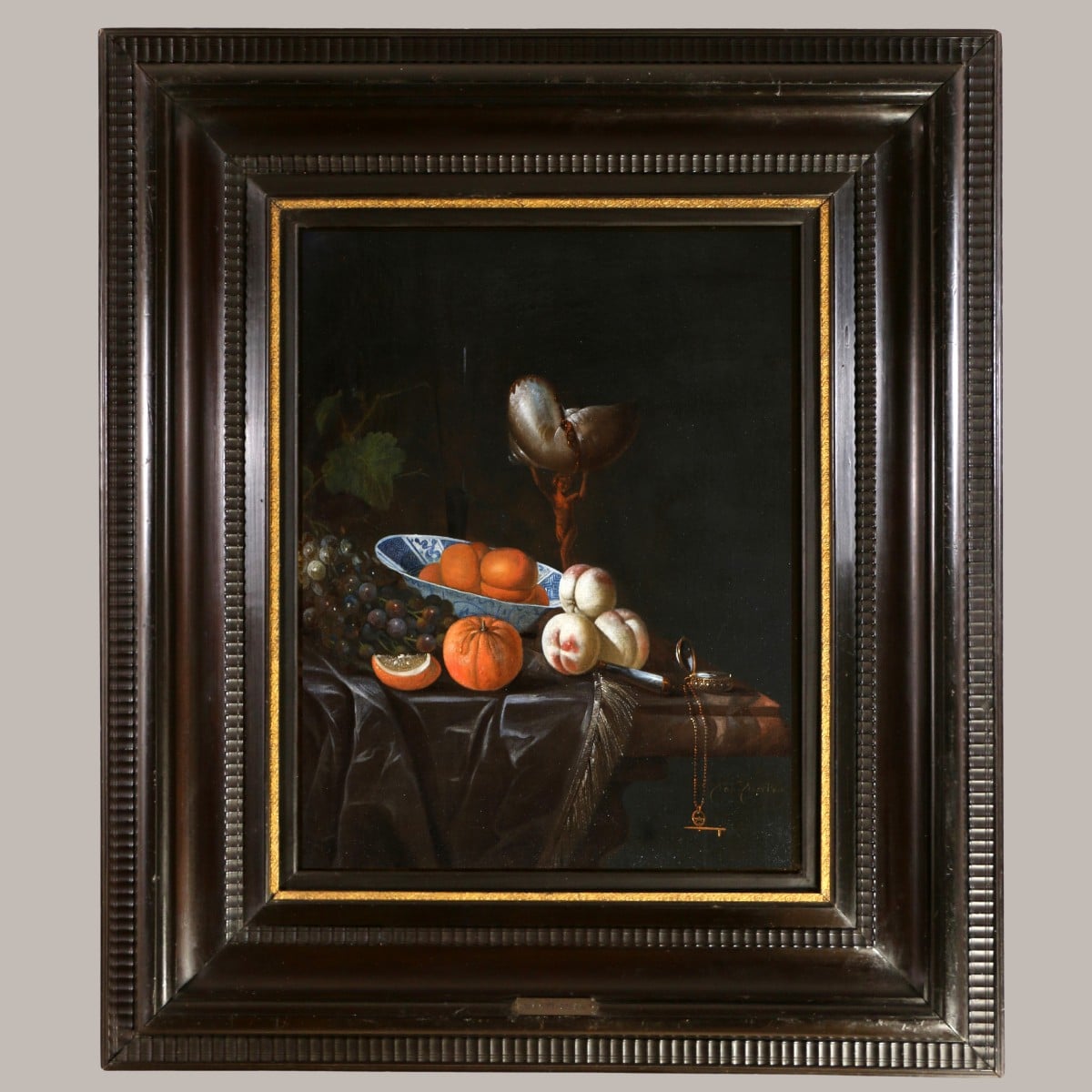
17th-century still life painting by Huybert Van Westhoven (1642-1712). A Kraak porcelain bowl among other expensive goods. © Galerie PhC
In the painting above, a still life evokes the luxury of the Dutch Golden Age, with a piece of Kraak porcelain displayed among other precious objects. Kraak was undoubtedly the most emblematic Chinese export porcelain to reach Europe before Delftware emerged. Yet, to understand the origins of Delftware, we must also consider the various types of porcelain imported through the beginning of the Qing dynasty and identify the major Chinese motifs and forms that captivated the West before being reinterpreted by Delft potters.
Chinese Porcelain Imports: A First Phase Dominated by the Portuguese
The Portuguese were the first Europeans to organize regular imports of Chinese porcelain, expanding this trade from the early 1530s. Lisbon’s Santos Palace (now the French embassy in Portugal) offers a spectacular testimony to the fascination it inspired: its Porcelain Room contains more than 260 Chinese dishes and plates, mostly sixteenth- and early-seventeenth-century blue-and-white wares, displayed across a gilded pyramidal ceiling.
Much of the porcelain reaching Europe came from the kilns of Jingdezhen and was made for export, tailored to foreign tastes. Europeans particularly admired the contrast between its luminous cobalt decoration and its fine, lightweight body: a milky white material, subtly tinged with green beneath a remarkably smooth and brilliant glaze.
First Orders and European Tastes
From around 1514, during the reign of the Ming emperor Zhengde (1506–1521), the Portuguese became the first Europeans to commission porcelain from Jingdezhen. Made for Manuel I and noble families, these rare blue-and-white vessels combine Chinese forms and motifs with Portuguese coats of arms, Christian emblems and the king’s armillary sphere. Ewers and dishes in the Medeiros e Almeida collection offer some of the earliest surviving evidence of this artistic exchange.
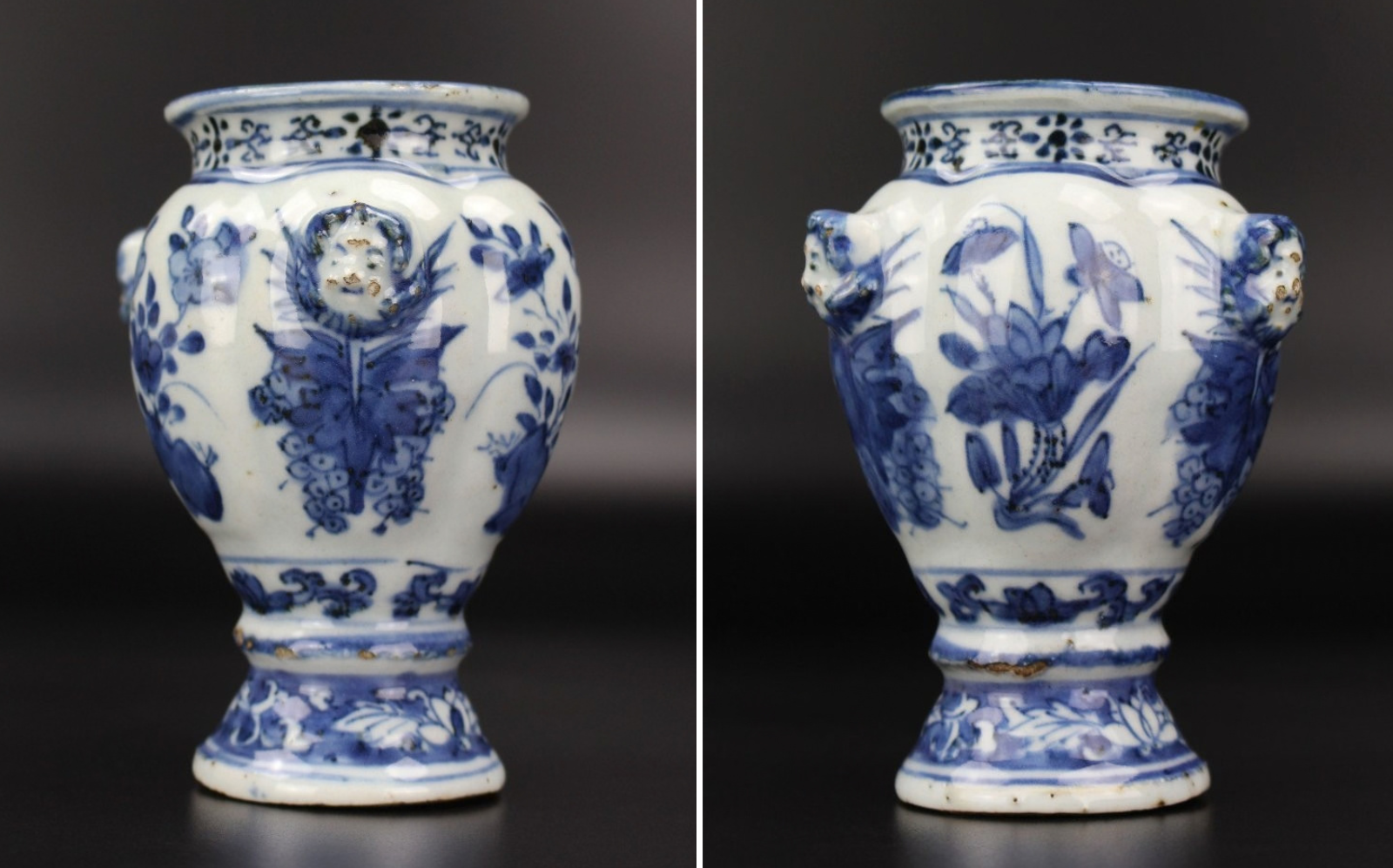
The pairing of angels with grape motifs further suggests a Eucharistic theme, likely for the Portuguese Jesuit market. This Chinese blue-and-white jar was probably made circa 1610-1630. © Menken Works of Art
Such adaptations continued as other European nations entered the trade, with vessels tailored to European uses, often following silverware models, and decoration incorporating Western imagery. The vase illustrated here, circa 1610–1630, probably made for Portuguese Jesuits, combines relief cherub heads and grapevines with Chinese floral and lotus motifs. It exemplifies the cultural hybridization of export porcelain, shaped by European demand and Chinese craftsmanship.
A Rich Decorative Repertoire: Zhengde, Jiajing, and Longqing Porcelain
Large export dishes associated with the Zhengde period (1506–1521) typically have thick white porcelain bodies and a slightly bluish glaze. Dense decoration surrounds a central subject with floral scrolls, separated by double blue lines. Pierced rocks, flowering plants, qilin, and winged sea dragons (feiyu) feature prominently, painted in dark to grayish blues with precise outlines.
Production under Jiajing (1522–1566) was exceptionally varied and inventive. Daoist beliefs encouraged imagery associated with longevity and immortality: deer, cranes, peaches, pine trees, lingzhi fungi, and the character shou. Borders frequently alternated flowers, fruit, and ribbon-tied auspicious emblems, while archaic chi dragons, lions, birds, insects, and flowering branches enriched the repertoire.
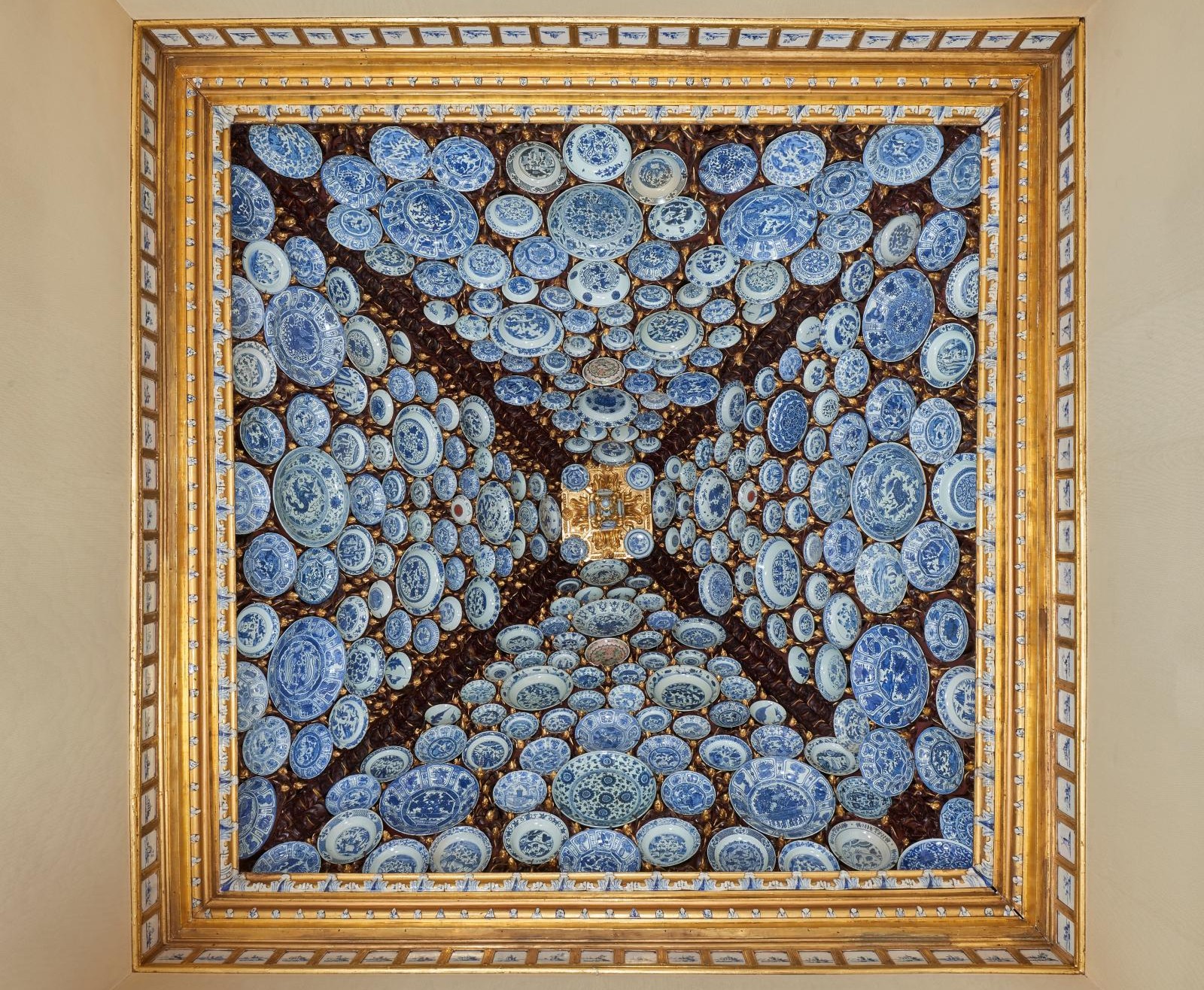
The 261 plates and dishes lining the pyramidal ceiling of the Porcelain Room at Santos Palace in Lisbon form an exceptional collection in Europe for its size and the period represented. Its many early export pieces have deepened our understanding of the Zhengde, Jiajing, and Longqing porcelains that reached Europe. © MNAAG, Paris/Thierry Ollivier, 2018
Most significantly, new marine and lakeside landscapes emerged. Islands, waterways, and rocky shores were populated with pavilions, pagodas, bridges, boats, fishermen, and waterbirds, offering schematic yet picturesque glimpses of Chinese nature, architecture, and everyday life. Produced in numerous variations, these scenes appear to have enjoyed considerable success among foreign buyers. Deep blues, sometimes with a violet cast, contrasted with lighter washes and firm, dark outlines.
The short Longqing reign (1567–1572) continued Jiajing styles while increasingly organizing decoration into medallions, lobed cartouches, and distinct panels—a transition toward the compartmentalized compositions of early Wanli export porcelain and kraak ware.
When the Dutch Took Over the Chinese Porcelain Imports
Imports increased dramatically after Dutch merchants entered the trade and the Vereenigde Oost-Indische Compagnie (VOC), i.e., the Dutch East India Company, was founded in 1602. Following the Dutch capture of Portuguese carracks loaded with Chinese porcelain in 1602 and 1603, and the resounding success of the auctions held in the budding Dutch Republic—particularly that of 1604—, the VOC developed the porcelain trade on a scale far beyond anything seen before.
Kraak Porcelain
Produced at Jingdezhen during the late Ming dynasty, chiefly from the Wanli reign (1573–1620) to that of Chongzhen (1628–1644), Kraak porcelain dominated Chinese exports until around 1635. Its name probably derives from the Portuguese carraca, the merchant ships that first carried it to Europe, but it became more closely associated with the Dutch as trade expanded dramatically under their auspices.
Kraak was not a single, unchanging style. Its light, highly vitrified body, thin edges, lobed rims and molded divisions distinguish it from earlier export porcelain. Its brilliant glaze often flakes at the rim, producing a “moth-eaten edge.” The cobalt decoration was organized around a central medallion and radial compartments covering the well and rim.

17th-century Kraak porcelain bowl with a diameter of 35.4 cm. Central medallion with two birds among peonies. Radial panels with chrysanthemums, peaches, lozenge with ribbon. © Galerie Drake
In the earliest Kraak designs, the radial panels are contiguous and separated only by single or double lines. Traditional subjects—deer, birds, insects and landscapes—remain prominent in the central medallion, while the surrounding compartments contain finely painted flowers, fruit and auspicious emblems. Narrow bands were gradually inserted between the broader panels, establishing the alternating rhythm that became one of the most recognizable features of Kraak porcelain.
As the formula developed, the divisions became more elaborate. Geometric designs increasingly surrounded the central medallion and filled the narrow bands, while the broader panels were sometimes enclosed within lobed cartouches. Auspicious and symbolic objects, initially confined to the border, began to appear as principal subjects alongside women in gardens, flower baskets, birds and landscapes. Quality varied considerably: the finest dishes have precise drawing and brilliant, subtly modulated blues, whereas mass production encouraged hurried execution, grayish cobalt and increasingly careless secondary decoration.
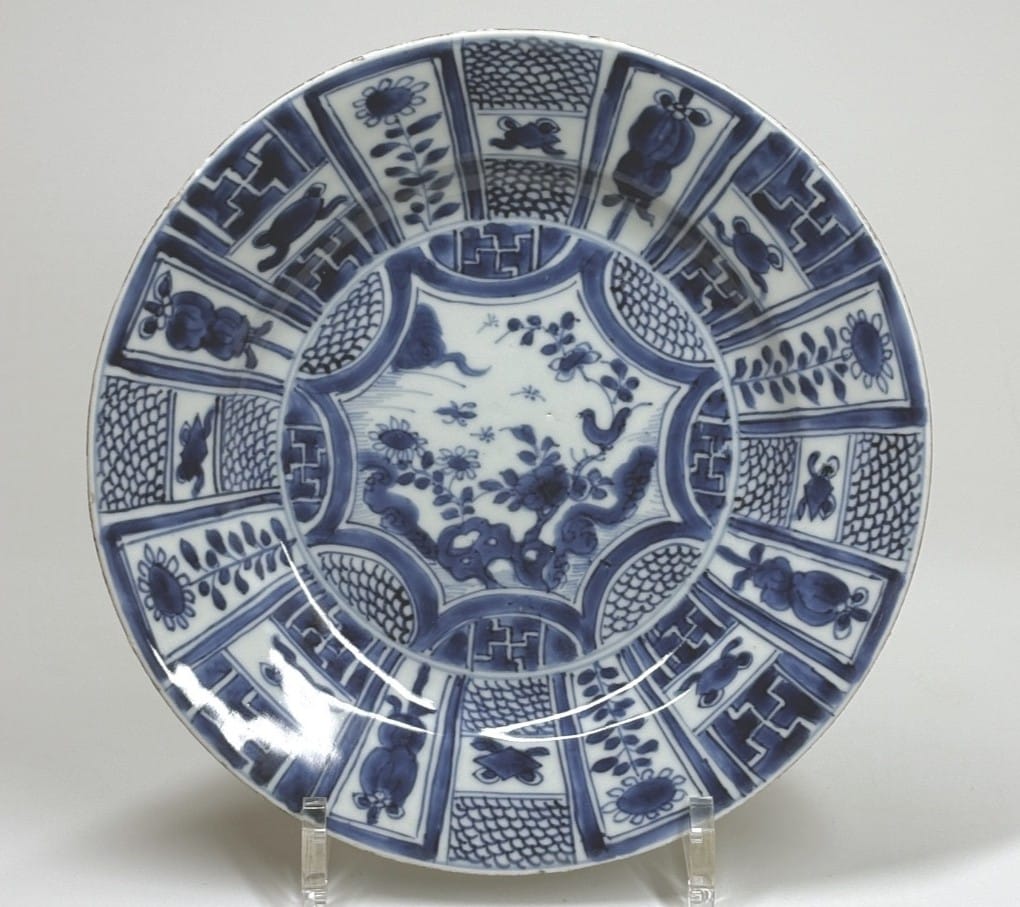
Prominent geometric patterns on this 17th-century Kraak porcelain plate (circa 1660). The center is emphasized by its star shape. © Bils Céramiques
In later examples, the radial compartments evolved into fruit-shaped medallions, particularly peaches. These were arranged around an increasingly angular central field that eventually assumed a star-like form. Larger dishes generally retained more complex geometric borders and finer painting, while smaller examples were often simpler and more rapidly executed. Abundantly represented in northern European collections and shipwreck cargoes, this adaptable system of a central image framed by radiating compartments became one of the principal models imitated by European potters.
Transitional Porcelain
Following the death of the Wanli Emperor in 1620, China entered a prolonged period of rebellion and dynastic conflict. As imperial patronage declined, skilled potters and painters increasingly worked for private kilns at Jingdezhen, serving domestic and foreign clients. This greater freedom encouraged the new forms and decoration now known as Transitional porcelain.
Rigid Kraak-style panels gave way to continuous landscapes and narrative scenes, sometimes inspired by illustrations in Chinese books. Scholars, horsemen, and attendants appeared among rocks, fences, terraces, and pavilions, surrounded by grasses, ferns, palms, and elongated flowering plants. Some romance scenes as well.
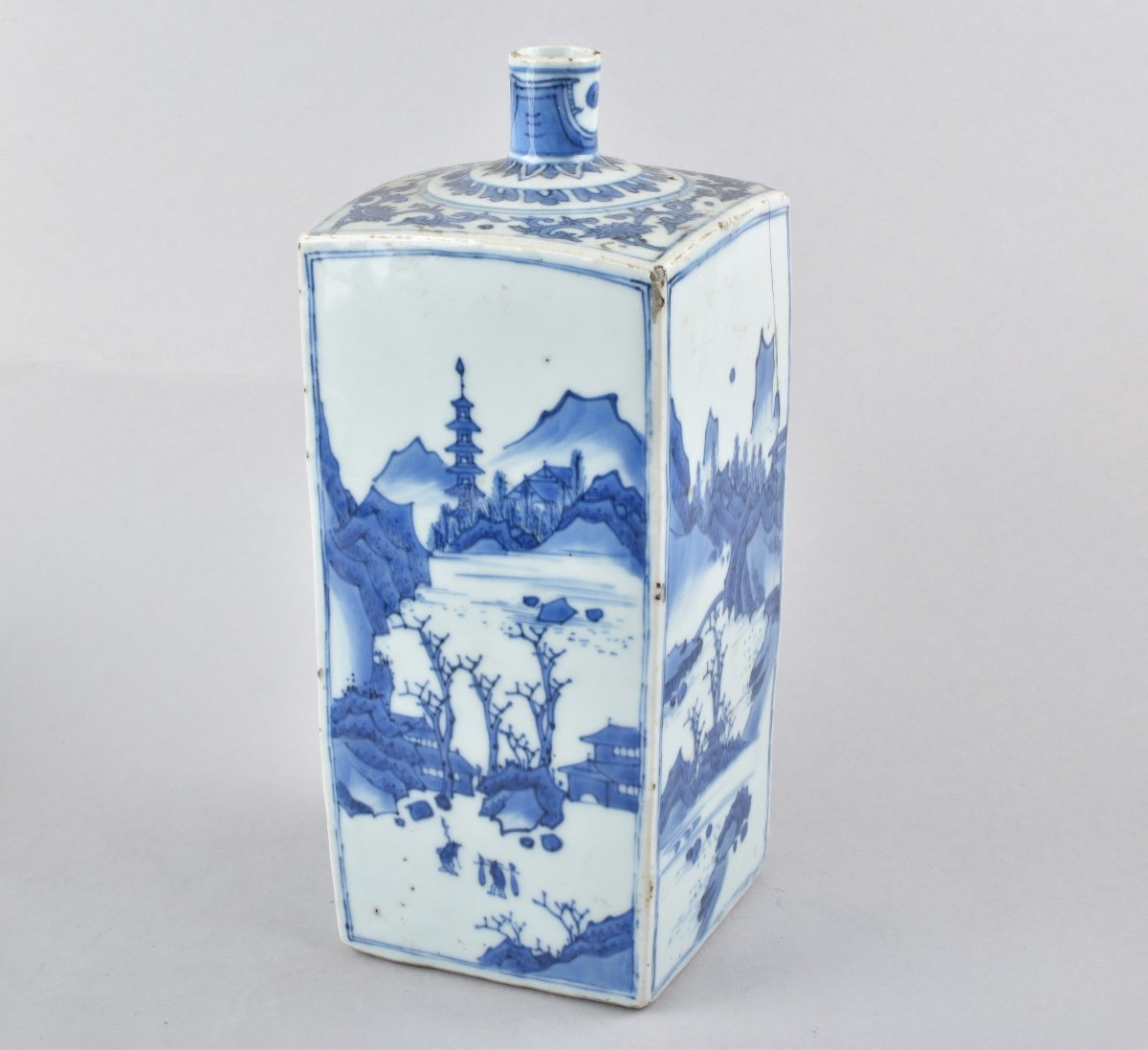
A Chinese blue-and-white porcelain bottle vase decorated with landscapes. From the Transitional period, circa 1630-1640. © Galerie Porcelaine des Compagnie des Indes
The Manchu conquest established the Qing dynasty in 1644, although resistance continued for decades. Warfare disrupted Jingdezhen and its supply routes, bringing regular VOC imports of Chinese porcelain almost to a halt from the late 1640s. Trade recovered only around 1680.
The Dutch Reaction to the Ming Dynasty Collapse
Find Another Source of Porcelain: Japan
When civil war disrupted Chinese porcelain exports, the VOC turned to Japan. Following the invasions of Korea in the 1590s, Korean potters had settled in Kyushu, where suitable porcelain stone was discovered near Arita. Their expertise laid the foundations of Japanese porcelain production. Meanwhile, the Portuguese were expelled from Japan in 1639, and the Dutch trading post was transferred to Dejima in 1641.
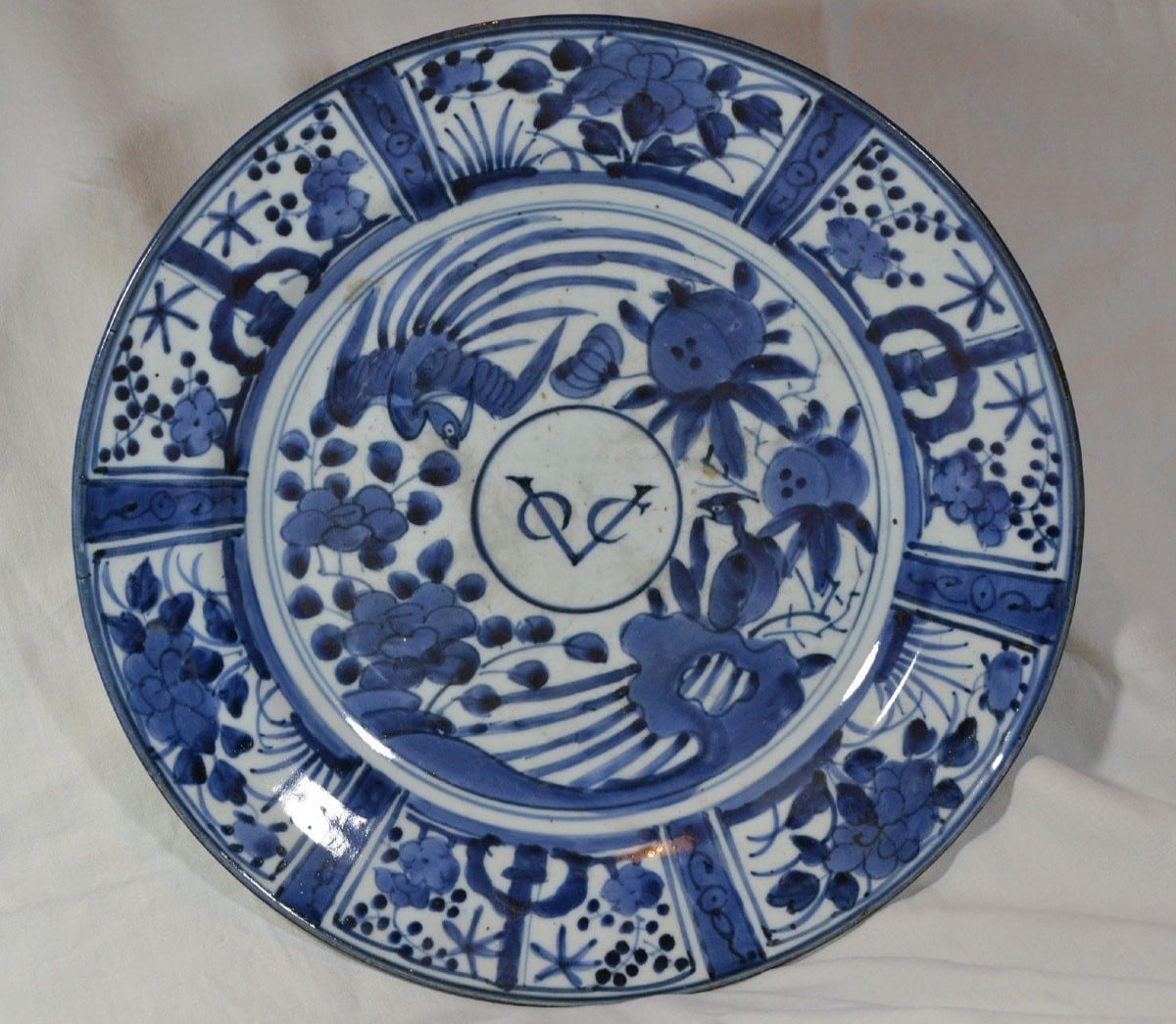
Late 17th-century Arita porcelain charger inspired by Chinese Kraak porcelain. Such dishes with the VOC mark were for high-ranking staff of the Dutch Vereenigde Oostindische Compagnie. © Conservatoire Sakura
From the 1650s, the VOC exported Arita porcelain in increasing quantities. Early wares imitated Chinese Kraak and Transitional designs, generally with softer blue and freer brushwork, before distinctively Japanese polychrome styles such as Kakiemon and Imari emerged. For more, see our article on The Ceramics of Hizen Province. When Chinese exports resumed in the 1680s, cheaper Jingdezhen porcelain again offered fierce competition.
Producing New Ceramics with Italian Technology: Delftware
European demand for porcelain far exceeded imports, yet its manufacture remained a mystery. Even the Medici workshop’s experimental soft-paste porcelain, developed in Florence around 1575, was costly and short-lived. If Europeans could not reproduce porcelain’s fine white body, however, they could imitate its appearance.
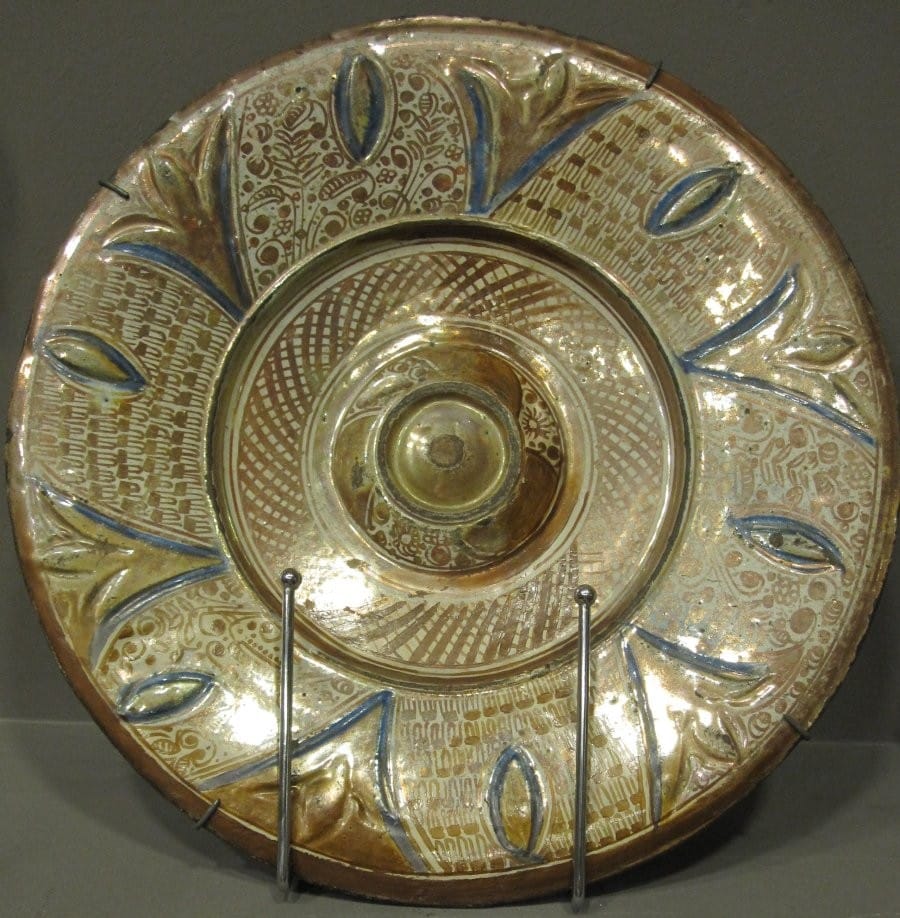
This 16th-century Hispano-Moresque lustreware dish features a raised central boss. The broad rim is decorated with foliage highlighted in blue against a background strewn with alternating solfas and tiny flowers. © Martin Villena Librero & Anticuario
The solution was maiolica: earthenware coated with an opaque white tin glaze, upon which colourful decoration could be painted. Developed in the Islamic world and transmitted to Italy through Hispano-Moresque pottery, the technique travelled north with Italian craftsmen.
Around 1508, Guido di Savino—later known as Guido Andries—settled in Antwerp and established an influential workshop. Antwerp subsequently became a centre from which this expertise spread to the Northern Netherlands, England, and Germany, laying the technological foundations for Delftware.

Polychrome majolica floor tiles of the type found at Herkenrode Abbey, made in Guido Andries’s Den Salm workshop, c. 1530–1540. © Mazereeuw Antiquair
Delftware: The Basics
The original aim of the pottery produced in Delft—in the province of Holland, within the young Dutch Republic—was to create the illusion of Chinese porcelain. The name of the first workshop, established by Herman Pietersz in 1598, perfectly illustrates this ambition: De Porceleyne Schotel (The Porcelain Dish).
Delftware reached its golden age in the late seventeenth century, particularly around 1680, although the period may be defined more broadly as extending from about 1640 to 1740. Delftware began as a blue-and-white ceramic tradition, and the vast majority of pieces remained so. Some, however, were left entirely white and became known as Delft Wits. From around 1670, green, yellow and brick red were added to the decorative palette.
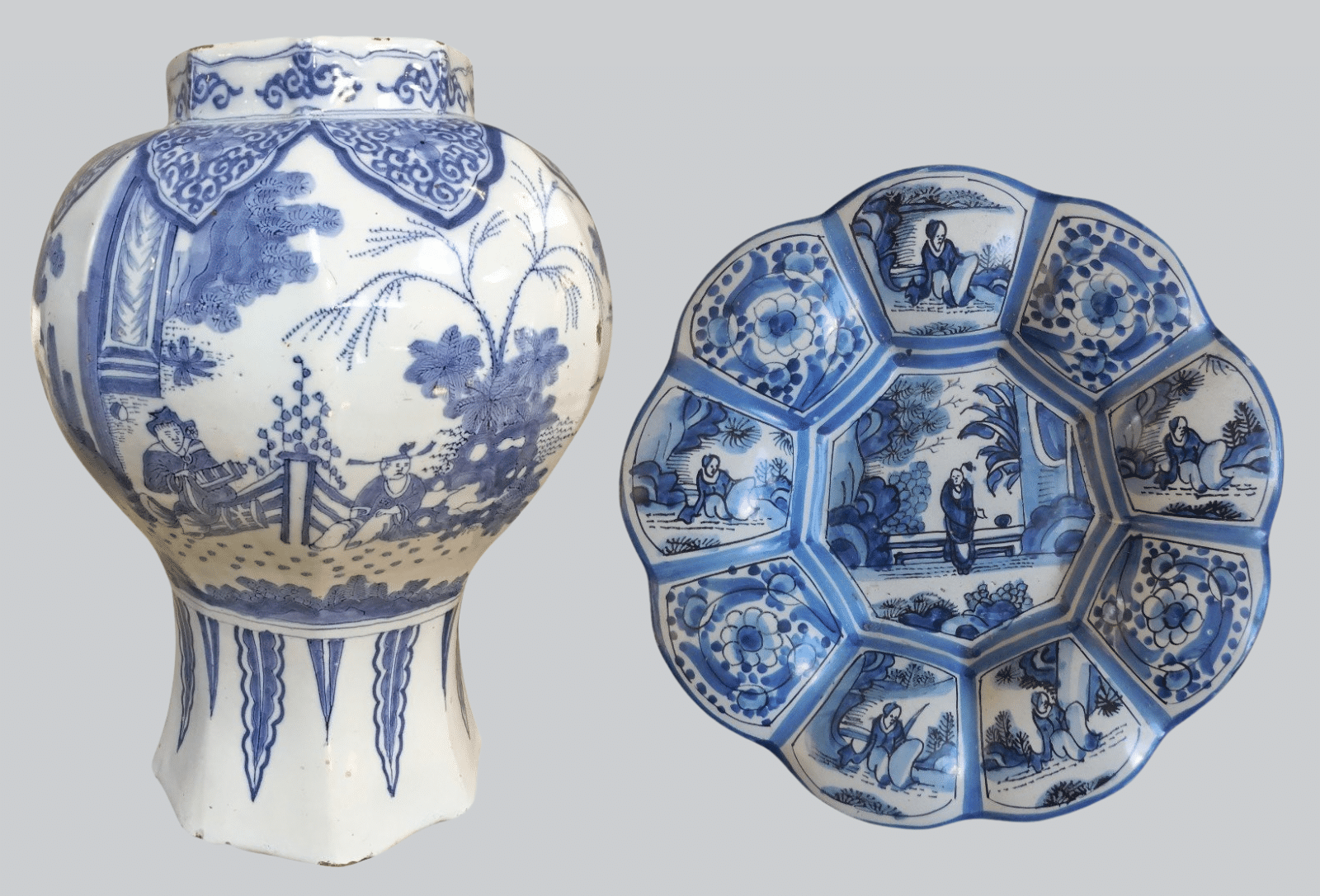
Two examples of Delft chinoiserie ceramics from the 17th century: a baluster vase (© Mazereeuw Antiquair) and a plate (© Galerie L’Héritage) that illustrate the range of blue tones and brushwork.
Technically, Delftware owed its fame to a thin, finely made earthenware body covered with an opaque white tin glaze. On finer pieces, an additional transparent lead glaze, known as kwaart, was applied before a second firing to enhance the brilliance and imitate porcelain’s glossy finish.
Cobalt-blue decoration, painted onto the unfired glaze, further enhanced this porcelain-like effect. Rather than using a single flat blue, Delft painters combined dark outlines—the trek—with paler washes and intermediate tones to suggest volume, distance, and shadow. Early pieces often display soft lavender-blue hues, while deeper blues became more common towards the end of the 17th century.
What Delftware Borrowed From Chinese Porcelain
As noted earlier, the porcelain imported from China was adapted to European markets. Nevertheless, Chinese forms and motifs remained essential to its appeal. Delftware did more than imitate the physical appearance of porcelain: it also drew extensively on the Chinese iconographic repertoire, even though many pieces remained firmly rooted in Western decorative traditions.
Our purpose here is not to explore the broader history of chinoiserie, which is far richer than the simple copying of Chinese designs. But we draw on the porcelain styles discussed above to identify the main decorative elements that caught European eyes and were adopted by Delft potters.
Motifs That Instantly Evoke China
Europeans adopted not only Chinese motifs but also their arrangement into medallions, radiating panels, reserves or continuous scenes.
Ruyi and Lingzhi
Among the most recurring ornaments was the ruyi head, derived from the curved end of a ceremonial sceptre whose name evokes the fulfilment of wishes. Its shape was closely associated with the lingzhi, the sacred fungus believed to confer longevity or immortality. Both motifs frequently appear amid stylized clouds, sometimes becoming almost indistinguishable from them. Detached from their original meaning, their sinuous outlines became a familiar element of chinoiserie decoration.
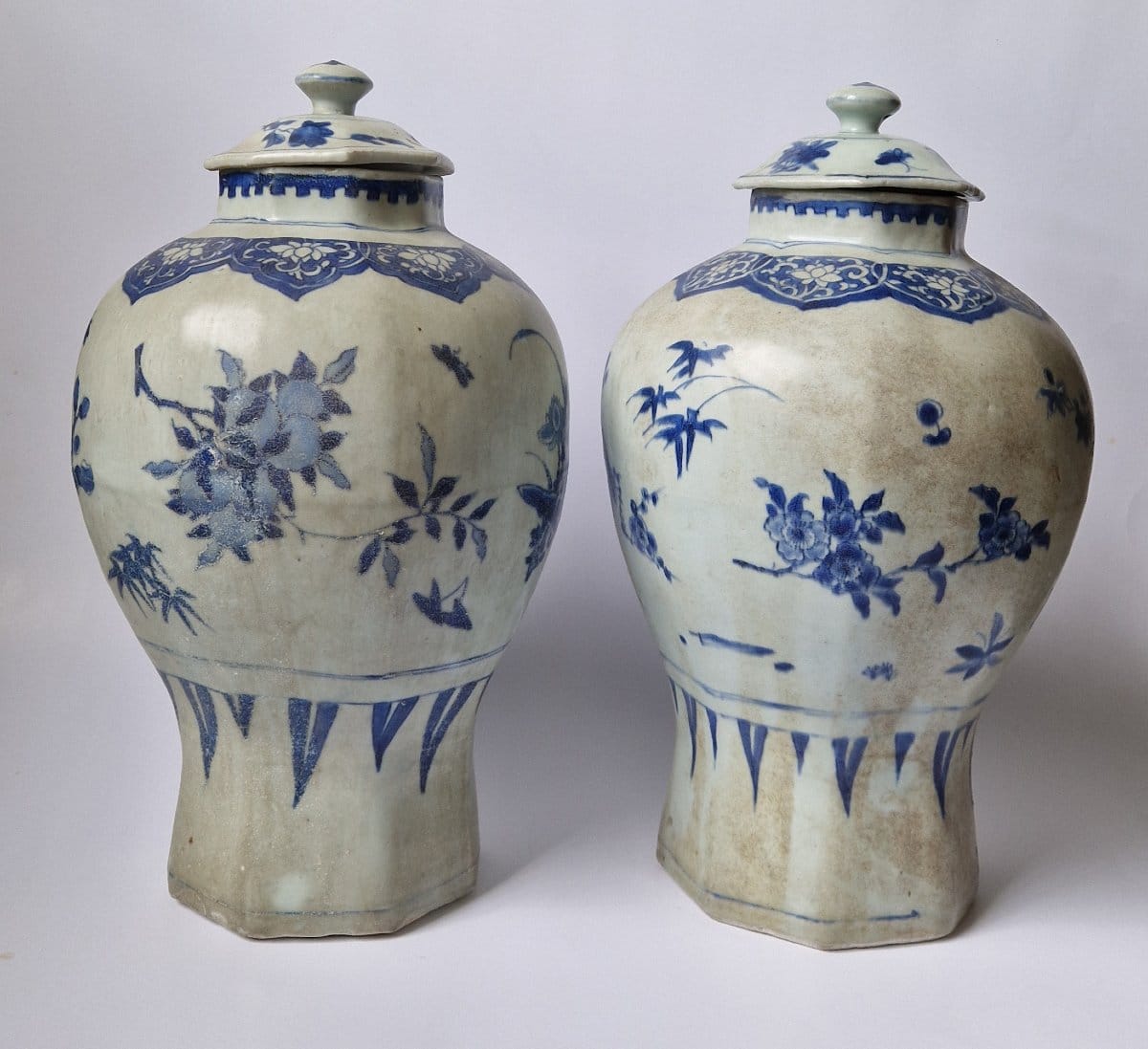
Note the two types of borders on this Transitional-style porcelain: a band of ruyi heads around the top of the neck and, below, a border of pendant banana leaves framing the principal decoration. This pair of blue-and-white covered jars is from the Hatcher cargo found in 1983. The shipwreck happened around 1643-1646 near the waters of Batavia. © Red Rose Fine Art
Symbols and Objects
The “Hundred Antiques” (bogu) brought together ancient bronzes, vases, books, scrolls and scholars’ objects, reflecting the antiquarian culture epitomized by catalogues such as the Xuanhe Bogu Tulu. These arrangements could be combined with Buddhist and Daoist emblems, particularly the Eight Auspicious Symbols (bajixiang): the wheel, conch shell, parasol, victory banner, lotus, paired fish, treasure vase and endless knot. Such motifs appeared frequently on export porcelain, including Kraak wares.
They should not be confused with the Eight Precious Objects (babao), whose composition varied. On Ming porcelain, they commonly included the flaming pearl, double lozenge, stone chime, pair of rhinoceros horns, paired coins, gold or silver ingot, coral branch and ruyi sceptre.
Often tied with fluttering ribbons and separated by flowers or clouds, these objects appealed to Western decorators primarily for their ornamental qualities. Their symbolism was generally misunderstood, and Delftware chinoiseries consequently combined elements from bogu, bajixiang and babao with considerable freedom.
Landscapes and Nature
Chinese porcelain introduced European decorators to a distinctive landscape vocabulary: pagodas and pavilions, fantastic rocks, waterfalls, figures crossing bridges, and sampans or junks navigating rivers, lakes and coastal waters. Buildings in the foreground were often partly concealed behind rocks or clouds, creating successive layers of scenery. Flowers—including chrysanthemums, lotus, peonies and camellias—were equally prominent, whether arranged in gardens, vases or ornamental borders.
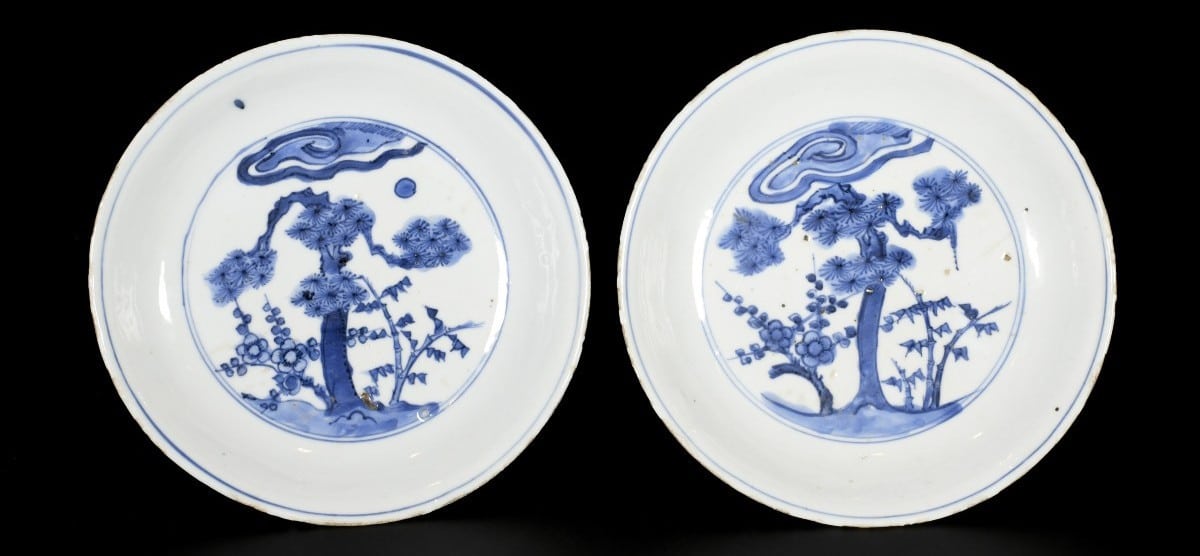
“Three Friends of Winter” on this pair of saucers from the Wanli period (1573-1620). © Galerie Drake
Certain plants carried particular symbolic importance. The “Three Friends of Winter”—pine, bamboo and flowering prunus—represented perseverance and resilience. The peach tree, especially when shown with a gnarled trunk, symbolized longevity, while its fruit was frequently combined with flowers and auspicious emblems. Banana plants, with their broad leaves, also became a favourite feature: their foliage could frame a scene or form a border and appeared unmistakably exotic to European eyes.
The animal world was equally rich. Deer, monkeys, hares, herons, cranes, ducks, fish, bats and tortoises appeared alongside imaginary creatures such as dragons, phoenixes, qilin and Buddhist guardian lions. Although each possessed specific associations—deer, for example, were linked to longevity and believed able to locate the sacred lingzhi—European painters generally retained their visual appeal while freely altering, combining or misunderstanding their meanings.
Iconic Chinese Vase Shapes
European potters repeatedly borrowed the distinctive profiles of Chinese porcelain: double-gourd hulu bottles, trumpet-shaped gu beakers, pear-shaped vase with a garlic mouth (known as suantouping), meiping vases, multi-faceted polygonal vases inspired by archaic ritual bronze vessels (stemming from fanghu or fangzun), ovoid jars and covered baluster vases.
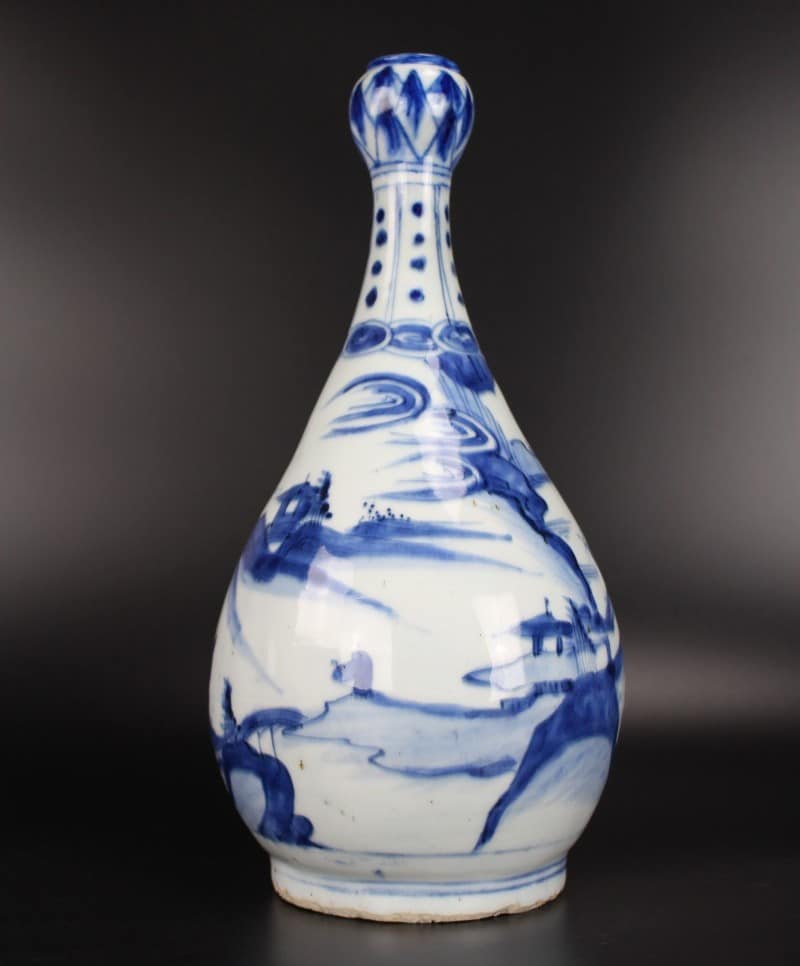
A Chinese pear-shaped porcelain vase with a garlic mouth from the Wanli period. © Menken Works of Art
In the Netherlands, three or five complementary vessels—usually alternating covered jars and beaker vases—were arranged symmetrically above cupboards and mantelpieces. Such a garniture was called a kaststel, or “cupboard set.”
Conclusion
In this article, we have briefly introduced delftware while focusing on the artistic and technical influences from abroad that shaped it, particularly the Chinese blue-and-white porcelain exported to Europe. Portugal initially dominated this trade before the Dutch Republic took the lead.
Chinese producers also showed considerable commercial acumen, tailoring their porcelain to the tastes of different markets. Outside the scope of this article are the wares they developed for Southeast Asia, such as Swatow, and for Japan, such as ko-sometsuke.
Kraak porcelain certainly played a major role in the European market. Yet we felt it was essential to examine other styles of Chinese blue-and-white porcelain up to the beginning of the Kangxi reign—a reign that roughly coincided with delftware’s period of full maturity. This broader perspective helps us identify the key shapes and motifs that Delft potters adopted in their chinoiserie wares.
The Untold Story of Stephen Junkunc III, One of the Great Chinese Art Collectors
Published By Sotheby's, New York
There are a handful of collectors in the world of Chinese art that are inextricably associated with works of exceptional quality. Stephen Junkunc, III, (d. 1978) is among these luminaries. Discover more about this inspiring collector ahead of Sotheby's Asia Week.
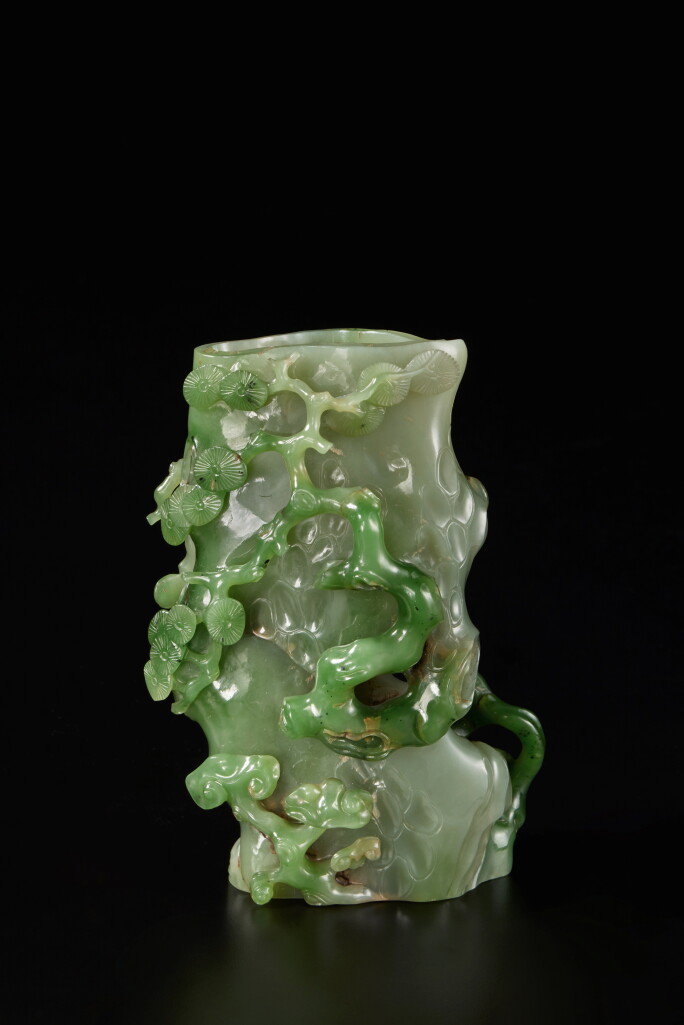
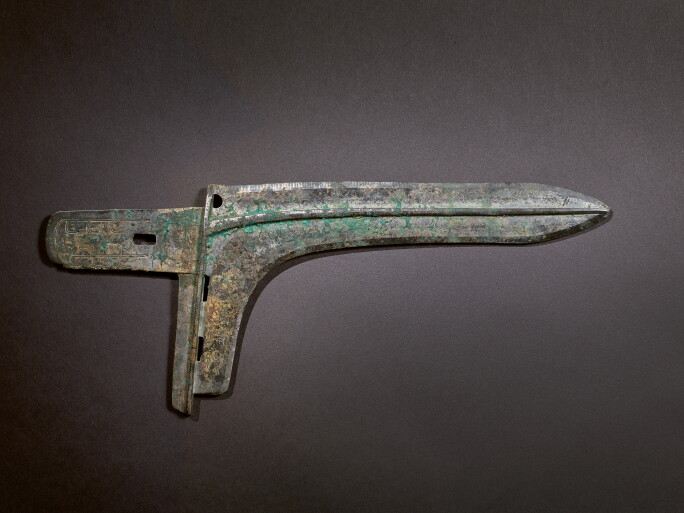
There are a handful of names in the world of Chinese art that are inextricably associated with works of exceptional quality. Stephen Junkunc, III is amongst these luminaries. The name itself instantly evokes a period during which some of the greatest Chinese treasures came to America. Today, the Junkunc name serves as one of the most important, and indeed desirable, provenances for Chinese art. Formed in America in the mid-20th century by Stephen Junkunc, III (d. 1978), the Junkunc Collection at its height numbered over 2,000 examples of exceptional Chinese porcelain, jade, bronzes, paintings and Buddhist sculptures; serving as a testament to a period of unprecedented wealth of Chinese material available in the West, as well as to an astounding intellectual curiosity and the means with which to buy internationally from the leading dealers in the field.
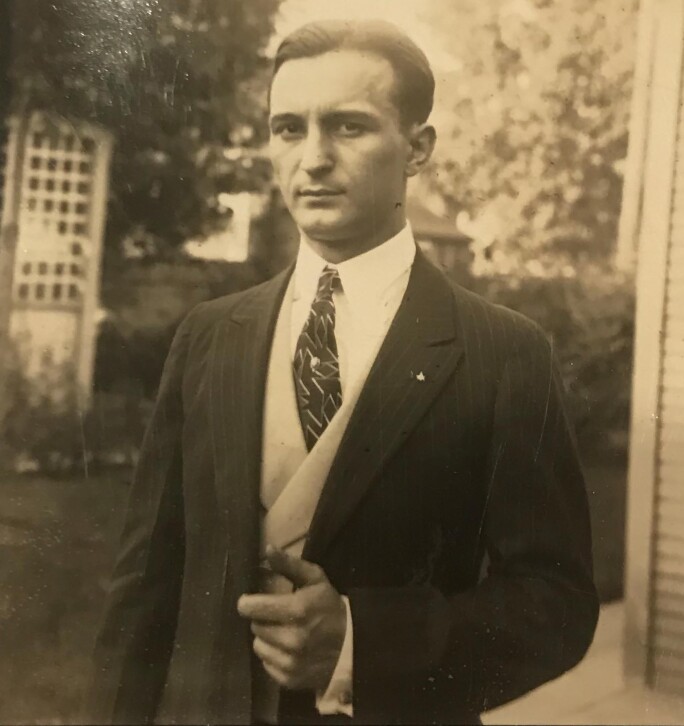
Stephen Junkunc, III was born in Budapest, Hungary circa 1905, and emigrated to Chicago, Illinois as a young child, where his father Stephen Junkunc, II (d. 1948), a tool-and-die maker, founded General Machinery & Manufacturing Company in 1918. The company specialized in the manufacture of knife edge fuel nozzle heads. With the outbreak of World War II, General Machinery converted its shop for the war effort and began manufacturing various aircraft parts, including B-29 hydraulic spools on behalf of Ford Motor Company, who was sub-contracting work from engine maker Pratt & Whitney.
Alongside his role as manager and part owner of the company, Stephen Junkunc, III spent his free time forming an extraordinary collection of Chinese art. With an unabated hunger for knowledge, Junkunc was a voracious reader who studied the Chinese language and kept extensive libraries of Chinese art reference books and auction catalogues at both his home and office. Junkunc appears to have made his first acquisitions in the early 1930s, apparently after having happened upon a book on Chinese art. It is perhaps no coincidence that Junkunc’s initial collecting activity largely coincided with the establishment of the Chicago branch of the reputable Japanese dealers Yamanaka & Co., Ltd., who opened a gallery at 846 North Michigan Boulevard in 1928. Many of Junkunc’s early purchases came from Yamanaka, and before long, he was buying directly from the leading London dealers specializing in Chinese art: Bluett & Sons, W. Dickinson & Sons, H.R.N. Norton and, of course, John Sparks, seeking fine examples of porcelain for his collection.
The collection of Chinese ceramics from the Junkunc Collection ranks amongst the greatest assemblages of porcelain ever formed in the West. The collection included two examples of the fabled Ru ware, of which only eighty-seven examples in the world are known. These two dishes represented two of the only seven examples of Ru ware to have been offered at auction since the 1940s. One of the Ru dishes, purchased from C.T. Loo in 1941, set a new world record when it sold at auction for $1.6 million in New York in 1992, and is today in the esteemed collection of Au Bak Ling. Junkunc’s discerning eye for ceramics was well established even in his nascent years of collecting, as evidenced by a letter he wrote to W. Dickinson & Sons in October 1935, requesting that they be on the lookout for him for Kangxi and Yongzheng period copper-red, peachbloom and celadon-glazed ‘cabinet pieces’ of ‘very fine quality only’. In May of 1936, he wrote to Bluett & Sons in London requesting that they continue to look for underglaze-red and peachbloom pieces for him, and to H.R.N. Norton in July of 1936 asking that he ‘send [him] photos of any nice pieces in monochromes finely decorated pieces of the Ching dynasty’, along with Ming pieces ‘in the Chinese taste’ such as ‘fine dainty bowls, stem cups, vases etc. of almost any description, but not the clumsy types with poor color and hurried drawings’.
Following the Japanese attack on Pearl Harbor in 1941, the inventories of Yamanaka’s galleries in America fell into the custody of the United States government, which dissolved the company, seizing and eventually selling off much of its merchandise through auctions held at the Parke-Bernet Galleries in New York in May and June 1944. This same year Hisazo Nagatani (d. 1994), the former manager of Yamanaka’s Chicago gallery, established himself as an independent dealer in Chicago under the company name Nagatani Inc. Nagatani continued to serve as a consistent source of works for Junkunc for over three decades, supplying by far the majority of the works in the Junkunc Collection. During the 1940s, Junkunc appears to have broadened the scope of his collecting interests to focus on earlier material, including Song to Ming ceramics, archaic bronzes and – crucially – Buddhist sculpture. Aside from Nagatani, he purchased extensively from auction, particularly from New York’s Parke-Bernet Galleries, as well from Tonying & Company and C.T. Loo, both in New York.
By the early 1950s, Junkunc had amassed an impressive collection of Chinese works of art which by then was largely securely stored in the museum-like environs of a subterranean bomb shelter in the grounds of his home in Oak Park, Illinois. In a 1952 profile in the Chicago Tribune, the bunker is described as storing a ‘priceless hoard’, with ‘shelves weighted with priceless pieces of Chinese art, prizes produced thru a span of centuries. A record of a nation in tapestry, bronze, jade, pottery, robes, and lacquer':
"Junkunc sits spider-like in the center of a web of agents scattered throughout the world. His escapades in procuring some objects have called for the suavity of a diplomat, the daring of an international spy, and the speed of a distance runner. Cloaked in intrigue and secrecy, and spiced by competition, collecting oriental art is no role of a Milquetoast."
- Chicago Tribune, 7th September 1952
Alfred Salmony (1890-1958), Professor at the Institute of Fine Arts, New York University since 1938, was one of the leading international authorities on the subject of early Chinese jades at the time, having published Carved Jade of Ancient China in 1938. He was planning a two-volume history of Chinese jade, to be entitled 1958, when he visited Junkunc in February 1950 to examine his collection of early Chinese jades. This meeting forged a strong friendship between the two men, who shared a passion for the material and a desire to formulate a chronology for post-archaic jades, a subject little understood at the time. For over eight years, Junkunc and the English collector Desmond Gure (1905–1970) supported Salmony in the research and preparation of this book. Tragically, Salmony died at sea whilst travelling to London on April 29th April 29th 1958, before the work was finished. The first half of his book was posthumously published in 1963 and entitled Chinese Jade Through the Wei Dynasty, illustrating a number of works from both Junkunc and Gure’s collections.
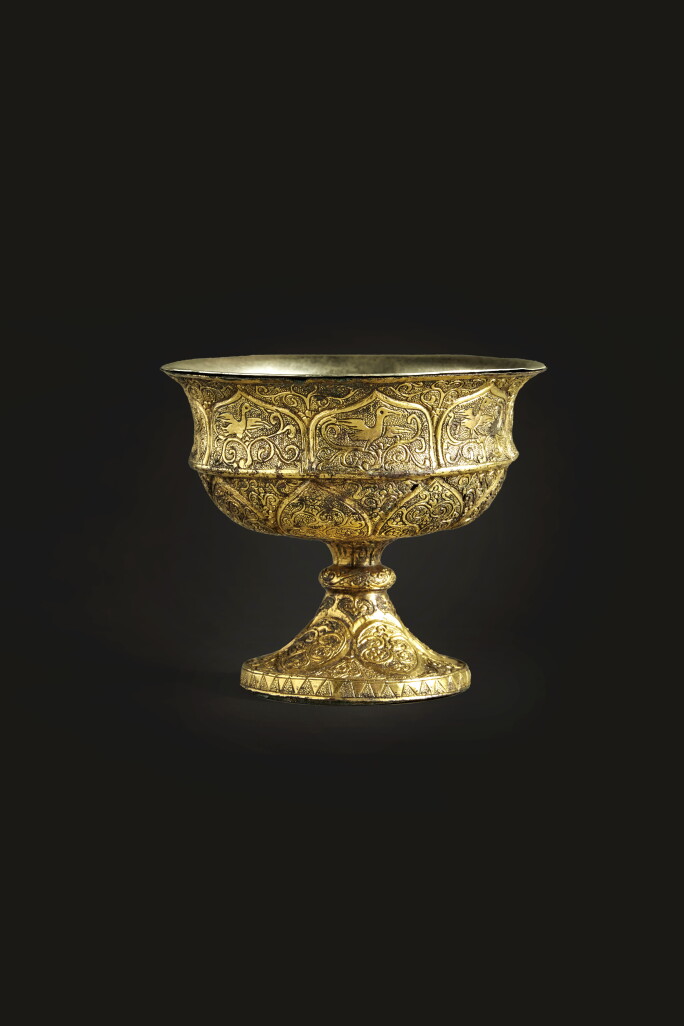
The 1950s witnessed perhaps the most fervent period of buying activity for Stephen Junkunc, when he continued to make large acquisitions from Nagatani and Frank Caro, the successor of C.T. Loo, as well as from Alice Boney and Warren E. Cox in New York, and Barling of Mount Street Ltd., in London. Unfortunately for Junkunc, this decade of buying coincided with the Korean War and restrictions placed by the American government on importing Chinese works of art into America. No works were permitted to be imported into the country unless it could be proven that they had not been in the hands of a national of China since 17th December 1950. Whilst these restrictions did, with the encouragement of John Sparks, encourage Junkunc to diversify his collection into non-Chinese works of art, an auction in Paris in 1952 presented him with an opportunity he could not afford to miss.
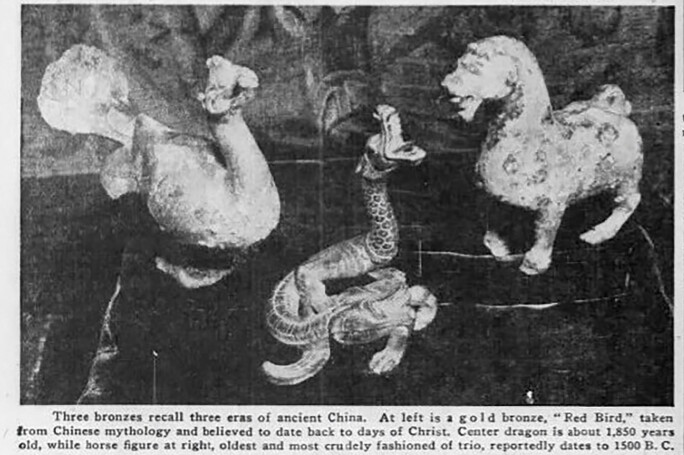
The sale of the collection of the Marquis de Ganay held at the Hôtel Drouot in May 1952 included a dazzling array of ancient Chinese art. Junkunc was successful in acquiring six lots from the sale (two of which are offered in this auction, lots 241 and 234) but endured multiple failed attempts to import them into the United States. It is only due to the numerous affidavits, witness documents and original purchase invoices that were submitted to the Foreign Assets Control department as part of his successful application that we today know the additional important provenances of these works.
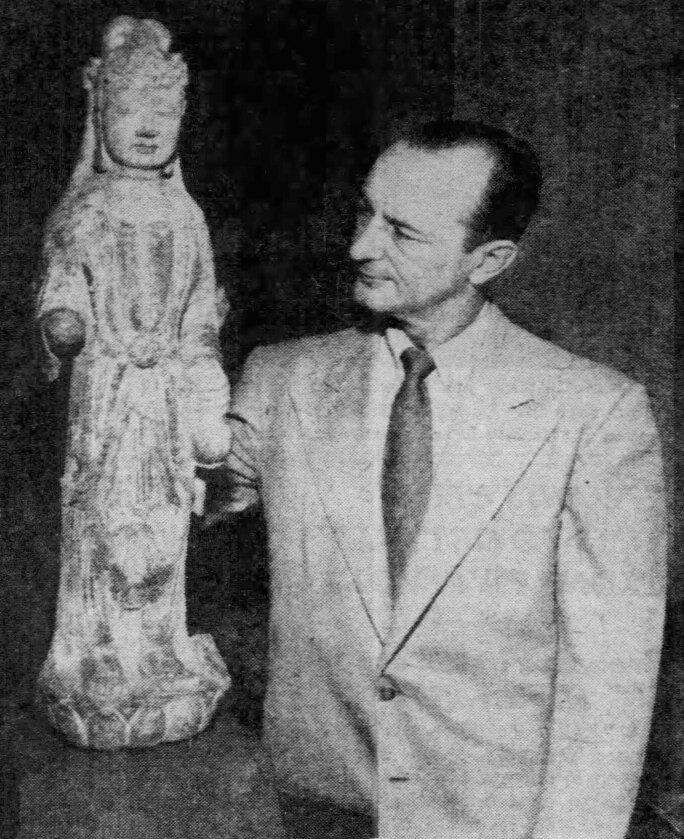
Throughout his lifetime, Stephen Junkunc, III worked closely with and actively supported the curators at American museums. He retained a particularly long-standing relationship with the Art Institute of Chicago (AIC), repeatedly loaning works from his collection to exhibitions through the 1940s-60s. Works from the Junkunc Collection were also loaned to the seminal Ming Blue and White exhibition at The Art Institute of Chicago, which traveled to the Philadelphia Museum of Art in 1949, and to the Arts of the T’ang exhibition of 1956, at the Los Angeles Museum of History, Science and Art. Junkunc’s generosity towards American museums also extended towards bequests, with gifts from his collection now housed in the Milwaukee Public Museum, Wisconsin, and the Lowe Art Museum, University of Miami, Florida, near his Coral Gables summer home.
Please consider joining the BIDAMOUNT Community by becoming a PATREON or Global Member Subscriber and help support this site and our YouTube Channel.
Thank you very much. Peter
$5 Per Month
$ 4 Per Month

&
Extra Video's.
Weekly YouTube Video's "AD FREE"
Auction House Report Card
FREE Weekly Copies Of The Antiques Gazette down loadable to your device.
Posts of Interest: News, Events etc.
Downloadable Books and Catalogs. All for $5 a month.
For the extra dollar a Month I think the Patreon Membership gives more bang for the buck.. Both support the YouTube Channel and maintain this site. ..

Weekly handpicked auction lost in the USA and Abroad as well as access to the AUCTIONEER Report Card, over 450 Auction Houses Graded A to F with comments. $4 a month.
Build YOUR Library: Reference Book Suggestions
For More Reference Books, Visit Our Bookshop. CLICK HERE