Bidamount News July 17, 2026, Vol 639
JAPANESE SHIBAYAMA ART
JAPANESE SHIBAYAMA ART - Article by Laura Bordignon
Sunday 17th July 2022 at 14:45
Laura Bordignon Japanese Art (website) Click To Visit
The art form known as Shibayama become very popular with the feudal daimyo lords and the wealthy merchants during the rule of Tokugawa Ienari (1773-1841) the eleventh shōgun of the Tokugawa shogunate of Japan.
Shibayama (芝山象嵌細工) was the mosaic-like inlay technique used to decorate Japanese objects such as inro, vases, dishes, table screens, incense burners (koro), panels and large cabinets.
A great variety of materials were used, including mother-of-pearl, tortoiseshell, abalone, coconut shell, bone, ivory, horn, amber and coral. This highly-skilled work required the meticulous carving of very small fragments, which were then patiently inlaid into a gold lacquer, wood or ivory base.
Just as in a jigsaw puzzle these pieces ultimately formed a complete scene. The subjects chosen for these decorations were predominantly landscapes, flora, fauna, mythological figures or scenes from traditional Japanese life.
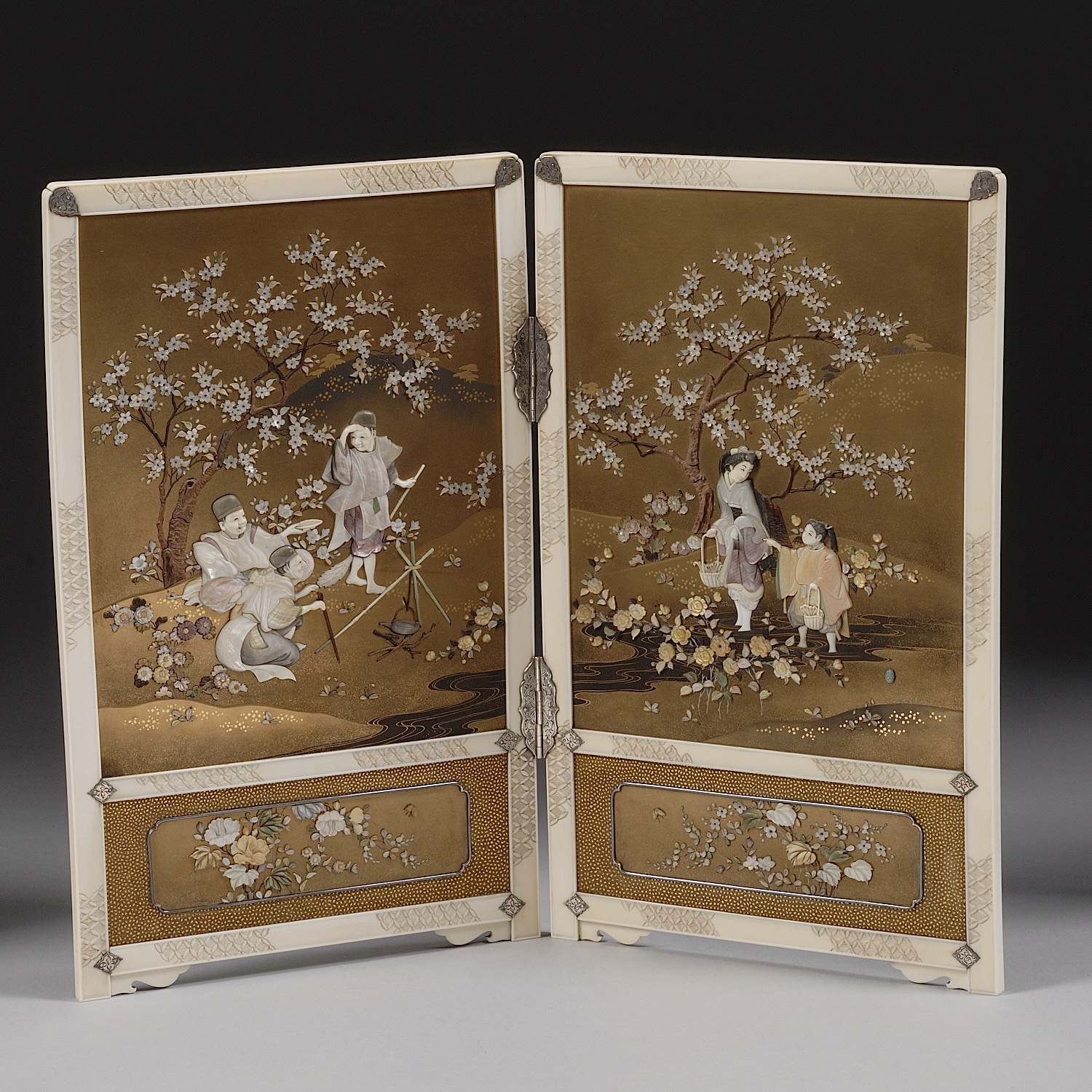
1. Japanese Shibayama table screen, the two gold lacquer panels minutely inlaid with a picture of a young boy accompanied by two servants on a cherry blossom viewing ( hanami 花見) in carved mother-of-pearl, tortoiseshell, stained ivory, coconut-shell, in togidashi, hiramakie on a kinji ground; the lacquer reverse is decorated with a nocturnal view of cranes amongst lakeside rushes, signed reserve Masakazu 政一and Kako 花光 on the black lacquer reverse, Meiji period.
The lacquer techniques are:
Togidashi研ぎ出し a lacquer technique where the hiramakie design is made visible by repeated coating and polishing.
Hiramakie平蒔絵 a flat sprinkled lacquer technique where the design is raised above the ground only by the thickness of its coats of lacquer.
Kinji金地 a lacquer ground with sprinkled gold powder, which has been polished to a high gloss finish.
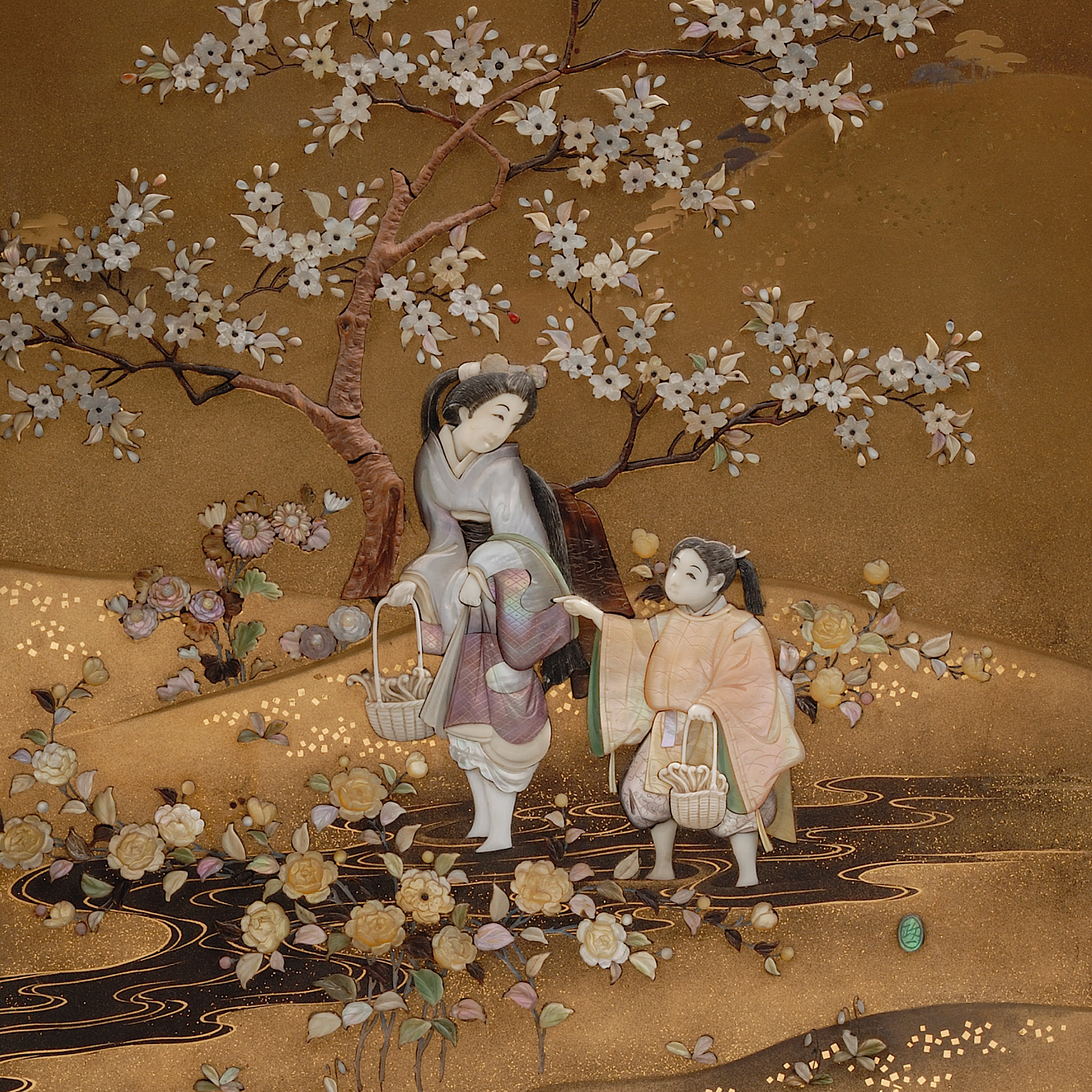
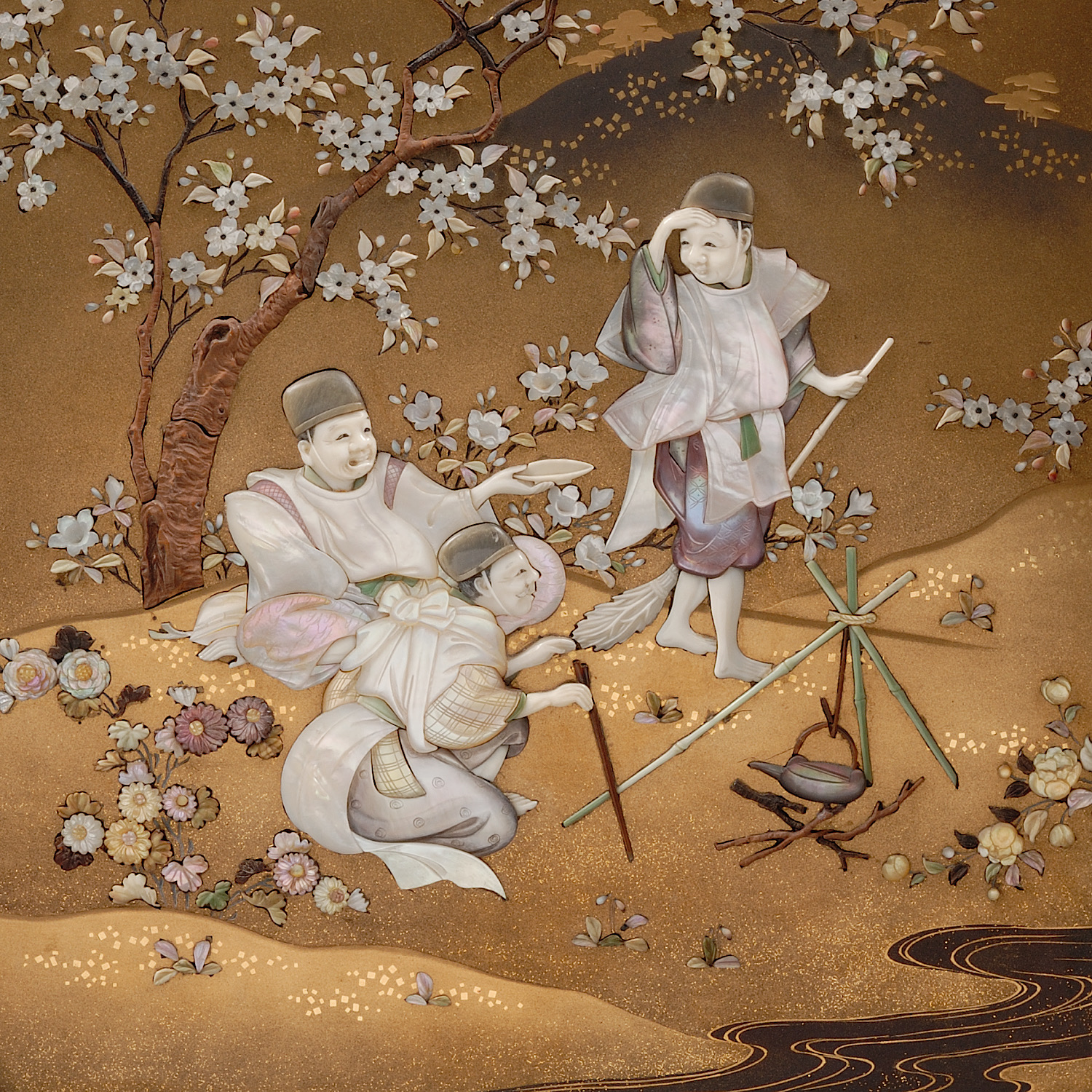
This decorative style of Shibayama inlaid work was started by Ōnogi Senzō (1775-1836) 大野木仙蔵 who was from the town of Shibayama in the Shimosa Province in the An’ei era (1772-1781).
He was from a farming family, and in order to further his artistic career, Senzō moved to the capital Edo, and adopted the name of his home town Shibayama to his surname (Shibayama Senzō).
Shibayama Senzō I is credited with founding the Shibayama School and had many followers.
His grandson, Shibayama Senzō III (芝山仙蔵三代) succeeded him in the School. However, it was Shibayama Sōichi (芝山宗一) a disciple of of Shibayama Senzō II, who was responsible for spreading the artistic reputation of Shibayama works.
Relocating from Tokyo to the large port town of Yokohama was a decisive moment for Shibayama Sōichi and for the successive Shibayama artists, as it opened the gateway to the export market.
In 1867 at the Paris Exposition Universelle many Shibayama works were exhibited and proved extremely popular with Westerners who visited the exposition.
During the Meiji period (1868-1912) the fascination with these exotic objects started a fashion for Shibayama lacquer objects and craftsmen did predominantly cater to a Western clientele.
Today the popularity of Shibayama works continues and is a very strong collecting field.
It is said that at its height in the late Meiji to Taisho periods, there were more than 100 Shibayama artists working in Yokohama. In 1879 alone, there were ten Shibayama artists recorded in the Tokyo Meikokan (東京名工鑑 famous Craftsmen in Tokyo):
Shibayama Sōshichi (Sōichi)
Shibayama Ekisei (Shinryōsai)
Nakayama Teijirō (Gosokusai Teimin)
Toyama Matashirō (Kōmin)
Kataoka Genjirō (Asahi)
Kataoka Tatsugorō (Yoshinobu)
Ishii Shinjirō
Yamanishi Kenjirō (Kansai Itchoku/Kazunao)
Nozawa Eijun
Ishimura Kintarō.
Some of the Shibayama craftsmen worked with the major Inro makers such as Kajikawa 梶川, Shokasai 松花斎 and Kanshosai 観松斎.
Several members of the Shibayama family exhibited at the various Domestic Industrial Expositions during the Meiji period.
In 1879 the following artists exhibited at the First Domestic Industrial Exposition:
Shibayama Senzo 芝山仙蔵
Shibayama Soshichi 芝山総七
In 1881 at the Second Domestic Industrial Exposition:
Shibayama Soshichi 芝山惣七,
Shibayama Chokichi 芝山長吉
Shibayama Yasumasa 芝山易政
Shibayama Yoshigoro 芝山芳五郎
In 1890 at the Third Domestic Industrial Exposition:
Shibayama Shichizo 芝山七造
Shibayama Soichi 芝山宗一
Shibayama Muneaki 芝山宗明
Shibayama Yukichi 芝山勇吉
Shibayama Toyokichi 芝山豊吉
Shibayama Muneaki 芝山宗明
Shibayama Yohei 芝山与兵衛
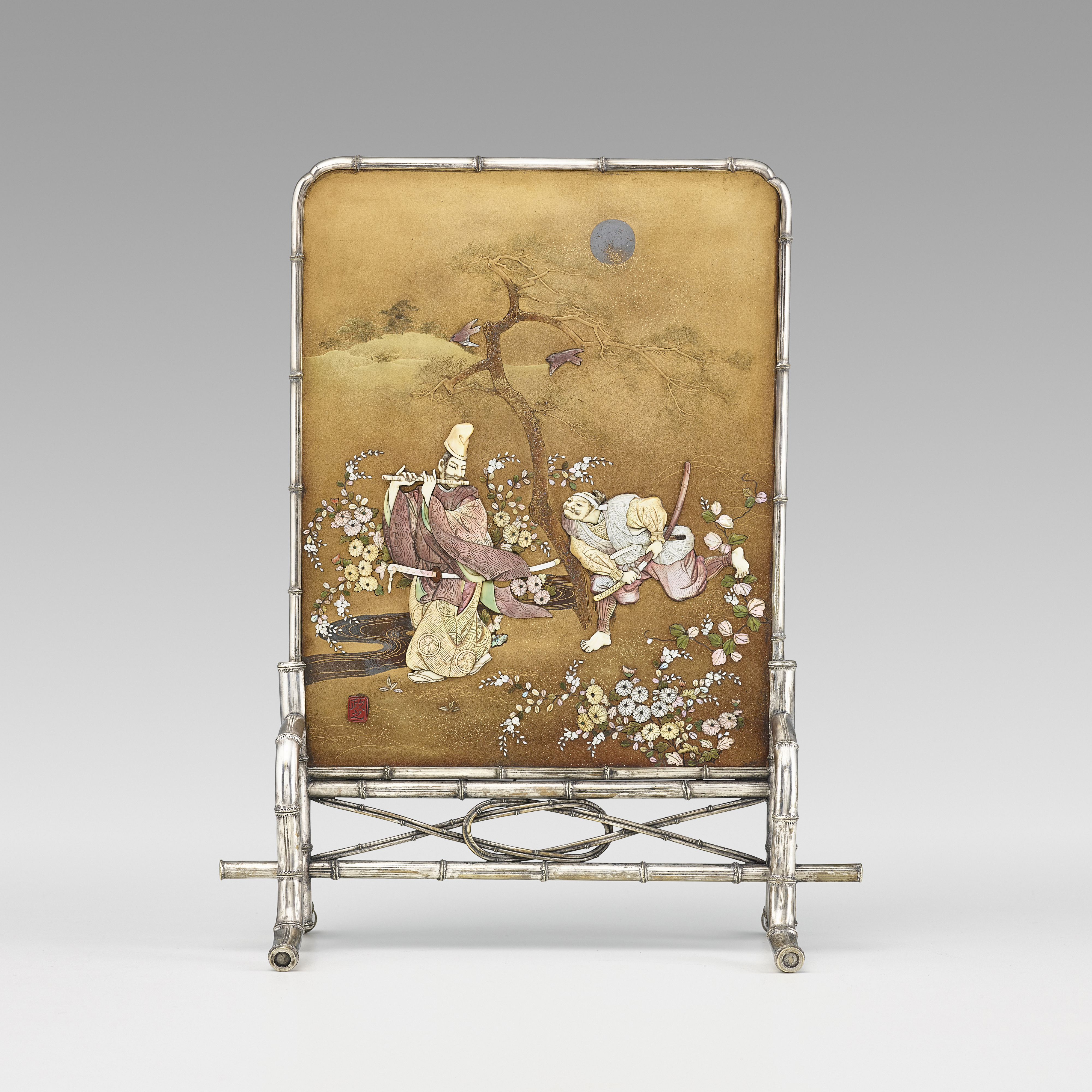
2. Japanese Shibayama table screen, the gold lacquer panel inlaid with a picture of Fujiwara no Yasumasa in carved mother-of-pearl, abalone, tortoiseshell all within a silver frame, signed in a tsuishu red lacquer reserve Masayuki 政之, Meiji period.
Reference: ‘Meiji no Takara 明治の宝 Treasures of Imperial Japan, the D. Khalili Collection', Lacquer Part II, no. 170.
Fujwara no Yasumasa was a noble at the Heian Court (958-1036) celebrated for his poetry and artistry on the flute.
Legend says that on a moonlight night when Yasumasa was playing his flute, the villain Hakamadare was laying in wait, intending to kill him.But he was so overcome by the beautiful music, that he was unable to draw his sword against Yasumasa.
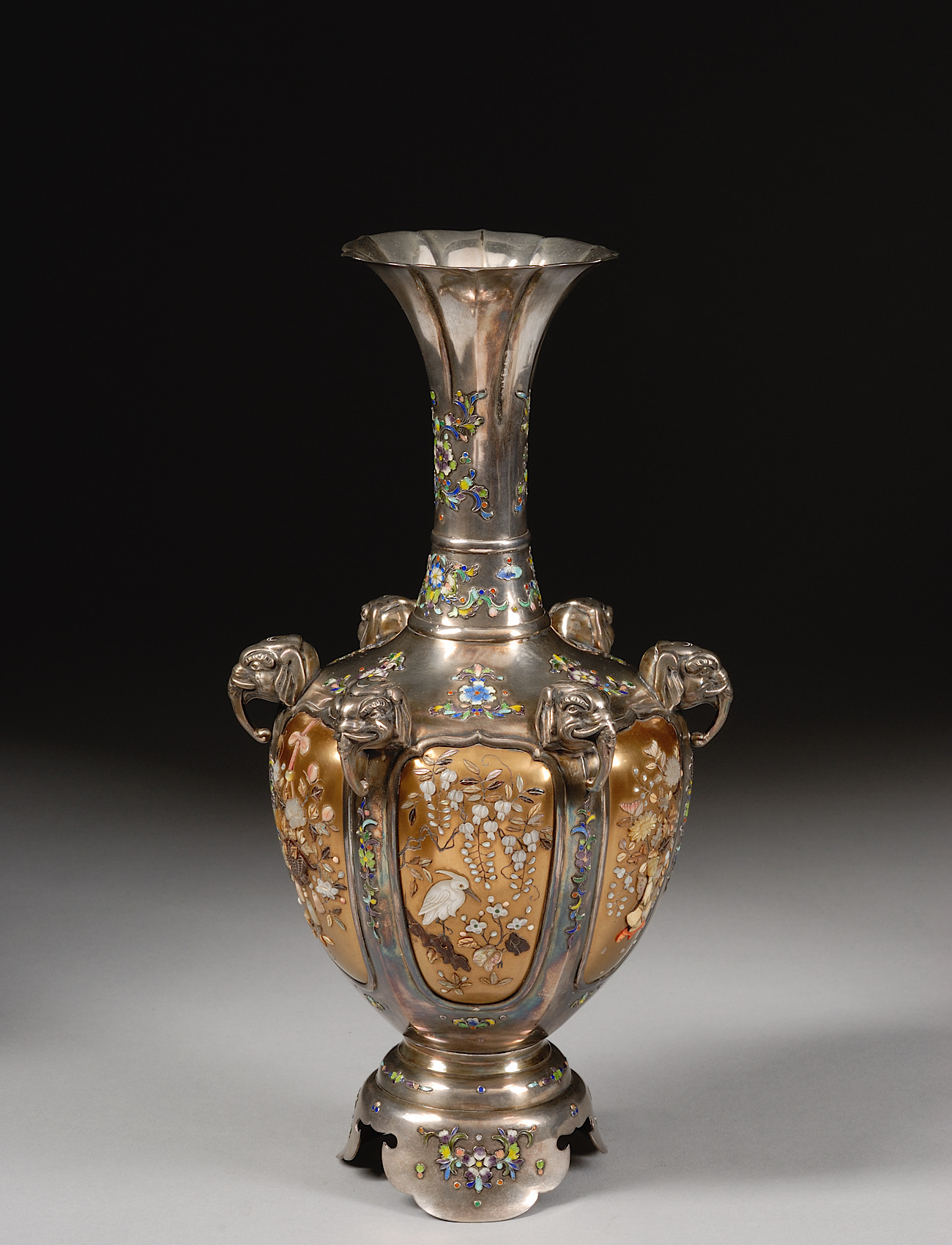
3. Japanese silver and enamel vase set with six elephants heads above six kinji gold lacquer Shibayama panels, decorated in encrustation of mother-of-pearl, tortoiseshell, coral with a hanging flower vase (hanaire), the neck and foot are decorated with floral motifs in cloisonné enamel, signed on a rectangular gilt reserve Masaaki 正明, Meiji period.
Reference: 'Meiji no Takara 明治の宝 Treasures of Imperial Japan, the D. Khalili Collection', Lacquer Part II, no. 154.
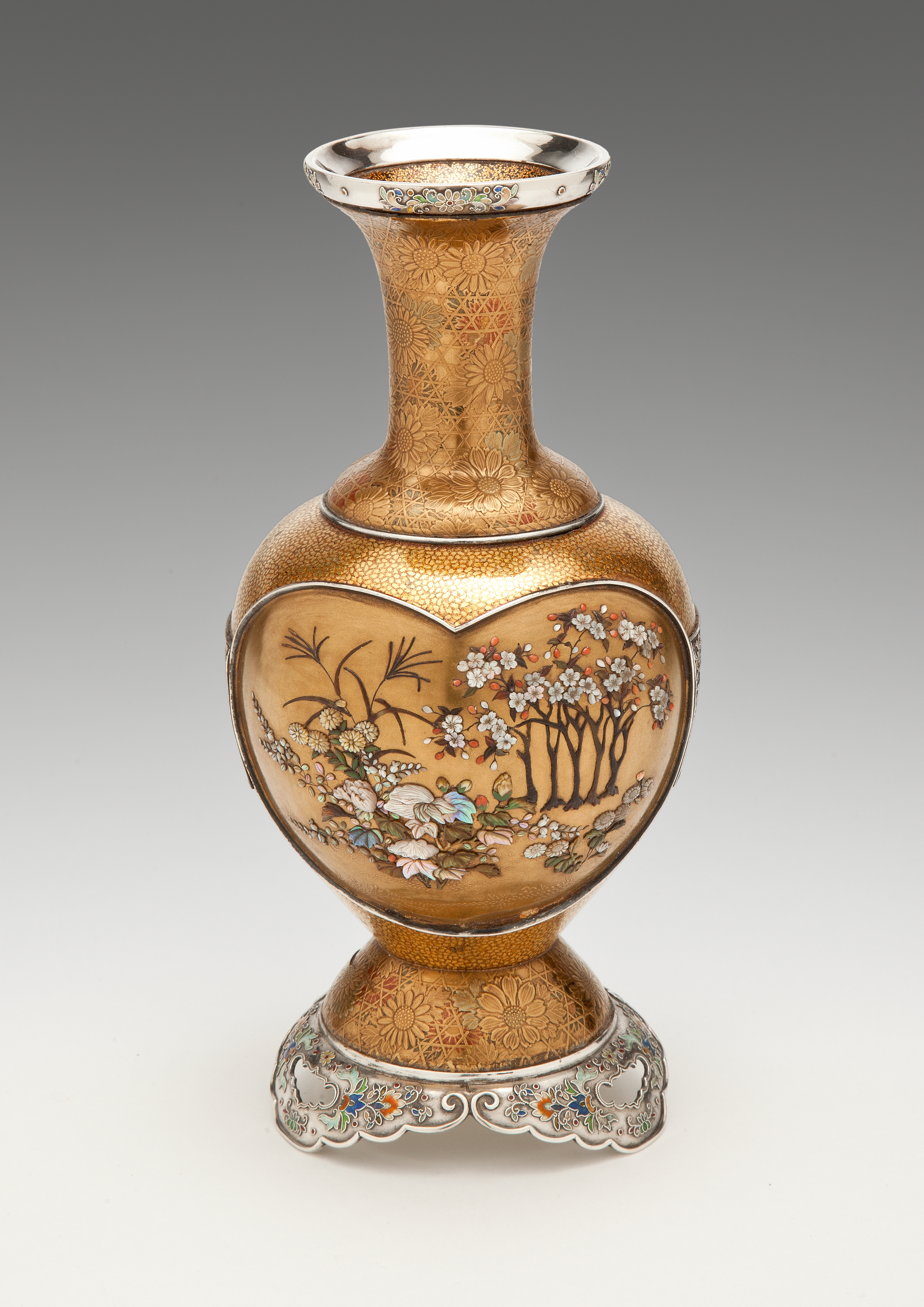
4. Japanese gold lacquer vase with body decorated with two Shibayama panels encrusted with flowers and birds in mother-of-pearl, abalone and coconutshell, raised on a silver and cloisonne' enamel mount and neck, signed Kaneko sei 金子製, Meiji period.
Provenance: This piece was in the Collection assembled over 40 years by the Chinese painter Mr. Lű Xiaguang (1906-1994). He settled in Paris at age 24 during the 1930's with his friend Wu Zuoren, both pupils of Xu Beihong the famous painter known for his Chinese ink paintings of horses and birds, and studied at the Beaux-Arts here and in Brussel. He returned to China in 1936 to join the Kuomintang, the Chinese National People's Party, which used his talent for the war propaganda, rising through the ranks as general in the Chang Kai-Check army during the Sino-Japanese conflict in 1937.
In 1946 he returned to France and resumed his painting career and as an Art's dealer until his death in 1994. He exhibited at the Biennale des Antiquaires in the 1960's, and together with his wife in the 1980's sponsored many Chinese artists to study in Paris by establishing a studio for the National Chinese Artists Association.
In 1993 he gifted to the Zhejiang Province Museum in Hangzou part of his Chinese and European paintings collection, notably paintings of his contemporaries Qi Baishi, Wu Zuoren and his teacher Xu Beihong.
Reference: ‘Japanese Imperial Craftsmen, Meiji Art from the Khalili Collection’ by V. Harris, pg. 104 no. 68, also pg. 228 no. 151.
‘Meiji no Takara 明治の宝 Treasures of Imperial Japan, the D. Khalili Collection', Lacquer Part II, no. 165, no. 176, no. 189.
Laura Bordignon is the author of ‘The Golden Age of Japanese Okimono’ (Antique Collectors’ Club 2010) an essential reference work for collectors, connoisseurs, dealers and scholars alike.
If You'd Like What We Do
Please consider joining the BIDAMOUNT Community by becoming a PATREON or Global Member Subscriber and help support this site and our YouTube Channel.
Thank you very much. Peter
$5 Per Month
$ 4 Per Month

&
Extra Video's.
Weekly YouTube Video's "AD FREE"
Auction House Report Card
FREE Weekly Copies Of The Antiques Gazette down loadable to your device.
Posts of Interest: News, Events etc.
Downloadable Books and Catalogs. All for $5 a month.
For the extra dollar a Month I think the Patreon Membership gives more bang for the buck.. Both support the YouTube Channel and maintain this site. ..

Weekly handpicked auction lost in the USA and Abroad as well as access to the AUCTIONEER Report Card, over 450 Auction Houses Graded A to F with comments. $4 a month.
This Week's Videos
A few items we think are nice.
Live Auctioneers....A few things you might like!
A small sample of things from the Global Member Pages and through PATREON, Join Today on the HOME PAGE
Build YOUR Library: Reference Book Suggestions
For More Reference Books, Visit Our Bookshop. CLICK HERE